India’s GDP Growth Estimated at 7.1% for April–June Quarter
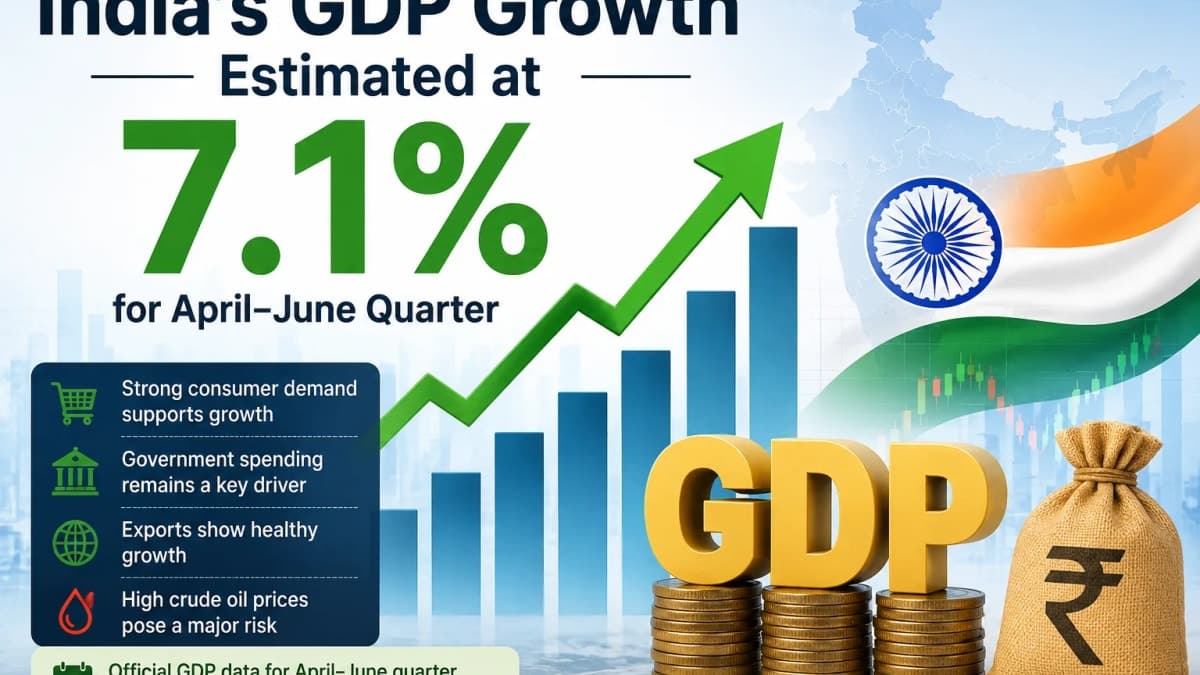
New Delhi: India’s economy is expected to have maintained a strong growth pace during the first quarter of the 2026–27 financial year, with economists estimating 7.1% real GDP growth for the April–June period.
The figure comes from the median forecast in a Reuters survey of 58 economists conducted between August 17 and August 24. Estimates ranged widely—from 6.2% to 8.0%—highlighting uncertainty surrounding the strength of economic activity during the quarter.
If the 7.1% estimate is confirmed by official data, growth would have moderated from the 7.8% expansion recorded during January–March 2026.
Consumer Demand Helps Support India's Economy
Household spending is expected to have remained an important pillar of economic activity during the June quarter.
Earlier reductions in income taxes and Goods and Services Tax rates likely continued to support disposable incomes and consumer demand, helping the economy absorb some of the pressure created by rising costs.
Government expenditure also appears to have contributed to economic momentum.
The combination of household consumption and public spending could therefore have prevented a sharper slowdown even as some other parts of the economy faced more challenging conditions.
Private Investment Remains a Key Concern
One of the more cautious signals comes from private-sector investment.
Businesses had shown signs of increasing investment during the second half of the previous financial year, but economists remain uncertain about whether that recovery will become broad-based and sustainable.
Geopolitical uncertainty, higher input costs and disruptions affecting international supply chains can make companies more reluctant to commit capital to new factories, equipment and capacity expansion.
This matters because stronger private investment is essential if India wants to maintain rapid growth without depending too heavily on government capital expenditure.
India Coming From a Strong FY26 Performance
The latest estimate follows a relatively strong financial year for the Indian economy.
Official provisional estimates showed that real GDP grew 7.7% in FY2025–26, compared with 7.1% in FY2024–25. The economy expanded by 7.8% during the January–March 2026 quarter.
India has also introduced a new GDP series using 2022–23 as the base year, replacing the previous 2011–12 benchmark. The revised framework is intended to capture structural economic changes, incorporate newer data sources and improve estimation methods.
That statistical change is important when interpreting current growth numbers because the latest quarterly figures are being measured under the updated framework.
Exports Provide Additional Support
India's external sector may also have helped economic activity during the quarter.
Goods and services exports increased by more than 11% year-on-year during the April–June period, according to economists cited in the survey.
Stronger exports can provide an additional growth engine when domestic investment is softer, although the sustainability of that contribution will depend partly on global demand and geopolitical conditions.
High Crude Oil Prices Create a Major Risk
Despite the relatively healthy GDP estimate, India's economic outlook is not without risks.
Crude oil prices above $90 per barrel have emerged as an important concern. India depends heavily on imported oil, making prolonged increases in international energy prices particularly significant for the economy.
Expensive crude can increase transportation and production costs, put pressure on household budgets and contribute to inflation. Companies can also experience pressure on profit margins when higher input costs cannot be fully passed on to consumers.
If elevated energy prices persist, they could eventually weaken both consumption and investment.
Growth Could Moderate in Coming Quarters
Economists surveyed expect growth to lose some momentum after the June quarter.
Their forecasts point toward GDP growth of around 6.6% in the following quarter and 6.5% in the quarter after that, with growth averaging approximately 6.7% for FY2026–27.
This suggests that the estimated 7.1% Q1 performance should not automatically be interpreted as evidence that India can maintain growth above 7% throughout the financial year.
Different Forecasts Show Economic Uncertainty
Not every institution has arrived at the same estimate for the June quarter.
Economic forecasts have varied considerably depending on assumptions about consumption, investment, energy costs, services activity and the effects of geopolitical disruption.
That divergence is significant. GDP forecasts are estimates based on available economic indicators rather than confirmed measurements of economic output.
The official numbers will therefore provide a clearer picture of whether domestic demand and government expenditure were strong enough to offset pressure on investment and other parts of the economy.
Why the 7.1% GDP Estimate Matters
A growth rate around 7% would still represent a comparatively strong economic expansion, particularly against a challenging international backdrop.
For policymakers, however, the composition of growth will be as important as the headline number.
Growth driven by healthy household demand, sustained business investment, productive government expenditure and expanding exports would provide a stronger foundation for future expansion. By contrast, persistent weakness in private capital expenditure or a prolonged energy-price shock could make maintaining the current pace more difficult.
What Happens Next?
India's official GDP estimates for the April–June quarter of FY2026–27 are scheduled to be released on August 31, 2026.
Until then, the 7.1% figure should be treated as an economist consensus estimate rather than an official growth number.
The eventual data will be closely watched for evidence of how consumption, manufacturing, services, investment and government expenditure performed during the opening quarter of the financial year.