India’s IPO Market Finds Its Momentum Again
India’s primary market is showing renewed energy as companies return to Dalal Street with public offerings after a relatively subdued beginning to the financial year.
The revival has been particularly visible in July and August 2026, when a concentration of sizeable IPOs helped lift fundraising sharply. Yet the headline numbers reveal an important distinction: the IPO market is accelerating, but FY27 as a whole is still playing catch-up.
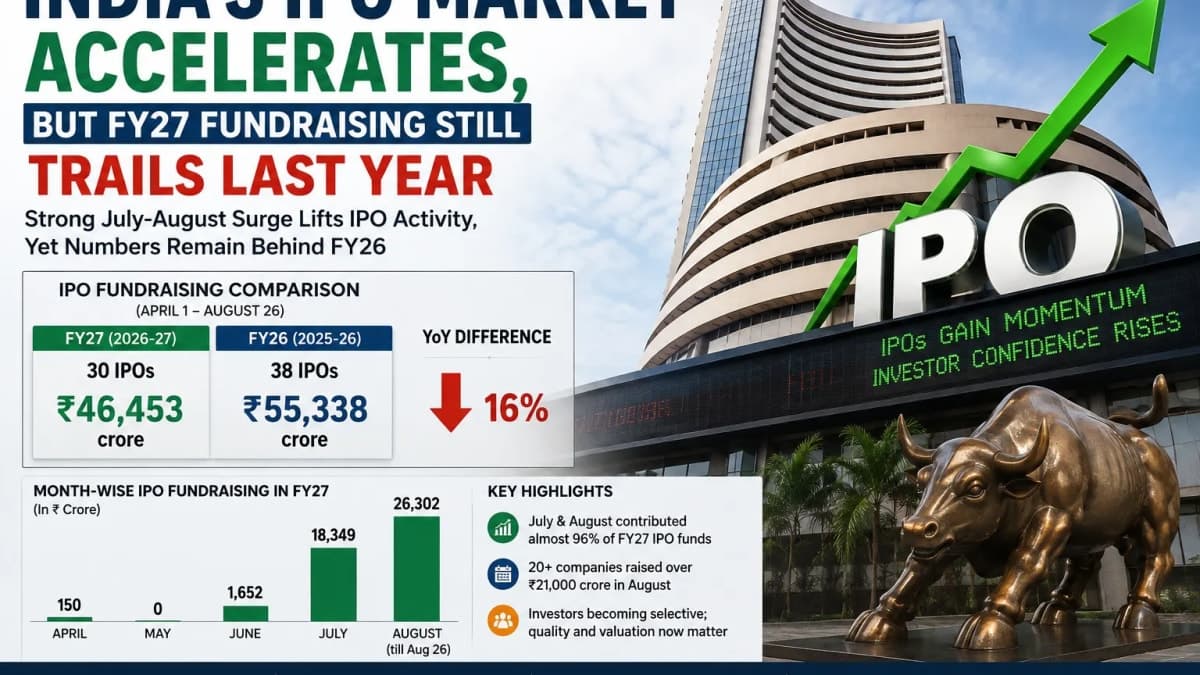
According to Prime Database data reported by Business Standard, companies raised approximately ₹46,453 crore from 30 IPOs between April 1 and August 26, 2026. During the corresponding period of the previous financial year, 38 IPOs had collected roughly ₹55,338 crore. That puts FY27 fundraising about 16% lower year-on-year so far.
July and August Drive the IPO Recovery
The most striking feature of the current rebound is how heavily fundraising has been concentrated in the past two months.
July recorded around ₹18,349 crore of IPO fundraising, while August generated approximately ₹26,302 crore through August 26. Together, those two months accounted for nearly 96% of IPO funds raised in FY27 up to that point.
The contrast with the beginning of the financial year is significant.
April saw only one IPO raising about ₹150 crore, while May had no IPO activity. June brought some improvement, with three issues collectively raising around ₹1,652 crore. Activity then accelerated dramatically, with 13 IPOs in July followed by another 13 through August 26.
The numbers suggest that India's primary market has shifted from a slow opening quarter into a much more active phase.
FY27 IPO Fundraising vs Last Year
Despite the recent surge, FY27 remains behind the comparable FY26 period.
FY27 through August 26, 2026
IPOs: 30
Funds raised: ₹46,453 crore
Comparable FY26 period
IPOs: 38
Funds raised: ₹55,338 crore
Year-on-year difference in fundraising: approximately -16%.
That gap is important because a strong July-August can create the impression that the IPO market has already returned to record-setting territory. In reality, much of the current financial year's fundraising is concentrated in a relatively short period.
Why Did FY27 Start Slowly?
The weak beginning was influenced by broader market uncertainty.
IPO launches typically depend on reasonably stable equity-market conditions because companies and their bankers need confidence that investors will support the proposed valuations.
Prime Database Managing Director Pranav Haldea linked the weaker first half of 2026 partly to volatility surrounding geopolitical tensions, including the US-Iran conflict. Greater secondary-market stability subsequently helped create a more favourable environment for companies waiting to launch public offerings.
This illustrates an important relationship between the primary and secondary markets.
Even companies with established IPO plans can delay their offerings when equity markets become volatile. A calmer market can reopen the issuance window relatively quickly, resulting in several IPOs arriving within weeks of one another.
Large IPOs Have a Major Impact on the Numbers
Year-on-year IPO comparisons also need to account for the influence of unusually large transactions.
The April-August period of FY26 included the ₹12,500-crore HDB Financial Services IPO. FY27 has had its own large offerings, including the roughly ₹9,795-crore SBI Funds Management offer and ₹9,275-crore Manipal Health Enterprises issue.
A few billion-dollar-scale transactions can therefore significantly change the annual fundraising total.
This means the health of the IPO market cannot be judged solely by the rupee amount raised. The number of companies accessing the market, investor participation, pricing discipline and post-listing performance are also important indicators.
Broader 2026 IPO Activity Shows a Stronger Recovery
Looking beyond FY27 and examining the calendar year provides another perspective.
During January-August 2026, around 60 IPOs raised ₹72,165 crore, according to Prime Database figures. July and August alone accounted for 33 deals raising approximately ₹49,592 crore — close to 69% of the amount raised during the first eight months of 2026.
That concentration reinforces the idea that this is a recent acceleration rather than an uninterrupted IPO boom throughout the year.
August has been particularly busy. More than 20 companies had raised over ₹21,000 crore during the month, making it one of the most active IPO periods in roughly a year.
Investors Are Becoming More Selective
Strong issuance does not necessarily mean investors are willing to buy every IPO at any valuation.
Recent evidence suggests that investors are differentiating more carefully between offerings.
Nearly one-third of 42 mainboard IPOs launched in 2026 had reportedly failed to achieve full subscription in the retail category, highlighting greater caution among individual investors.
At the same time, successful IPOs have demonstrated that demand remains strong for companies investors consider attractive.
Among IPOs that opened from July through the period covered by an Economic Times analysis, 18 of 22 listings delivered positive debut-day returns, with average listing gains of around 25%, compared with about 7% during the first quarter of FY27.
The combination of strong winners and weaker demand for some other issues points toward a healthier but more discriminating market.
Why the IPO Revival Matters
A functioning IPO market is important for more than short-term listing gains.
Public offerings allow companies to raise growth capital, reduce debt, fund expansion and create liquidity for existing shareholders. They also give public-market investors access to businesses and sectors that may previously have been dominated by private capital.
For India's broader capital markets, a steady IPO pipeline can deepen equity participation and increase the range of businesses available to investors.
It also provides an important exit route for private-equity and venture-capital investors, potentially allowing capital to be recycled into newer companies.
The current rebound therefore matters not simply because IPO numbers are rising, but because it suggests companies are again becoming comfortable accessing public equity markets.
Can FY27 Catch Up?
The remainder of FY27 will determine whether the current surge can erase the fundraising deficit.
There are reasons for optimism. Investment bankers expect a busier period ahead, supported by a pipeline of large transactions. Bank of America Securities' India corporate and investment banking head Mandar Donde has said upcoming supply could help the market make up much of the shortfall after the slower start to 2026.
But several variables could change that outlook.
Global geopolitical developments, equity-market volatility, foreign institutional flows, domestic liquidity and company valuations can all influence whether planned IPOs proceed on schedule.
A strong pipeline therefore represents potential fundraising rather than guaranteed fundraising.
Balanced Analysis: Momentum Is Strong, But Quality Will Matter
India's IPO market is clearly in a stronger position than it was at the beginning of FY27.
July and August have demonstrated that investor demand can return quickly when market conditions improve. Large transactions have successfully accessed capital, and positive listing performances have added to enthusiasm surrounding new issues.
However, describing the situation simply as another IPO boom would overlook several important signals.
FY27 fundraising through August 26 remained about 16% below the comparable previous-year period. The number of IPOs was also lower, and retail investors appear increasingly willing to reject issues they consider expensive or less attractive.
That selectivity could ultimately be positive for the market.
A sustainable IPO ecosystem depends less on every company receiving extraordinary subscriptions and more on credible businesses being priced realistically, attracting long-term capital and performing reasonably after listing.
India's primary market has regained speed. The next test is whether that momentum can continue through the remainder of FY27 — and whether the companies arriving on the exchanges can justify the valuations investors are being asked to pay.
This article is based on reporting published by Business Standard.