Oil Falls as Strait of Hormuz Optimism Grows, Easing Global Supply Fears
Global oil prices extended their decline on Wednesday as investors became more optimistic that diplomatic discussions between Iran and Oman could eventually restore more normal shipping through the Strait of Hormuz.
The development provided some relief to an energy market that has spent months pricing in the possibility of severe disruptions to Middle Eastern oil supplies.
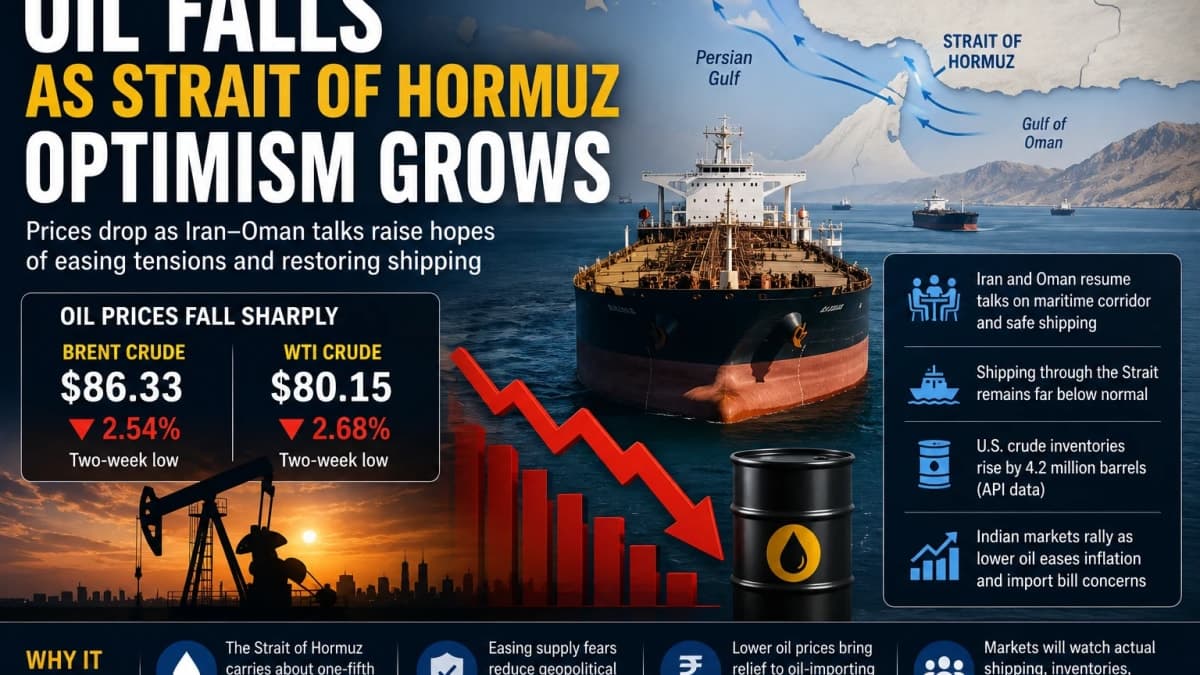
Brent crude futures fell more than $2 per barrel, dropping about 2.5% to around $86 a barrel, while U.S. West Texas Intermediate crude declined by a similar percentage to approximately $80 per barrel during Wednesday trading.
Both benchmarks touched their lowest levels in roughly two weeks.
The decline reflects a significant shift in market sentiment. Instead of focusing exclusively on the possibility of prolonged disruption, traders are now considering whether diplomatic efforts could gradually reopen one of the world's most important energy corridors.
Why the Strait of Hormuz Matters So Much to Oil Markets
The Strait of Hormuz is a narrow maritime passage connecting the Persian Gulf with the Gulf of Oman and the Arabian Sea.
Its importance to global energy markets is enormous.
Before the current conflict, approximately one-fifth of global oil and liquefied natural gas shipments moved through the waterway.
Major oil and gas producers including Saudi Arabia, the United Arab Emirates, Kuwait, Iraq and Qatar rely heavily on regional shipping routes connected to the Strait.
That concentration makes Hormuz one of the world's most important energy chokepoints.
Any threat to shipping can quickly increase crude prices because traders begin calculating the possibility that millions of barrels of supply could become difficult to transport to global customers.
The reverse is also true.
Signs that shipping conditions could improve can rapidly remove part of that geopolitical premium from oil prices.
Iran and Oman Talks Change Market Sentiment
The immediate catalyst behind the latest decline is renewed diplomatic engagement between Iran and Oman.
Iran said discussions with Oman over managing the Strait had resumed, reviving expectations that the two countries could establish arrangements allowing more vessels to move through the waterway.
Reports indicate that discussions have included a possible temporary maritime corridor and efforts related to clearing mines and improving navigation.
The possibility of even a partial reopening matters because shipping through Hormuz remains far below normal levels.
Markets are therefore reacting not to a complete restoration of traffic but to the possibility that conditions may gradually improve.
For oil traders, that difference is important.
Crude prices incorporate expectations about future supply. If investors believe the probability of a major supply interruption is falling, prices can decline before physical oil flows fully recover.
Oil Still Carries a Large Geopolitical Risk Premium
Despite the latest decline, the energy crisis surrounding Hormuz is far from resolved.
Shipping remains restricted, and geopolitical tensions involving Iran and the United States continue.
That means oil prices still contain a considerable geopolitical premium.
Brent crude has fallen sharply from recent highs, but prices remain substantially elevated compared with levels seen before the conflict disrupted regional energy flows.
The latest move therefore represents an easing of fears rather than confirmation that the crisis has ended.
Any breakdown in negotiations, new military confrontation or renewed threat to energy infrastructure could quickly reverse the decline.
Rising U.S. Inventories Add Pressure to Oil
Diplomacy is not the only factor weighing on crude.
Preliminary industry data indicated that U.S. crude inventories increased by approximately 4.2 million barrels in the latest reporting period.
An increase in inventories can signal that available supply is growing faster than immediate demand.
When that occurs at the same time geopolitical supply concerns are easing, the combination can put additional downward pressure on prices.
Markets are therefore dealing with two bearish signals simultaneously:
Improving expectations surrounding Hormuz and indications of higher U.S. crude inventories.
Together, those factors helped accelerate Wednesday's decline.
Why Falling Oil Matters for India
The movement in crude prices has particular significance for India, one of the world's largest oil-importing economies.
India imports the majority of the crude oil it consumes.
When international oil prices rise sharply, the country's import bill can increase, placing pressure on the trade balance and potentially contributing to inflation.
Lower crude prices can provide relief.
Cheaper oil can reduce costs for refiners, transportation companies, airlines, manufacturers and other businesses that depend heavily on energy.
The impact can eventually extend to inflation expectations and government finances.
Indian equity markets responded positively as crude prices declined, reflecting investor expectations that lower energy costs could improve the outlook for an oil-importing economy.
Asian Markets Welcome Lower Energy Prices
The reaction was not limited to India.
Several Asian markets benefited from the decline in crude because countries including India and Japan depend heavily on imported energy.
High oil prices effectively transfer income from importing economies to energy-producing countries.
When crude falls, some of that pressure is reversed.
Businesses face lower input costs, consumers potentially retain more purchasing power and central banks may face less inflationary pressure.
This explains why developments around Hormuz are influencing not only commodity markets but also equities, currencies and government bonds.
Could Oil Prices Continue Falling?
Much will depend on whether diplomatic progress produces measurable changes in shipping activity.
If more tankers begin moving safely through the Strait, traders could remove additional geopolitical risk from crude prices.
That could push oil lower, particularly if global supply remains adequate and U.S. inventories continue increasing.
However, the opposite scenario remains possible.
The Strait of Hormuz is still operating under extraordinary geopolitical conditions.
Negotiations could stall.
Military tensions could escalate.
Shipping infrastructure could face new threats.
Any of those developments could cause traders to rapidly rebuild the geopolitical premium that has recently been disappearing.
U.S. Sanctions Add Another Layer of Uncertainty
The United States has also increased economic pressure on Iran through additional sanctions.
Washington has threatened consequences for countries continuing certain forms of business with Tehran, although immediate secondary penalties have not been imposed across the board.
This creates a complicated environment for oil markets.
On one side, diplomatic discussions over Hormuz suggest the possibility of improving energy flows.
On the other, stronger economic pressure on Iran creates additional uncertainty surrounding Iranian exports and regional stability.
Oil traders are therefore attempting to price two competing forces at the same time: potential diplomatic de-escalation and continuing economic confrontation.
Balanced Analysis: Optimism Is Growing, but the Risk Has Not Disappeared
The latest fall in crude prices demonstrates how sensitive global energy markets remain to developments surrounding the Strait of Hormuz.
Renewed Iran–Oman discussions are clearly encouraging for markets because even a gradual normalisation of shipping could improve access to Middle Eastern energy supplies.
For oil-importing economies, that would be a significant positive development.
But it would be premature to assume that normal conditions have returned.
Actual shipping volumes remain constrained, negotiations are ongoing and the broader geopolitical conflict remains unresolved.
The market is currently pricing a higher probability of improvement, not certainty.
That distinction is essential.
If diplomatic progress continues and tanker traffic increases, crude prices could face additional downward pressure.
If talks fail or regional tensions intensify, the same geopolitical premium that has disappeared over the past few sessions could return quickly.
What Investors Should Watch Next
The most important indicator will be actual vessel traffic through the Strait of Hormuz.
Diplomatic announcements can influence markets immediately, but sustained changes in crude prices will eventually depend on whether more oil and LNG cargoes can physically move through the region.
Investors will also monitor U.S. crude inventories, Iranian exports, sanctions policy and any further developments in negotiations involving Iran and regional governments.
For now, markets are treating the renewed diplomatic effort as a meaningful sign that the worst supply-disruption scenario may be becoming less likely.
That has been enough to send oil sharply lower.
But until shipping through Hormuz returns closer to normal, the world's most important energy chokepoint will remain one of the biggest sources of volatility in global oil markets.
This article is based on reporting published by Reuters.