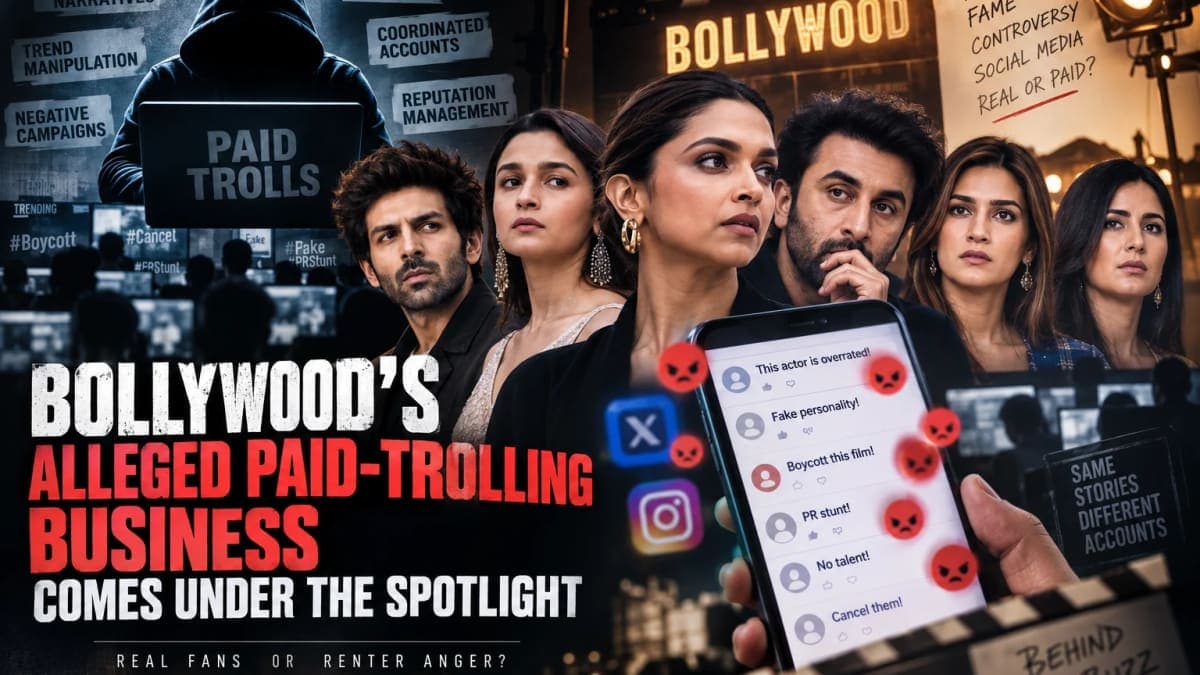
Bollywood’s Alleged Paid-Trolling Business Comes Under the Spotlight
A film star waking up to thousands of hostile posts is no longer necessarily dealing with a conventional publicity crisis. According to people working in Bollywood, the backlash may sometimes have been encouraged before most social-media users even noticed the controversy.
Accounts from publicists, actors and other film professionals have brought renewed attention to the role of online reputation-management agencies in Hindi cinema. Their claims, reported by SCREEN, describe a publicity environment where digital campaigns are used defensively to protect clients but can allegedly also be deployed against rivals.
There is no evidence that every burst of criticism surrounding a Bollywood celebrity is manufactured, and allegations involving rival publicity teams do not establish that the actors they represent personally approved such tactics.
The concern raised by industry insiders is narrower, but significant: organised digital campaigns have become sophisticated enough that genuine audience reaction and paid amplification can be difficult to separate.
Reputation Management Becomes Part of the Film Business
Managing a star's public image is hardly new to Bollywood. What has changed is the machinery available to do it.
Publicists once relied heavily on entertainment journalists, newspaper columns and television coverage. Social platforms have opened another front, one where anonymous accounts can react immediately and large numbers of similar posts can rapidly give an issue momentum.
A veteran PR professional told SCREEN that online reputation management, or ORM, has become a regular consideration in film budgets, including for celebrities who may need protection from attacks rather than campaigns against competitors.
“It’s a part of every film’s budget now. Even if you don’t indulge in paid trolling, you need an ORM agency handy for damage control. What if someone launches a smear campaign against you?” the professional said.
The basic principle of celebrity rivalry has not necessarily changed. The same professional recalled an earlier period when damaging information could be planted through one publication and answered through another.
Social media makes that contest faster and considerably harder to trace.
How a Rumour Can Acquire a Life of Its Own
The danger is not simply that false or misleading claims can be posted. It is the speed with which repetition can make an unsupported allegation appear credible.
SCREEN cited an episode involving Kartik Aaryan as an example.
A Reddit discussion had reportedly drawn attention to similarities in the backgrounds of holiday photographs separately posted by Aaryan and a young female student. That observation led to speculation that they had been travelling together.
According to the report, a rival actor's PR machinery then picked up the discussion, after which troll accounts amplified a more serious narrative involving the woman's age.
The woman subsequently stated in her Instagram bio that she did not know Aaryan.
Nothing in that sequence establishes that Aaryan had a relationship with her. Nor does the allegation about rival PR activity prove that another actor personally commissioned or knew about the alleged campaign.
What the episode illustrates is the vulnerability of social media to escalation. A small piece of speculation can move from an online forum into a wider network, accumulating increasingly serious claims along the way.
Riddhima Kapoor Sahni Says the Line Has Blurred
Riddhima Kapoor Sahni addressed the broader problem while discussing the online environment surrounding Bollywood.
Her brother Ranbir Kapoor and sister-in-law Alia Bhatt have both been frequent targets of social-media criticism.
“In entertainment, it’s often rival camps buying buzz for one star. The line between real fan anger and rented anger has basically disappeared, and there’s no legal accountability for the agencies running. It’s extremely sad, but true,” she told SCREEN.
Bhatt's online reception was also raised in connection with Alpha. A technician who worked on the film alleged to SCREEN that agencies associated with three other leading actresses appeared to have participated in negative campaigning.
Crucially, the technician also acknowledged that the actresses themselves might not have known what was allegedly being done on their behalf.
That distinction is essential. An accusation involving a publicity agency cannot automatically be extended to its celebrity client without evidence that the client authorised or knew about the activity.
Online Abuse Is Not Confined to One Bollywood Camp
The scale of the issue becomes clearer when looking beyond individual rivalries.
Deepika Padukone has faced extensive online criticism after discussing eight-hour working shifts on film sets. Kriti Sanon encountered backlash over a Raksha Bandhan advertisement that was eventually withdrawn by the brand. Katrina Kaif has been subjected to comments about her appearance and clothing despite maintaining a relatively low public profile following the birth of her son.
Women in the industry often encounter attacks centred on appearance, relationships and personal choices. Male stars face aggressive campaigns as well, though the character of the abuse can differ.
After Varun Dhawan received criticism over his performance in Border 2, co-producer Nidhi Dutta described some of the accounts attacking him as paid trolls and called them “anti-national.” Ranveer Singh and Ranbir Kapoor have likewise been at the centre of intense online criticism around films and controversies.
None of those cases, by themselves, proves that the negative reaction was purchased. Genuine criticism, fandom rivalries and organised amplification can all exist within the same conversation.
That overlap is precisely what makes the system difficult to read.
Mass Reporting Adds Another Weapon
Influencing the conversation is only one alleged tactic.
Actor-filmmaker Anshuman Jha told SCREEN that an agency informed him his Instagram account had been subjected to paid mass reporting, allegedly at the request of another star. He said the apparent intention was to reduce the account's traction.
“He has millions of followers whereas I have thousands, so quite unnecessary,” Jha said.
The star Jha referred to was not named, and his allegation should be treated as his account rather than an independently established finding.
Still, mass reporting represents a different type of pressure from hostile comments or hashtags. If successfully coordinated, it can potentially affect the reach or operation of an account rather than simply damaging the person's reputation among users.
When Manufactured Attention Meets Real Audiences
The most complicated part of paid amplification begins after a campaign gains traction.
A coordinated group might start a narrative, but ordinary users can subsequently adopt it. Entertainment accounts may repeat it. Influencers can react to it. News organisations may eventually report on the resulting controversy.
By then, determining where an organised campaign ended and genuine public interest began can be nearly impossible.
Film criticism is not necessarily insulated from that pressure. SCREEN reported that critics reviewing Aditya Dhar's Dhurandhar faced significant trolling and said a publication with an international presence removed its chief critic's review amid the backlash.
Priyanka Bose described what she sees as the effect of an increasingly calculated publicity culture.
“Bad or good PR can make or break a lot, and honestly, it takes the humanity and joy out of the game,” she told SCREEN.
The Cost Is Credibility
For studios and stars, social-media perception now carries commercial value. Trailer reactions, hashtags, fan conversations and controversy can all affect the atmosphere surrounding a release.
That gives the industry a strong incentive to manage those conversations. It also weakens their value when audiences cannot determine how much activity is genuine.
A trending hashtag does not prove widespread public enthusiasm. Thousands of hostile comments do not necessarily demonstrate widespread dislike. Neither can automatically be dismissed as paid activity.
The ambiguity works in both directions.
That is ultimately why the allegations surrounding Bollywood's paid-trolling economy matter beyond celebrity feuds. Reputation management is no longer confined to responding to stories after publication. The accounts emerging from within the industry describe a contest to shape what people see, how frequently they see it and which interpretation reaches them first.
For audiences, the result is a social-media environment in which popularity and outrage may both require more scepticism than the numbers on the screen suggest.