Gauravv Dhingra, Akaisha Vats to Lead Indrajit Lankesh’s ‘Jai Hind Jai Sindh’
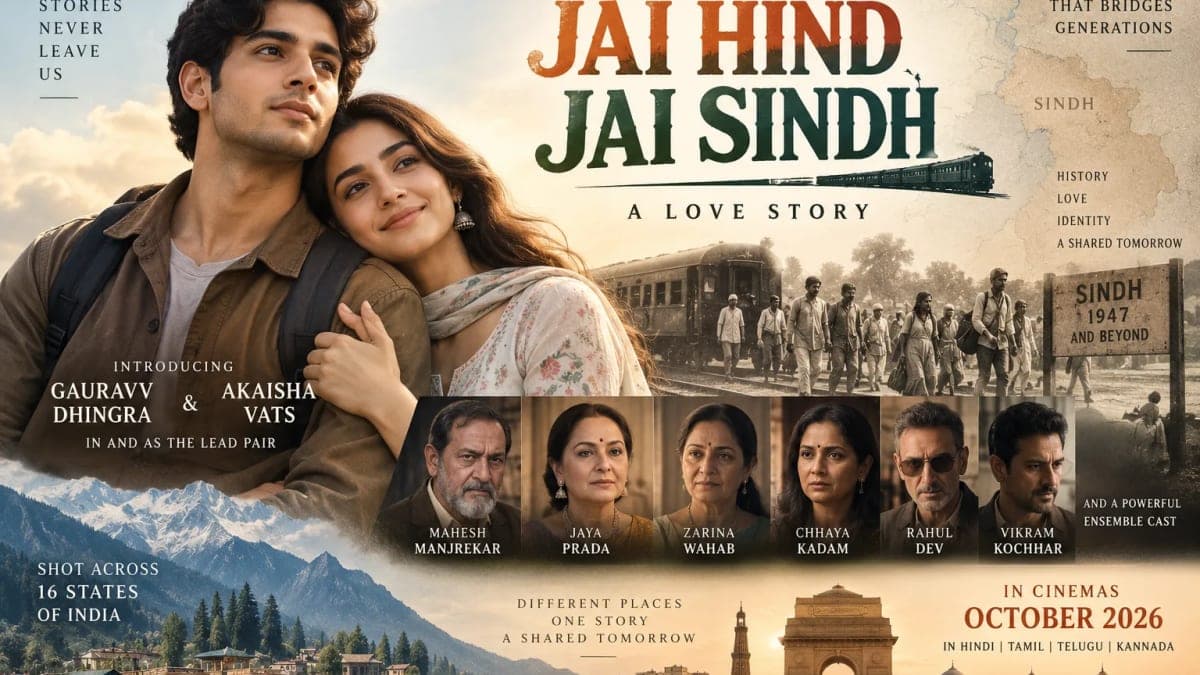
Indrajit Lankesh has chosen two newcomers to carry the central relationship in Jai Hind Jai Sindh: A Love Story, pairing Gauravv Dhingra and Akaisha Vats in a film that brings a contemporary romance into conversation with the legacy of Partition.
The decision stands out because the young actors will make their introduction alongside a cast filled with experienced performers. Mahesh Manjrekar, Jaya Prada, Chhaya Kadam, Rahul Dev, Vikram Kochhar and Zarina Wahab are among the established names appearing in the film.
Lankesh said that experience, or the lack of it, was not the deciding factor when he searched for his leads. He wanted actors who arrived without an established screen persona.
Why Lankesh Chose Two New Faces
“When I began casting Jai Hind Jai Sindh, I wasn’t looking for familiar faces, I was looking for actors who could make the audience believe in the characters,” Lankesh said in a statement.
“Gaurav and Akaisha had that honesty and innocence. They walked into the auditions without any baggage, and that freshness is exactly what the story needed.”
That reasoning places considerable responsibility on Dhingra and Vats. They are not being introduced through peripheral roles before moving towards larger parts; their relationship is central to a film built around love, family history and displacement.
The veteran ensemble, meanwhile, gives the production an experienced supporting structure.
Lankesh said working around senior actors became part of the newcomers’ preparation.
“Watching actors like Mahesh Manjrekar, Jaya Prada and Zarina Wahab perform every day was like a masterclass,” he said.
“Gaurav and Akaisha absorbed everything with incredible sincerity, and I think audiences will notice that honesty in their performances.”
Whether that translates effectively to the screen will be for audiences to judge. What is clear from the casting is that Lankesh wants the young characters to arrive without associations from previous films.
A Romance Shaped by an Older History
The title Jai Hind Jai Sindh points towards the historical thread running beneath its love story.
The film connects a present-day relationship with Partition and the experiences of an earlier generation. Lankesh has described a narrative that reaches back to the protagonists’ grandparents, using family history to connect the younger characters with events that preceded them.
Sindh carries particular weight in that setting.
The province became part of Pakistan following Partition in 1947, while large numbers of Sindhi Hindus migrated to India. The resulting displacement left families rebuilding their lives in different parts of the country while maintaining cultural and emotional connections to Sindh.
Rather than treating that history as a separate period drama, Jai Hind Jai Sindh uses it as the background to a contemporary relationship.
That gives the film two distinct tasks: making the younger romance work on its own terms while giving appropriate weight to the history that informs it.
Production Spanned 16 Indian States
The geographical scale of the shoot reflects those broader ambitions.
According to Lankesh, the production travelled through 16 states, with filming locations including Kashmir, Himachal Pradesh, Uttarakhand, Punjab, Delhi, Maharashtra, Karnataka and Andhra Pradesh.
A production spread across that many locations is an unusually large canvas for a romance, but it fits the filmmakers' attempt to connect an intimate story with questions of place, migration and identity.
The extensive location work also gives the project a visual scale that contrasts with its decision to centre the film on two first-time leads.
Veteran Actors Surround the Newcomers
The supporting cast extends well beyond the film's most recognisable names.
Along with Mahesh Manjrekar, Jaya Prada, Chhaya Kadam, Rahul Dev, Vikram Kochhar and Zarina Wahab, the ensemble includes Amit Behl, Indira Tiwari, Upasana Singh, Ehsan Khan, Pooja Katyal, Ajit Shidhaye, Ankiith Arora, Rajveer Singh, Nanak Singh, Kartikey Malviya, Fatima Ayesha Khan and Garima Agarwal.
Sammy Nanwani is producing the film under Sammy’s Entertainment, with Lankesh directing.
The mixture of newcomers and veteran performers is more than a promotional talking point. It shapes how the film is likely to be received. Dhingra and Vats have no previous screen identities for viewers to bring into the story, while the supporting actors arrive with decades of combined experience.
That can give new performers room to establish themselves, but it also puts their work alongside actors accustomed to carrying substantial roles.
October Release Planned in Four Languages
The makers are planning a pan-India theatrical release in October 2026, with the film set to be presented in Hindi, Tamil, Telugu and Kannada.
That gives Dhingra and Vats a comparatively wide launch. Instead of beginning with a smaller regional or single-language release, the pair will be introduced through a film intended for audiences across several major theatrical markets.
The multilingual release also fits the subject. Although Sindhi history and Partition form part of the narrative, the filmmakers are positioning the story for audiences beyond one linguistic or regional community.
The challenge will be to make that historical backdrop feel integral to the characters rather than simply expansive.
For Dhingra and Vats, however, the immediate significance is simpler. Their first major screen roles place them at the centre of an ambitious production, surrounded by established actors and carrying a romance that Lankesh believes needed precisely what newcomers could offer: unfamiliarity.