Kriti Sanon Raksha Bandhan Ad Controversy Intensifies as GIVA Defends Campaign’s Message
The controversy surrounding Kriti Sanon’s Raksha Bandhan advertisement has taken a new turn after jewellery brand GIVA clarified why it removed the campaign from circulation.
The advertisement initially faced criticism over Sanon’s Indo-Western outfit and a scene showing her tying a rakhi to a pet dog. The debate soon expanded beyond the commercial itself, drawing reactions from actor and BJP MP Kangana Ranaut, Congress leader Rahul Gandhi and Sanon.
GIVA first withdrew the advertisement and expressed regret that the campaign had offended some viewers. The company’s founder, Ishendra Agarwal, has now said the decision was prompted by concerns for employees after tensions around certain stores reportedly created an unsafe environment.
The brand maintains that it continues to support the campaign’s underlying message.
What the GIVA Advertisement Showed
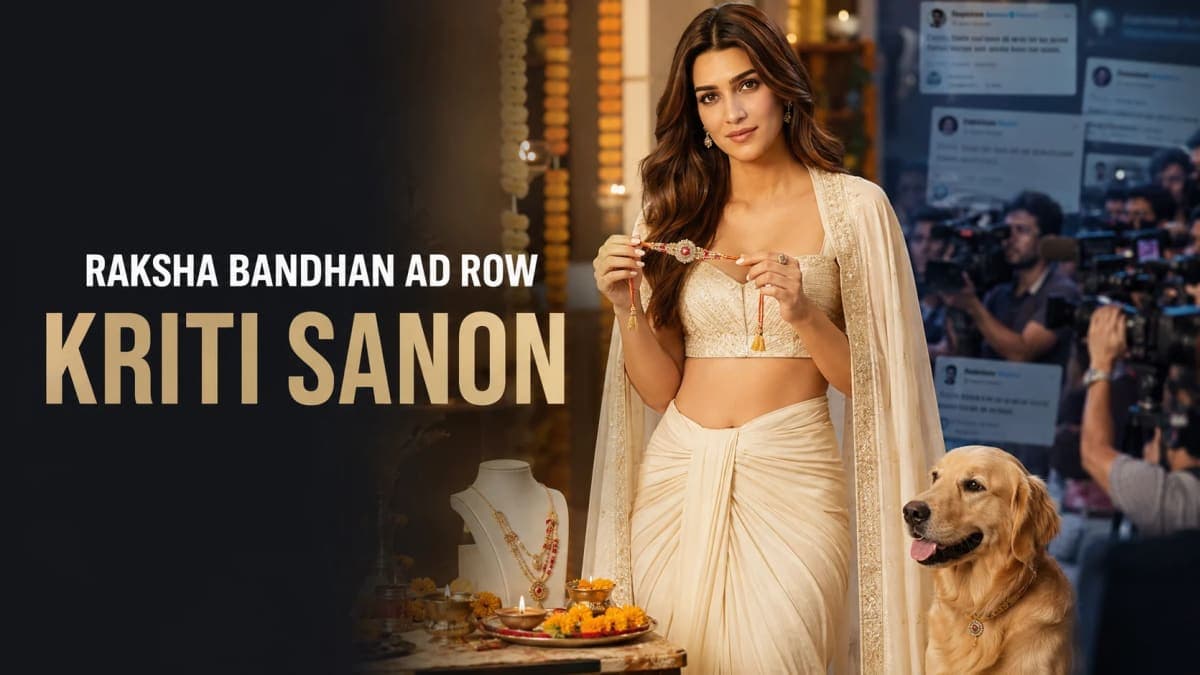
The festive jewellery campaign featured Sanon wearing an off-white Indo-Western ensemble consisting of a bralette-style blouse, cape and draped skirt.
She was shown participating in a Raksha Bandhan celebration and tying rakhis to family members, including a pet dog. The pet scene appeared intended to present animals as members of the family who also share bonds of affection and protection.
A section of social-media users objected to Sanon’s clothing, arguing that the styling did not suit a campaign centred on a traditional festival. Others criticised the decision to extend the rakhi ritual to a pet.
Supporters responded that clothing is a matter of individual choice and that traditions can be expressed differently by different families.
Kangana Ranaut Criticised the Campaign
The debate gained wider attention after Kangana Ranaut criticised the advertisement. Her objection was directed at its overall representation of the festival, including Sanon’s styling and what she viewed as the absence of customary elements associated with Raksha Bandhan.
Ranaut argued that traditional festivals should not be detached from their cultural setting when presented in commercial campaigns.
Her comments intensified discussion over whether brands should follow familiar religious and cultural imagery or have the freedom to interpret festivals in contemporary ways.
Kriti Sanon Responds to Clothing Criticism
Sanon defended the campaign’s approach and questioned why women’s cultural values continue to be judged through their clothing.
Her response emphasised that the meaning of Raksha Bandhan lies in affection, responsibility and protection rather than a particular neckline or dress style. She also presented the festival as a bond that need not be limited to the conventional idea of a brother protecting a sister.
Sanon later referred humorously to the continuing discussion about “rakhi fashion” while posting photographs with her sister, Nupur Sanon, for the festival.
Her position shifted the conversation from one advertisement to a broader debate about women’s autonomy, public scrutiny and who gets to define an acceptable representation of Indian culture.
Rahul Gandhi Supports Sanon’s Right to Choose
Congress leader Rahul Gandhi publicly supported Sanon amid the criticism, arguing that decisions about what a woman wears, does or where she goes belong to her.
His intervention added a political dimension to a disagreement that had begun around a jewellery campaign. With prominent figures on opposing sides, the controversy increasingly became a proxy debate about tradition, gender and personal freedom.
Political participation can increase attention to such issues, but it can also make a discussion more polarised by encouraging people to respond along partisan lines rather than evaluating the advertisement independently.
GIVA Withdraws the Advertisement
As the backlash grew, GIVA removed the campaign from its media channels.
In its initial statement, the company said it respected Indian culture, festivals and traditions. It explained that the campaign had attempted to include pets in a family celebration and stated that offending anyone had not been its intention.
The company withdrew the advertisement out of respect for those whose sentiments it said had been inadvertently affected.
That response led some observers to conclude that the brand had abandoned its original creative position under public pressure.
Founder Cites Safety Concerns for Employees
GIVA founder Ishendra Agarwal subsequently offered a more detailed explanation. He said the advertisement was not withdrawn because the company had rejected its message.
According to Agarwal, incidents around some stores created an unsafe atmosphere for employees working at those locations. The commercial was consequently removed to protect on-ground staff.
The clarification changes the interpretation of the withdrawal. It suggests that the company’s decision was motivated by immediate operational and safety concerns rather than a reversal of its views on clothing, pets or the meaning of Raksha Bandhan.
However, detailed independent information about the reported incidents has remained limited. Claims concerning threats or disturbances should therefore be described using the company’s attribution rather than presented as independently established facts.
False Sonu Nigam Statement Adds Misinformation to the Row
The controversy also produced a false statement attributed to singer Sonu Nigam.
A social-media post claimed that Nigam had commented on the advertisement and warned against testing the tolerance of Hindus. Nigam publicly denied making the statement and clarified that he had not reacted to the campaign.
The incident illustrates how quickly fabricated endorsements can enter a polarised online discussion. False statements attached to celebrities can intensify outrage, mislead users and make it harder to distinguish genuine responses from manufactured content.
Readers should verify celebrity comments through official accounts or reliable reports before sharing them.
Why the Controversy Matters for Advertisers
Festival advertising occupies a commercially valuable but culturally sensitive space in India. Brands frequently update traditional imagery to appeal to younger audiences, promote products and include contemporary ideas about family and identity.
That approach can attract attention, but it also creates reputational risk. Viewers may interpret a modern presentation as creative freedom, while others may see it as an inaccurate or disrespectful depiction of a meaningful custom.
Brands must therefore consider several questions:
Is the cultural context represented with sufficient care?
Does the campaign explain an unconventional creative choice clearly?
Has the company prepared a response plan for public criticism?
Can employees and retail locations be protected if an online dispute moves offline?
Will withdrawing a campaign reduce harm or encourage organised pressure?
There is no single answer that will satisfy every audience. Nevertheless, cultural consultation, clear internal decision-making and employee-safety planning can reduce avoidable problems.
Balanced Analysis: Cultural Criticism and Personal Freedom
Critics have a legitimate right to say that an advertisement does not reflect how they understand or practise Raksha Bandhan. Consumers can disagree with a brand’s styling, storytelling or treatment of a religious and cultural occasion.
At the same time, criticism of a campaign is different from personal attacks directed at an actor or pressure that makes employees feel unsafe. Sanon’s outfit does not determine her personal values, and disagreement over fashion does not justify harassment.
The advertisement’s supporters are also entitled to view pets as family members and Raksha Bandhan as an evolving expression of mutual care. Indian families follow traditions in diverse ways, and commercial representations cannot capture every variation.
The strongest public discussion would examine the campaign’s creative choices without policing women’s bodies, spreading fabricated statements or threatening people unrelated to the decision.
A Commercial Campaign Becomes a Larger Cultural Debate
The GIVA controversy demonstrates how quickly a short festival advertisement can become a national discussion about identity and social expectations.
What began with questions about an outfit and a pet-rakhi scene expanded into arguments over cultural authenticity, women’s autonomy, political speech, corporate responsibility and employee safety.
GIVA has removed the commercial but says it continues to stand by its message. The continuing debate suggests that the campaign’s influence now extends far beyond its original purpose of promoting jewellery.
This article is based on reporting published by NDTV.