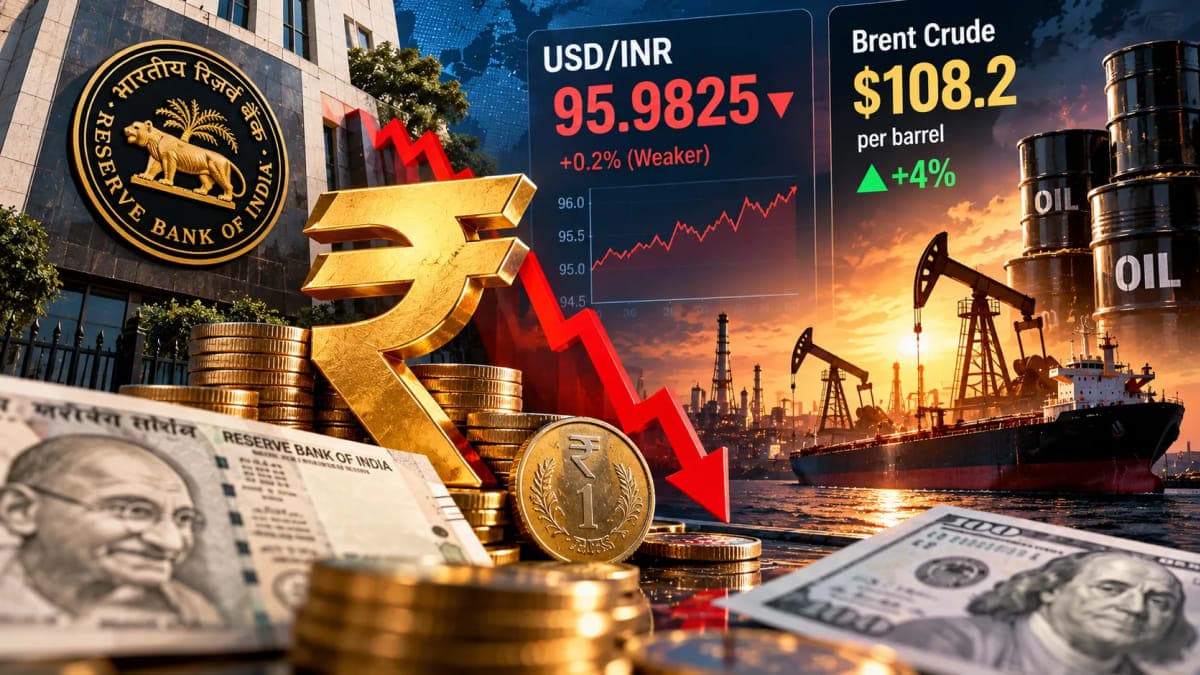
The Indian rupee moved within a fraction of the psychologically important ₹96-per-dollar mark on Monday, September 28, as another surge in global crude oil prices intensified pressure on one of Asia’s major oil-importing economies.
The rupee settled 0.2% weaker at ₹95.9825 against the US dollar, according to Reuters. Its decline was contained by dollar sales from state-run banks, which traders believe were most likely acting on behalf of the Reserve Bank of India.
The immediate trigger was oil. Brent crude jumped nearly 4% to $108.2 per barrel as uncertainty surrounding US-Iran diplomacy kept concerns over Middle East energy supplies elevated.
For India, the combination of expensive crude, stronger global yields, weaker equities and pressure across Asian currencies creates a particularly difficult environment for the rupee.
Rupee closes just below ₹96/$
The currency's weakness was visible from the start of Monday's session.
Moneycontrol reported that the rupee opened around ₹95.87-95.88 per dollar, compared with roughly ₹95.82 in the preceding session, as oil prices moved higher.
The pressure intensified during the day.
By the close, the rupee stood at ₹95.9825/$, leaving it extremely close to the ₹96 threshold. Reuters described this as its weakest level in more than a week.
That distinction matters: the rupee approached ₹96 on September 28 rather than recording a closing rate clearly beyond it.
Why is expensive oil hurting the rupee?
India's exposure to crude oil is the central issue.
According to Reuters, India imports nearly 90% of its crude requirements. When international oil prices rise, Indian refiners need more dollars to pay for imports. That can increase demand for the US currency in the domestic foreign-exchange market.
There is a second economic effect.
A sustained rise in crude prices can increase India's import bill and potentially worsen its trade and current-account balances. Expensive fuel can also feed into inflation directly through energy costs and indirectly through transportation and production expenses.
That combination can make a prolonged oil shock particularly challenging for the rupee.
Brent crude jumps to $108.2
Reuters reported that Brent crude climbed nearly 4% to $108.2 a barrel on Monday.
The move followed continued uncertainty over US-Iran diplomatic efforts. US President Donald Trump rejected an Iranian peace proposal, although he told Axios that he expected US negotiators to hold further talks during the week.
The outcome of those negotiations matters to currency markets because the Middle East conflict has heightened concerns about energy supply.
For the rupee, therefore, developments in the oil market are currently functioning almost like a second currency-market indicator: a sustained rise in crude increases pressure, while a meaningful decline could provide some relief.
RBI appears to be defending the ₹96 zone
The rupee could have weakened further during Monday's session, but dollar sales from state-run banks limited the move.
Reuters reported that those transactions were most likely conducted on behalf of the RBI.
A foreign-bank trader told Reuters:
“For now, 96 is the floor under INR.”
The trader added that the RBI did not appear willing at that point to allow the currency to move beyond the level.
This should not, however, be interpreted as an official RBI commitment to permanently defend ₹96.
The central bank has not declared ₹96 as a fixed exchange-rate target. Market intervention can instead be used to reduce disorderly volatility or slow the pace of currency depreciation.
Why does RBI intervention work?
To support the rupee, the RBI can sell dollars into the foreign-exchange market.
That increases the supply of dollars and can help meet demand from importers and other market participants, reducing immediate downward pressure on the rupee.
Reuters reported that policy measures between June 8 and September 18 attracted $143.6 billion of capital inflows, providing the central bank with additional room to counter currency-market pressure.
Goldman Sachs analysts said the RBI had the capacity to keep the rupee broadly within a ₹94-₹97 range, or at least manage the pace of depreciation. That is Goldman's assessment, not an official RBI target or guaranteed trading range.
It isn't only an oil story
Crude is currently the biggest visible pressure point, but several forces are acting on the rupee simultaneously.
High oil prices have contributed to concerns about inflation and global interest rates. US Treasury yields have remained elevated, while Asian equities and currencies have also faced pressure.
Reuters reported that the MSCI gauge of Asian shares fell nearly 1% on Monday, while Indian equities declined about 1.5% to their lowest level since April.
Goldman Sachs analysts said investors had turned bearish on several higher-yielding emerging Asian currencies—including the Indian rupee, Indonesian rupiah and Philippine peso—because of their vulnerability to higher energy costs.
The rupee's weakness therefore reflects both India-specific oil exposure and a broader risk-off environment across emerging markets.
₹96 is important psychologically—but it isn't a magic number
Currency markets often attach importance to round numbers such as ₹90, ₹95 or ₹100 against the dollar.
₹96 has become one such reference point because market participants have repeatedly observed intervention as the rupee approached that zone.
Business Standard reported on September 24 that a state-owned-bank dealer described ₹96 as an important psychological threshold, with RBI-linked dollar selling helping contain depreciation around that level.
But crossing ₹96 would not automatically mean that India's currency fundamentals had suddenly changed.
What matters more is whether depreciation becomes sustained and disorderly—and whether oil prices, capital flows, inflation expectations and the dollar continue moving against the rupee.
Rupee has already crossed ₹96 briefly this month
Another important clarification is needed around the phrase “approaches ₹96.”
₹96 is not an all-time untouched boundary.
The rupee briefly crossed the ₹96 level earlier in September, after the US Federal Reserve delivered its first rate increase since 2023. The dollar index strengthened following that decision, adding pressure to the Indian currency.
Therefore, Monday's development is better described as the rupee returning close to ₹96 and settling just below it, rather than approaching ₹96 for the first time.
Why high oil can affect ordinary consumers
A weaker rupee and expensive crude can reinforce each other.
Oil is priced internationally in dollars. If crude becomes more expensive in dollar terms while the rupee simultaneously weakens, the rupee-denominated cost of imported energy can rise even faster.
That does not mean retail petrol and diesel prices automatically move one-for-one with the exchange rate or international crude. Domestic fuel pricing also depends on taxes, refining economics, marketing margins and government or oil-company pricing decisions.
But prolonged weakness can raise input costs throughout the economy, particularly for industries dependent on imported fuel, chemicals, machinery and other dollar-denominated commodities.
What happens next?
The immediate direction of the rupee will depend heavily on oil prices, US-Iran developments, US bond yields, global dollar strength, foreign capital flows and RBI intervention.
The ₹96 area will remain closely watched because of recent central-bank activity around that level.
But the larger variable is crude.
If Brent remains above $100 for an extended period, India's import dependence means pressure on the currency and inflation outlook could persist. If geopolitical tensions ease and oil prices retreat significantly, one of the rupee's largest current headwinds would weaken.
That makes the currency's next move less about ₹96 itself and more about what happens to the global energy shock surrounding it.
Conclusion
The rupee's close at ₹95.9825/$ on September 28 puts it almost exactly at a level traders have been watching for RBI intervention.
But the story extends well beyond a single exchange-rate number.
Brent crude's surge to $108.2 a barrel, India's dependence on imports for nearly 90% of its crude needs, elevated global yields and weakness across emerging-market assets are combining to put pressure on the currency. RBI-linked dollar sales have so far helped prevent a more disorderly move.
For India, the key question is therefore not simply whether the rupee trades at ₹95.98 or crosses ₹96.
It is how long oil stays expensive—and how much intervention is required to prevent that energy shock from translating into sustained currency and inflation pressure.
Sources
The primary source for this report is Reuters — Oil woes push rupee to over one-week low, RBI caps fall near 96/USD, published on September 28, 2026. Reuters provided the closing exchange rate, Brent crude price, oil-import dependence, RBI-intervention context and market commentary. Reuters
Opening-market data and additional domestic currency context were cross-checked with Moneycontrol's September 28 currency report and Business Standard's reporting on recent rupee and bond-market pressure.