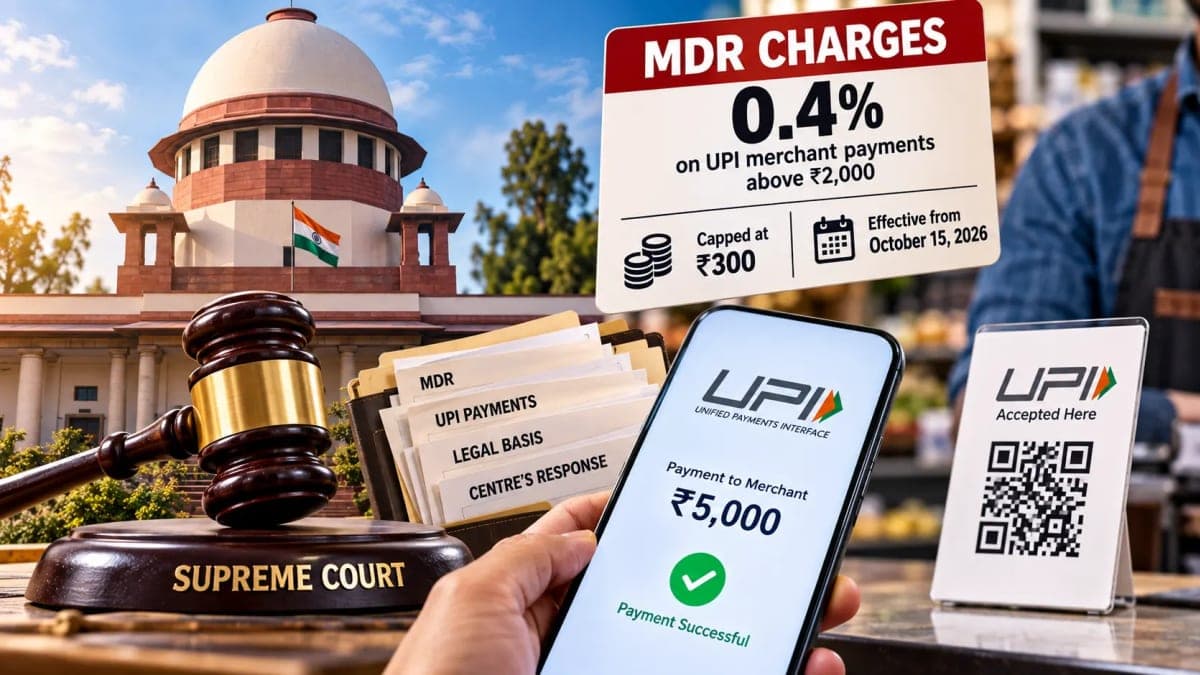
Supreme Court asks Centre: What exactly is this charge?
India's new UPI merchant-payment framework has come under judicial scrutiny just weeks before it is scheduled to take effect.
On Monday, September 28, a Supreme Court bench comprising Chief Justice of India Surya Kant and Justices Joymalya Bagchi and V Mohana heard a public interest litigation challenging the Centre's decision to introduce Merchant Discount Rate, or MDR, on specified person-to-merchant UPI transactions exceeding ₹2,000.
The Court did not suspend the new framework. Instead, it asked the government to submit a short affidavit explaining the factual and legal basis of the arrangement.
CJI Surya Kant observed:
“This is less of a legal and more of a technical issue.”
The bench also questioned the legal character of the payment, asking what executive authority permitted the charge and whether it should legally be considered a fee.
That distinction could become central to the case.
What is changing for UPI payments?
Under the announced framework, a 0.4% MDR will apply to specified person-to-merchant (P2M) UPI transactions above ₹2,000 from October 15, 2026.
The charge is capped at ₹300 for transactions of ₹75,000 and above.
However, this does not mean every UPI transaction above ₹2,000 will automatically become chargeable.
Person-to-person (P2P) UPI transfers remain free regardless of their value, while merchant transactions up to ₹2,000 also remain outside the MDR framework.
The distinction matters because MDR is associated with the merchant-payment ecosystem rather than being presented as a direct fee imposed on every person using UPI.
Different rates for different transactions
The framework contains separate treatment for some categories.
For general qualifying merchant payments above ₹2,000, MDR is 0.4%. For essential and thin-margin sectors—including railways, telecommunications, insurance, fuel and agricultural inputs—the charge is a flat ₹5 per qualifying transaction.
Capital-market UPI payments involving categories such as mutual funds, securities, stockbrokers and dealers carry an MDR of 0.02%, capped at ₹300. Merchants receiving up to ₹1 lakh per month are exempt under the framework described to the Court.
Government says 96% of merchant transactions will remain unaffected
Appearing for the Centre, Additional Solicitor General N Venkataraman told the Supreme Court that around 96% of merchant transactions would remain unaffected by the decision.
He also clarified that person-to-person transactions would continue to remain free.
The government's position is that the MDR is not a government tax.
Venkataraman told the Court:
“Not one rupee from this will go to the government.”
He described it instead as a settlement-related payment involving banks and service providers, facilitated through the National Payments Corporation of India (NPCI). Hindustan Times
The Supreme Court has not yet ruled on whether that legal characterisation is correct.
Why has the MDR been challenged?
The PIL was filed by advocate Anjan Datta.
It challenges the Centre's September 14 notification and the MDR framework announced on September 15. The petitioner argues that the system was introduced without adequate statutory safeguards, transparency or public consultation.
The petition also challenges the constitutional validity of the amended Section 10A of the Payment and Settlement Systems Act, 2007, arguing that it gives the executive excessive discretion over which electronic payment systems receive protection from charges.
These remain the petitioner's allegations; the Supreme Court has not accepted or rejected them on the merits.
Why is the ₹2,000 threshold being questioned?
Another part of the challenge concerns the structure of the threshold itself.
The petition argues that a transaction of ₹2,000 attracts no MDR, while a transaction of ₹2,001 can enter the chargeable category, potentially creating what the petitioner describes as a financial “cliff”.
It also questions why UPI receives a ₹2,000 threshold while RuPay debit-card transactions continue to receive no-charge protection without a comparable monetary ceiling.
The petitioner has asked for the framework to be quashed or suspended, or alternatively reconsidered following consultation, publication of supporting data and an impact assessment.
Will customers have to pay 0.4%?
This is where headlines about a “UPI fee” can become misleading.
The framework imposes MDR within the merchant-payment system; it is not presented as a 0.4% fee directly charged to a customer simply for making an eligible UPI payment.
Government officials have said banks have been instructed to ensure merchants do not pass the MDR directly to customers.
The petition, however, argues that merchants—particularly low-margin businesses—could still face an economic burden and that the cost could indirectly enter pricing, discourage UPI acceptance or encourage merchants to split transactions.
Those are concerns raised by the petitioner, not findings made by the Supreme Court.
How much would 0.4% MDR amount to?
For a general merchant transaction subject to the 0.4% rate, the basic calculation would look like this before applying the ₹300 cap:
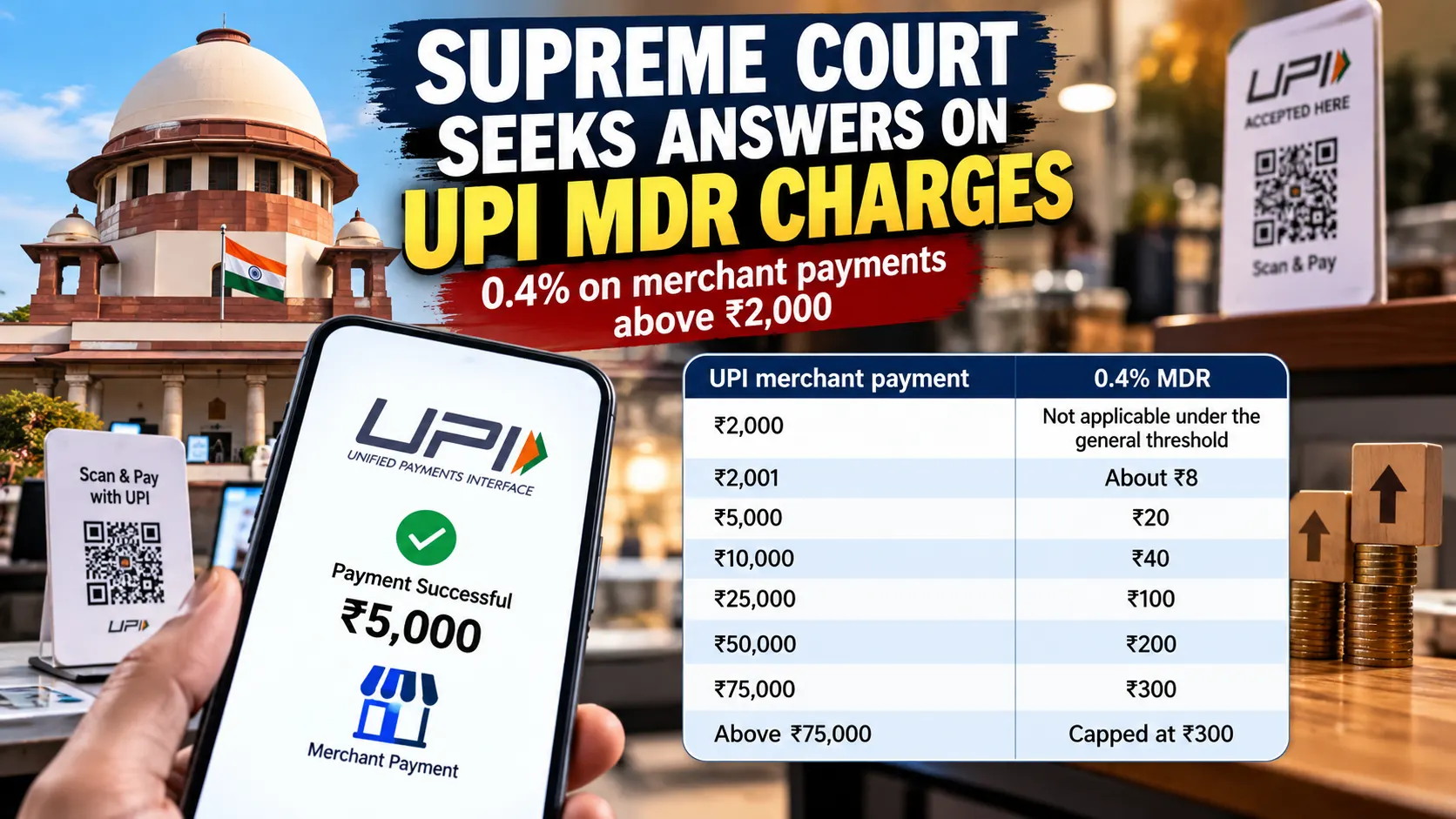
This illustrates why the ₹2,000 threshold and ₹300 ceiling have become important parts of the debate. The actual treatment can differ for exempt merchants and special categories such as essential services and capital-market payments.
Why MDR matters to India's UPI ecosystem
UPI has operated for nearly six years under a zero-MDR regime for these payments, making the September policy shift significant for banks, payment companies and merchants.
The economic debate therefore involves two competing considerations.
Banks and payment-service providers incur infrastructure and operating costs in processing digital transactions. On the other side, merchants—especially businesses with thin margins—are concerned about absorbing another transaction cost.
The Supreme Court proceedings are now adding a third question: what is the precise statutory and legal basis on which the new charge is being implemented?
Court refuses to stop October 15 rollout — for now
The Supreme Court's September 28 order does not strike down the MDR framework.
It also does not uphold its legality.
Instead, the Court has declined to grant an interim stay while asking the Centre to explain the framework through an affidavit. Notices have also been issued to the Reserve Bank of India, NPCI and other respondents.
Unless the legal position changes before then, the announced framework is scheduled to take effect from October 15, 2026.
That makes the next stage of the case important not only for the government and payment companies, but also for millions of businesses that rely on UPI for everyday transactions.