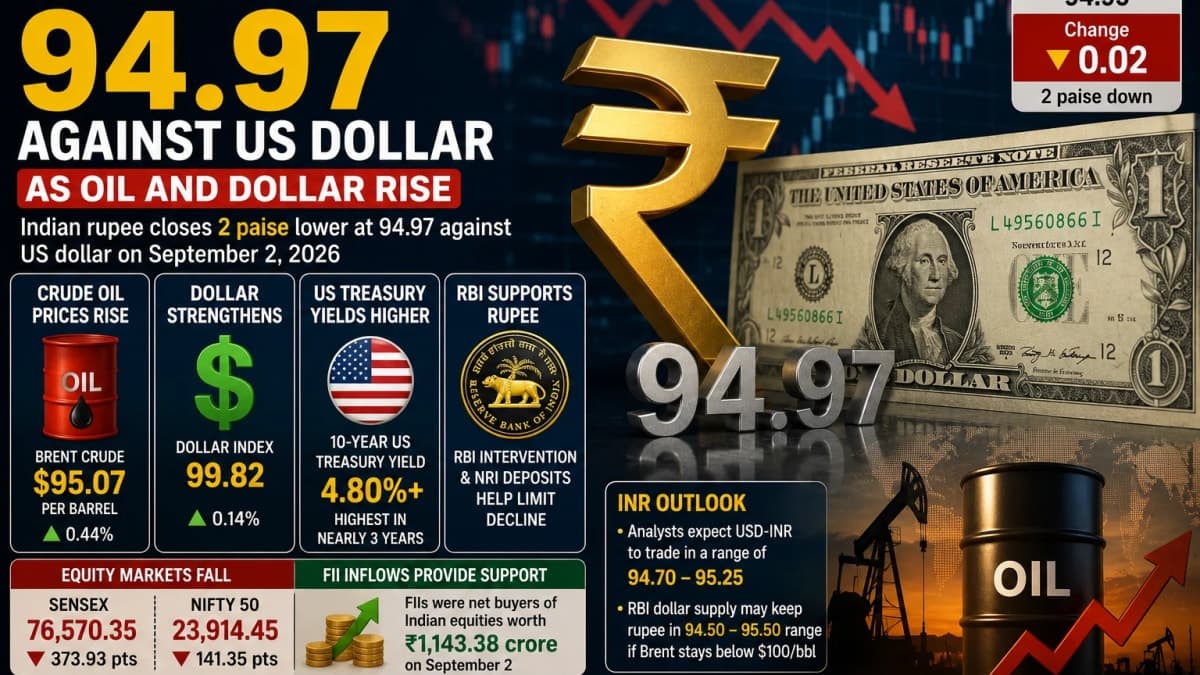
The Indian rupee closed at 94.97 against the US dollar on Wednesday, September 2, 2026, slipping 2 paise as global risk factors continued to put pressure on the domestic currency.
The rupee had settled at 94.95 against the dollar on Tuesday.
Despite the relatively small movement at the close, the trading environment remained challenging. Higher crude oil prices, renewed geopolitical tensions involving the United States and Iran, elevated US Treasury yields and broad strength in the dollar created multiple headwinds for the Indian currency.
At the same time, intervention by the Reserve Bank of India (RBI) and foreign currency inflows appear to have helped contain volatility, preventing the rupee from weakening more sharply.
Rupee Trades in Narrow Range Before Closing at 94.97
At the interbank foreign exchange market, the rupee remained within a relatively tight range during Wednesday’s session.
It touched an intraday high of 94.83 and a low of 94.99 before ending at 94.97 against the US dollar, according to market data.
The 2-paise decline was modest, particularly considering the combination of rising crude prices and strengthening global bond yields.
Reuters reported that the rupee opened at 94.89 before briefly strengthening and eventually spending much of the session near Tuesday’s closing level.
The relatively contained movement suggests that opposing forces were at work: global conditions were negative for the rupee, while central-bank support and foreign inflows provided a buffer.
Rising Crude Oil Prices Put Pressure on the Rupee
Oil remains one of the most important external variables for the Indian currency.
Brent crude futures were trading around $95.07 per barrel, up 0.44%, during the session. Oil had climbed substantially during the week amid renewed concerns about disruption to global energy supplies.
The latest escalation in tensions between the United States and Iran has increased concerns over potential disruptions to crude supplies, particularly through the strategically important Strait of Hormuz.
That matters significantly for India because the country depends heavily on imported crude oil.
When global oil prices rise, Indian refiners and other importers generally require more dollars to pay for imports. Higher demand for the US currency can therefore increase downward pressure on the rupee.
Persistently expensive oil can also affect India through a second channel: inflation.
If elevated energy costs feed into transportation, manufacturing and other parts of the economy, they can complicate the inflation and interest-rate outlook.
Dollar Index Approaches the 100 Mark
The rupee also faced pressure from strength in the US currency.
The dollar index, which measures the greenback against a basket of six major currencies, was trading around 99.82, up approximately 0.14%.
A stronger dollar typically creates challenges for emerging-market currencies because global investors may shift capital toward dollar-denominated assets when US yields become more attractive or global risk aversion increases.
The dollar’s strength has been reinforced by changing expectations around US monetary policy.
Market participants have increased the probability of another Federal Reserve interest-rate hike, contributing to higher Treasury yields and supporting the greenback.
For the rupee, the combination of a strong dollar and expensive crude oil creates a particularly difficult external environment.
US Treasury Yields Add Another Headwind
US government bond yields have also moved sharply higher.
The 10-year US Treasury yield climbed above 4.8%, reaching levels not seen in nearly three years, according to Reuters.
Higher Treasury yields can strengthen demand for US financial assets because investors can earn higher returns from dollar-denominated government debt.
That can reduce the relative attractiveness of emerging-market assets and put pressure on currencies such as the rupee.
The increase in yields has also revived concerns about global borrowing costs and the inflation outlook.
In effect, the rupee is currently navigating three connected pressures: expensive oil, a stronger dollar and higher US yields.
RBI Intervention Helps Contain Rupee Volatility
Despite those global pressures, the rupee avoided a major decline.
Market participants told Reuters that the Reserve Bank of India likely intervened through dollar sales, including before the formal opening of the foreign-exchange market.
The central bank has reportedly increased its presence in the currency market in recent sessions as it seeks to prevent excessive volatility.
When the RBI sells dollars from its foreign-exchange resources, it increases dollar supply in the domestic market. That can help meet importer demand and reduce sudden pressure on the rupee.
The objective of such intervention is generally not necessarily to defend one specific exchange rate indefinitely, but to prevent disorderly or excessively volatile currency movements.
The RBI has not independently confirmed every market intervention attributed to it by traders, so reports of specific dollar sales should be understood as assessments from market participants.
NRI Deposits Strengthen RBI’s Buffer
Another important factor supporting the currency has been the sharp increase in foreign-currency deposits from non-resident Indians.
Reuters reported that the RBI has benefited from a surge in deposits linked to its Foreign Currency Non-Resident, or FCNR, scheme.
Krishna Bhimavarapu, APAC economist at State Street Investment Management, said:
“I think the FCNR scheme achieved its intended objective of supporting external funding environment and stabilizing the rupee.”
He estimated that FCNR flows may eventually have exceeded $100 billion.
These inflows potentially give the RBI greater capacity to manage external volatility by strengthening the foreign-currency resources available to the financial system.
The impact is particularly important at a time when high crude oil prices are increasing demand for dollars from Indian importers.
Importer Dollar Demand Remains a Challenge
While RBI support helped stabilise the rupee, dollar demand from importers continued to provide resistance.
Indian companies importing crude oil, machinery, electronics and other goods require foreign currency to settle international transactions.
When import costs increase—particularly because of higher oil prices—the demand for dollars can rise.
This creates a tug-of-war in the foreign-exchange market: importer demand and global risk aversion can weaken the rupee, while RBI intervention and foreign capital inflows can support it.
Wednesday’s narrow trading range illustrates that balance.
Sensex and Nifty Fall as Global Risk Aversion Hits Equities
Pressure was not limited to the currency market.
Indian equities also ended lower on September 2.
The BSE Sensex dropped 373.93 points to close at 76,570.35, while the NSE Nifty 50 declined 141.35 points to 23,914.45.
Higher crude oil prices are generally viewed negatively by Indian equity investors because they can raise input costs, increase inflation risks and potentially affect corporate profitability.
Weak domestic equities can also indirectly weigh on the currency when they contribute to broader risk aversion.
However, foreign institutional investment provided some support.
According to exchange data, foreign institutional investors were net buyers of Indian equities worth ₹1,143.38 crore on Tuesday.
Why High Oil Prices Matter So Much for the Indian Rupee
The relationship between crude oil and the rupee is especially important because India is one of the world’s major oil-importing economies.
When crude prices increase significantly, India must spend more foreign currency for broadly the same quantity of imported energy.
That can affect the economy through several channels:
Higher demand for US dollars from oil importers
Increased pressure on the rupee
A potentially larger import bill
Greater inflation risks
Higher costs for businesses dependent on fuel or petroleum products
Possible pressure on government and household finances
However, the relationship is not mechanical. Capital flows, RBI intervention, global dollar movements, interest rates and investor sentiment can all offset or amplify the effect of oil prices.
That is precisely what happened on September 2: oil prices created significant pressure, but the rupee’s actual daily decline remained limited.
What Could Happen Next to USD-INR?
The immediate direction of the rupee is likely to depend heavily on geopolitical developments, crude oil prices, US monetary policy expectations and RBI activity.
Anuj Choudhary, Research Analyst at Mirae Asset ShareKhan, said the rupee could retain a “slight negative bias” amid renewed geopolitical tensions and higher crude oil prices.
He expects the USD-INR spot rate to trade in a range of 94.70 to 95.25.
Meanwhile, Alok Singh, Head of Treasury at CSB Bank, told Reuters that continued RBI dollar supply could help keep the rupee broadly within 94.50–95.50, provided Brent crude remains below $100 per barrel.
These ranges are analysts’ forecasts rather than guaranteed exchange-rate outcomes.
What Should Investors and Businesses Watch?
Several indicators are likely to determine the rupee’s near-term direction.
The most immediate is Brent crude. A sustained move toward or above $100 per barrel could increase pressure on India’s import bill and demand for dollars.
The second is the US dollar index. A decisive move above 100 could create additional pressure across emerging-market currencies.
US Treasury yields and Federal Reserve policy expectations will also remain important, particularly as investors assess whether interest rates could rise further.
Finally, markets will closely monitor the RBI.
If the central bank continues supplying dollars during periods of heightened volatility, it could limit sudden depreciation even if the broader global environment remains difficult.
Rupee’s 94.97 Close Tells a Bigger Story
The rupee’s 2-paise decline may appear insignificant on its own, but the limited movement masks a much larger battle taking place in the currency market.
On one side are higher crude oil prices, geopolitical tensions, importer dollar demand, rising US Treasury yields and a strengthening greenback.
On the other are RBI intervention, foreign capital flows and increased foreign-currency resources.
For now, those supporting factors have helped keep the rupee relatively stable despite an unusually difficult external environment.
The next major test could come if crude oil moves sustainably above $100 per barrel or if the dollar and US bond yields continue climbing.
Until then, the rupee’s trajectory is likely to remain closely tied to developments far beyond India’s borders—from the oil market and Middle East tensions to decisions made by the US Federal Reserve.