
For many Indians, building a corpus of ₹1 crore represents an important financial milestone. It could form part of a retirement fund, a child's education corpus, a house purchase or simply a long-term wealth-building target.
But there is no single answer to the question: How much should you invest every month to reach ₹1 crore?
The amount depends primarily on two variables: how long you remain invested and what return your investments actually earn.
Illustrative calculations show that an investor targeting ₹1 crore in 20 years would need to invest about ₹10,100 per month if the investment earns an average annualised return of 12%. With a 10% return assumption, the requirement rises to roughly ₹13,200 a month.
The important word, however, is assumption. These returns are not guaranteed.
SEBI states that mutual funds and securities investments are subject to market risks, their values can rise or fall, and past performance does not guarantee future results.
How Much Monthly Investment Could Build ₹1 Crore?
Here is an illustrative calculation of the monthly investment required to accumulate approximately ₹1 crore under different time horizons.
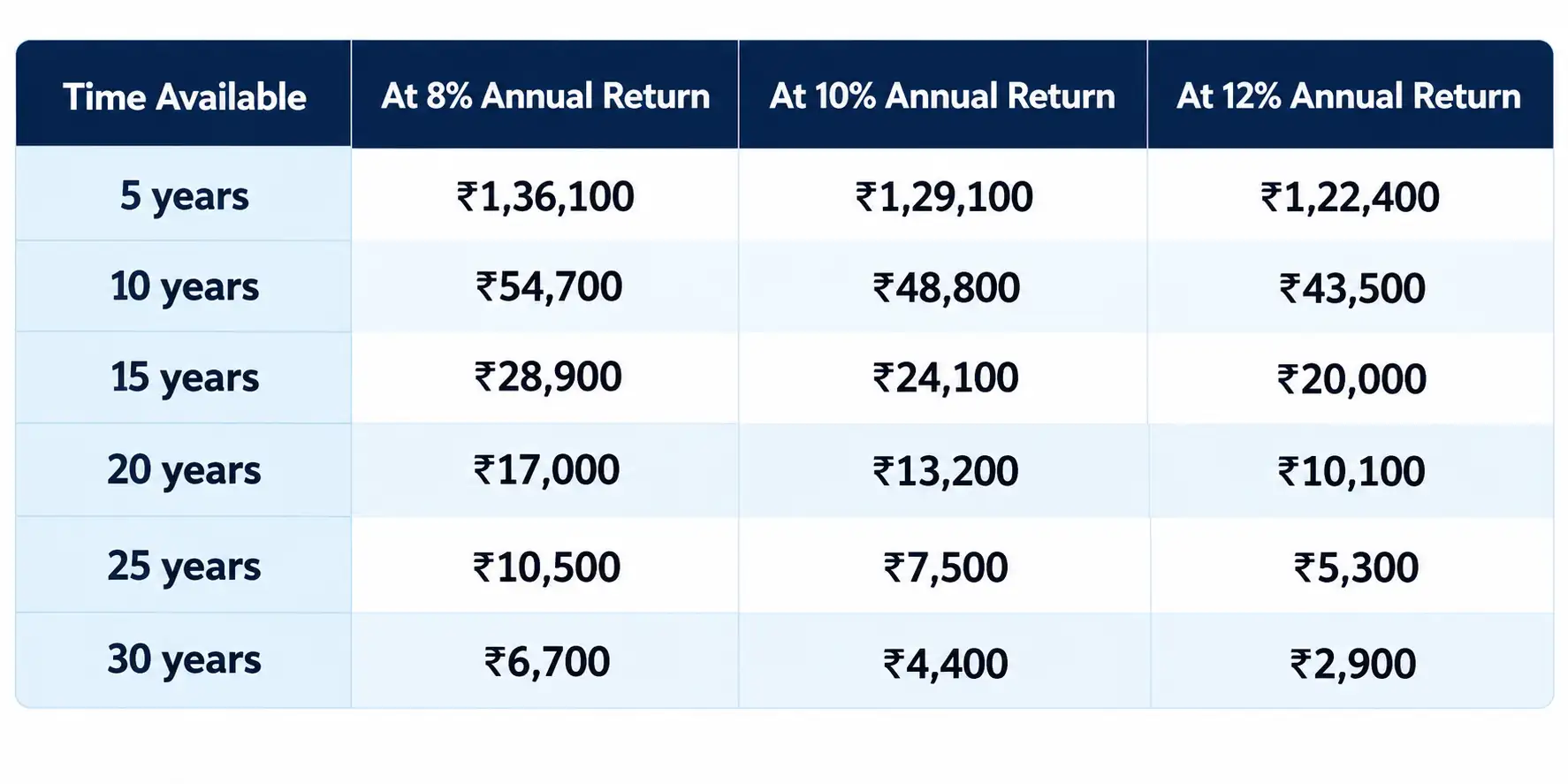
Figures are rounded and calculated assuming a fixed investment at the end of every month and monthly compounding. They are mathematical illustrations, not forecasts or guaranteed investment outcomes.
The table highlights one of the most important principles of long-term investing: time can have an enormous impact on the amount you need to contribute yourself.
₹10,000 a Month Could Get Close to ₹1 Crore in 20 Years — But Only Under the Assumption
Consider an investor who puts aside approximately ₹10,000 every month for 20 years.
The investor would contribute roughly:
₹10,000 × 12 × 20 = ₹24 lakh
If that money were to compound at approximately 12% annually throughout the period, the final corpus would approach ₹1 crore.
That does not mean investing ₹10,000 a month guarantees ₹1 crore.
Actual mutual-fund returns fluctuate with markets. SEBI explicitly warns investors that there can be no assurance that a mutual fund's investment objective will be achieved and that past performance does not indicate future performance.
The Real Advantage Is Starting Early
Now compare two people targeting the same ₹1 crore corpus under the same hypothetical 12% annual return.
An investor with 10 years would need approximately:
₹43,500 every month.
Someone with 20 years would need about:
₹10,100 every month.
And someone with 30 years would need only around:
₹2,900 every month.
The dramatic difference occurs because the earliest investments have considerably more time to compound.
SEBI explains compounding as earning returns not only on the original investment but also on previously accumulated returns. Over sufficiently long periods, this can substantially change the growth of an investment.
What Exactly Is an SIP?
A Systematic Investment Plan, or SIP, is not a separate investment product. It is a method of investing a fixed amount into a mutual-fund scheme at regular intervals.
The Association of Mutual Funds in India (AMFI) says SIPs allow investors to contribute fixed amounts periodically instead of making a single lump-sum investment.
SIPs can also help impose investment discipline because contributions continue at regular intervals rather than depending on an investor's attempts to identify the perfect time to enter the market.
AMFI says regular SIP investing can provide the benefit of rupee-cost averaging: when a fund's NAV is lower, the same investment buys more units, while a higher NAV results in fewer units being purchased.
However, AMFI also makes an important qualification: rupee-cost averaging does not guarantee profits or protect investors from losses in declining markets.
The Cost of Waiting Can Be Huge
Suppose two investors both want ₹1 crore and both use the same hypothetical 12% return assumption.
Investor A begins with 30 years remaining.
Required monthly investment: approximately ₹2,900.
Investor B waits 10 years and therefore has only 20 years remaining.
Required monthly investment: approximately ₹10,100.
Investor C waits until only 10 years remain.
Required monthly investment: approximately ₹43,500.
The goal remains exactly the same. What changes is the amount of time available for compounding.
This is why focusing only on finding the “best return” can miss a major part of wealth creation. Investment duration can be just as important.
But Is ₹1 Crore Really Enough?
This is where investors should look beyond the attractive round number.
₹1 crore today and ₹1 crore 20 or 30 years from now will not have the same purchasing power because prices generally rise over time.
For example, assuming inflation averages 6% annually purely for illustration, something costing ₹1 crore today would cost roughly:
₹1.79 crore after 10 years
₹3.21 crore after 20 years
₹5.74 crore after 30 years
That means a young investor planning for retirement decades away should not automatically treat ₹1 crore as the final goal.
The more useful question is:
How much will my financial goal cost when I actually need the money?
The investment target can then be calculated backwards from that future requirement.
What If You Cannot Invest ₹10,000 or ₹20,000 Today?
A large target does not necessarily mean an investor has to begin immediately with the full required amount.
One alternative is a step-up approach, where the investment contribution increases periodically as income grows.
For example, someone may start with an amount that comfortably fits their present budget and increase the contribution after salary increases.
The final outcome will depend on the starting investment, the size and frequency of increases, actual investment returns, fees, taxes and the investment period.
Investors should therefore calculate their own goal rather than assuming a generic SIP amount will produce the desired corpus.
Return Assumptions Need to Be Treated Carefully
Using 10% or 12% in a calculator does not mean an investment will actually deliver that return.
Equity markets can experience extended periods of strong performance as well as declines and weak returns.
SEBI advises investors to consider their financial objectives, asset allocation and risk factors when evaluating mutual funds. Investors should also examine scheme documents, investment objectives, strategies, costs and risks before investing.
The appropriate investment mix may therefore differ substantially between someone investing for a goal 25 years away and someone who needs the money in three years.
A Better Way to Think About the ₹1 Crore Goal
Instead of beginning with the question, “Which investment will make me ₹1 crore?”, investors can approach the goal in four stages:
1. Decide when the money will be needed.
A 10-year target requires a very different contribution from a 30-year target.
2. Estimate the future cost of the goal.
Factor in inflation rather than relying only on today's prices.
3. Use reasonable return assumptions.
Avoid treating historical equity returns as guaranteed future returns.
4. Review the plan periodically.
Income, expenses, markets and financial goals can all change over time.
The Bottom Line
Reaching ₹1 crore is less about finding a secret investment and more about the interaction between time, regular contributions and compounded growth.
Under a hypothetical 12% annual return, the mathematical difference is striking:
30 years: about ₹2,900 per month
20 years: about ₹10,100 per month
10 years: about ₹43,500 per month
5 years: about ₹1.22 lakh per month
Starting earlier therefore reduces the monthly amount required to pursue the same nominal target.
But investors should remember that these calculations are illustrations rather than promises. Mutual-fund and securities returns are market-linked, and SEBI states that investors should not interpret past performance as an assurance of future returns.
Ultimately, the better financial target is not simply ₹1 crore. It is building a corpus that is appropriate for the investor's actual goal, time horizon, inflation exposure and capacity to take risk.
Sources
Securities and Exchange Board of India (SEBI) — Investor Education: Power of Compounding and mutual-fund investor education material.
Association of Mutual Funds in India (AMFI): Systematic Investment Plan, rupee-cost averaging and compounding investor-education material.
Calculation methodology: Standard future-value calculation for equal monthly investments, assuming end-of-month contributions and monthly compounding. Calculations are illustrative and rounded.
Suggested Disclaimer:
This article is for educational and informational purposes only and does not constitute investment advice. Returns used in calculations are hypothetical. Mutual fund investments are subject to market risks. Investors should consider their financial goals, risk tolerance and investment horizon before investing.