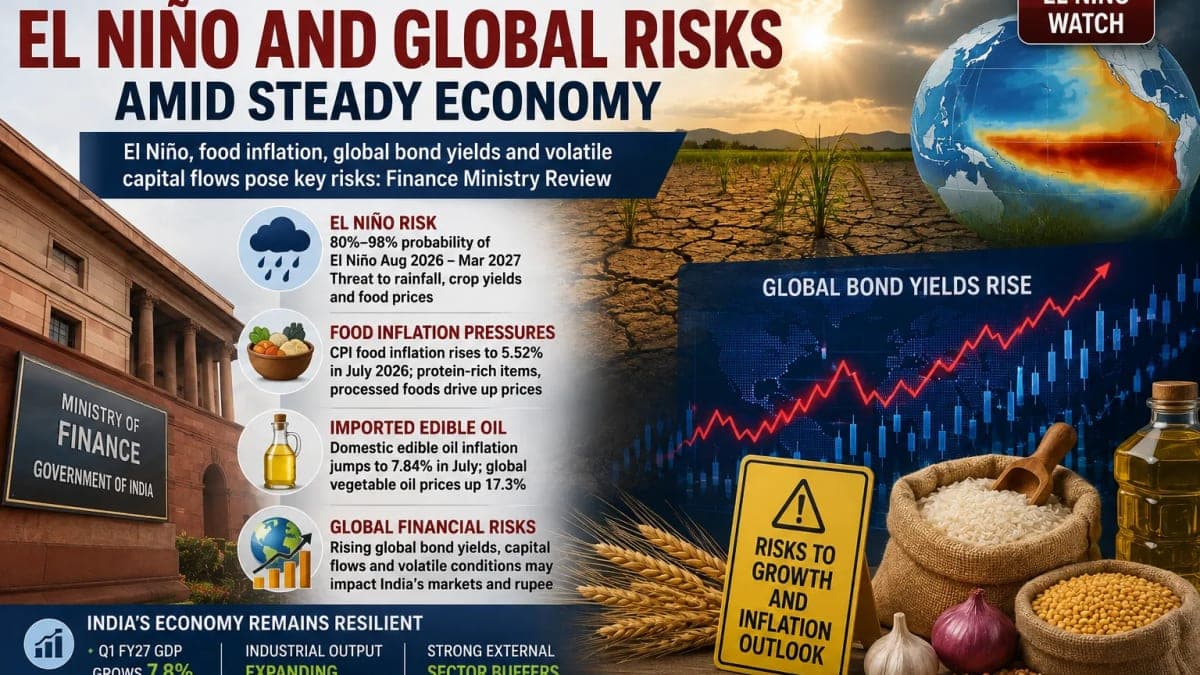
New Delhi, September 1, 2026: India’s economy continues to demonstrate resilience despite global uncertainty, but an intensifying El Niño, changing food-price pressures and volatile international financial conditions could complicate the outlook in the coming months, according to the Finance Ministry’s latest Monthly Economic Review.
The ministry said economic activity, inflation and India’s external position have remained “relatively stable” despite external risks, with resilient domestic demand continuing to support activity.
At the same time, the August review struck a cautious note on agriculture and food inflation. El Niño conditions are expected to intensify and potentially peak in late 2026, creating risks for rainfall-sensitive crops and conditions affecting the upcoming Rabi season.
Global developments present another layer of uncertainty. The ministry is monitoring international sovereign bond yields and investment flows, as movements in global interest rates could affect Indian bond yields, the rupee and capital markets.
El Niño Emerges as a Key Domestic Risk
One of the clearest warnings in the Finance Ministry’s review concerns the weather.
The latest Special El Niño Outlook Bulletin from the Indian National Centre for Ocean Information Services (INCOIS) confirmed that El Niño conditions had developed over the central Pacific by July 2026.
According to the outlook cited by the ministry, there is an 80%–98% probability of El Niño remaining the dominant El Niño–Southern Oscillation phase between August 2026 and March 2027.
The Finance Ministry cautioned:
“The persistence of El Nino raises the risk of a weaker or uneven monsoon and, consequently, of pressure on crop yields and food prices.”
The ministry, however, did not suggest that El Niño automatically means poor agricultural performance.
It specifically noted that the relationship between El Niño and agricultural outcomes is not one-to-one. Irrigation coverage, government procurement systems and food stocks can provide important buffers against weather-related disruptions.
Pulses, Oilseeds and Rice Require Attention
The Finance Ministry said particular attention may be needed for pulses, oilseeds, rice and other rainfall-sensitive crops in the months ahead.
An intensifying El Niño could affect crop yields during critical flowering and grain-formation stages. It could also influence soil-moisture and temperature conditions relevant to the upcoming Rabi crop cycle, including major crops such as wheat and mustard.
That makes the weather outlook economically important beyond agriculture.
If adverse conditions significantly reduce food production, higher prices could affect household budgets and potentially limit consumers’ ability to spend on discretionary non-food products and services.
However, this remains a risk scenario rather than a confirmed outcome.
Food Inflation Is Changing in Composition
India’s food inflation challenge is also changing.
Consumer Food Price Index-based inflation increased to 5.52% in July 2026 from 5.32% in June.
According to the Finance Ministry’s review, protein-rich products and processed foods emerged as important contributors to food and beverage inflation during July.
Fruits and nuts continued to add inflationary pressure, while the contribution from cereals and cereal products increased between April and July.
Several products — including milk, chicken, mutton, fish, refined oil, onion and arhar/tur — recorded notable inflation during July compared with the preceding month.
The numbers indicate that food-price risks are no longer concentrated solely in vegetables.
Imported Edible Oil Becomes Another Inflation Risk
Edible oils represent a particularly important vulnerability because India depends on imported crude palm, soybean and sunflower oils.
The Finance Ministry highlighted elevated international vegetable-oil prices.
The FAO Vegetable Oil Price Index recorded inflation of 17.3% in July 2026.
The impact has increasingly passed through to Indian consumers.
Domestic edible-oil inflation climbed from 2.82% in March to 7.84% in July, according to the review.
The ministry said this reflected the delayed transmission of higher landed import costs into retail prices, creating persistent upside risks for headline inflation.
Global vegetable-oil supplies have also been affected by the diversion of palm, soybean and rapeseed oils toward biofuel production as alternatives to petroleum diesel.
Global Bond Yields Put Markets on Watch
Weather is not the only concern.
The Finance Ministry is also closely monitoring sovereign bond yields across major global economies as governments finance fiscal spending and refinance debt.
The review highlighted two possible channels through which rising international yields could affect India.
Indian bond yields could rise alongside global yields. Alternatively, if domestic yields do not increase correspondingly, a narrowing interest-rate differential could create pressure on the Indian currency.
This makes movements in international bond markets relevant not only to government borrowing costs but also to exchange rates and foreign portfolio investment.
Capital flows therefore remain an important variable in India’s external outlook.
External Sector Provides Important Buffers
Despite these risks, the ministry’s assessment of India’s external position remains relatively reassuring.
The review said India remains well positioned to absorb pressures created by changing global trade patterns and volatile international financial conditions.
Although the current account deficit widened marginally during the first quarter of FY27, subsequent recovery in capital flows, a resilient services surplus and comfortable foreign-exchange reserves provide important buffers.
These safeguards could become particularly important if global financial markets experience another period of heightened volatility.
Domestic Demand Keeps Economy on Firmer Ground
The Finance Ministry’s warning should therefore not be interpreted as a prediction of an economic downturn.
Its central assessment remains that domestic activity is steady.
The report said:
“Domestic economic activity remains steady, with resilient domestic demand providing support amid some moderation in the pace of expansion.”
India’s industrial sector has also remained resilient despite the difficult international environment, with manufacturing continuing to expand.
Data for the first quarter of FY27 showed capital goods output expanding 14%, while intermediate goods grew 8.5% and infrastructure/construction goods increased 6.8%.
Consumer durables recorded growth of 7.2%, while consumer non-durables increased 1.5%.
Separately released national accounts data showed India's economy expanded 7.8% in the April-June quarter of FY27, reinforcing the picture of strong domestic economic momentum.
Why the Finance Ministry’s Warning Matters
The latest review presents an economy facing two different sets of forces.
Domestically, resilient demand, manufacturing activity and external-sector buffers are providing stability.
Externally, India remains exposed to developments it cannot fully control — including international interest rates, commodity prices, geopolitical uncertainty and global capital movements.
El Niño introduces another variable because agriculture continues to influence rural incomes and food inflation, which in turn can affect household consumption.
This combination means strong headline economic growth does not eliminate downside risks.
Instead, policymakers may increasingly have to balance supporting growth with containing food-price pressures and maintaining financial stability.
What to Watch in the Coming Months
The intensity and duration of El Niño will be among the most important indicators to watch through late 2026 and into early 2027.
Crop performance — particularly for pulses, oilseeds, rice, wheat and mustard — will help determine whether weather risks translate into meaningful food-price pressure.
Global vegetable-oil prices will also matter because of India's reliance on imports.
Outside agriculture, investors will be watching movements in global sovereign bond yields, foreign capital flows, the rupee and international commodity markets.
For now, the Finance Ministry’s assessment remains one of cautious resilience: India's domestic economic foundations remain relatively stable, but climate and global financial risks could test that strength over the coming months.