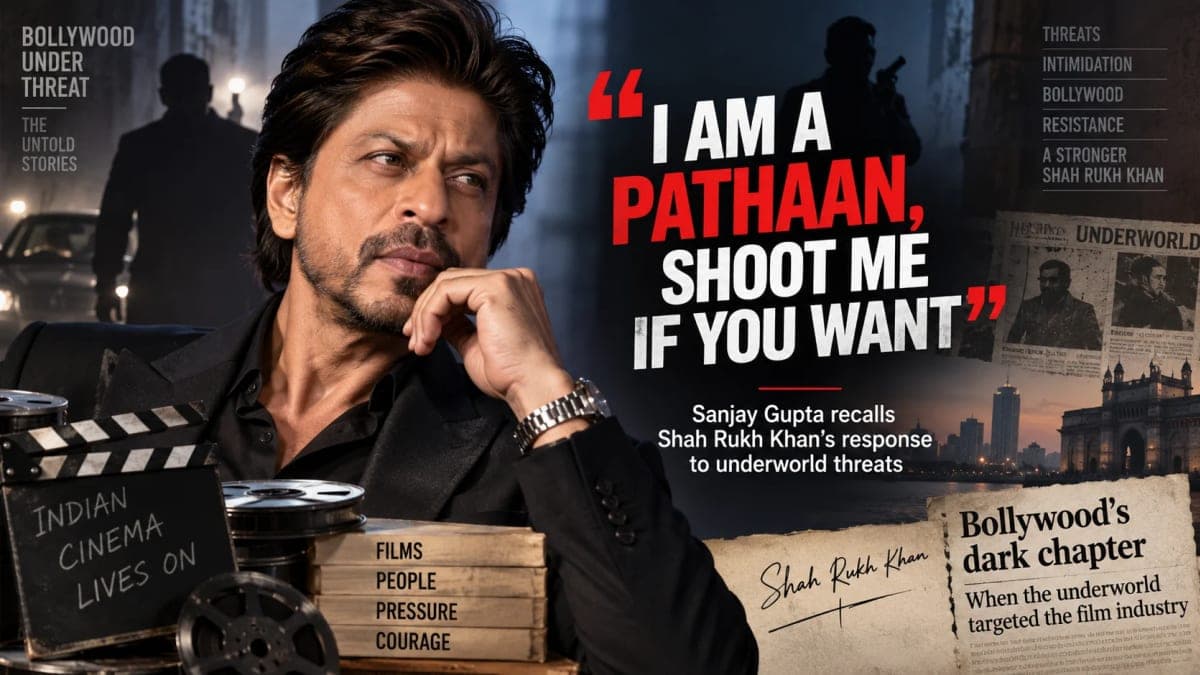
Sanjay Gupta recalls a turbulent period in Bollywood
For much of today’s Bollywood audience, stories of gangsters attempting to influence films belong to another era. For people working in the industry in the 1990s and early 2000s, the threat could be much more immediate.
Filmmaker Sanjay Gupta has returned to that period while discussing Shah Rukh Khan and the pressure leading actors faced from organised crime.
Speaking on the Hussain Zaidi Files podcast, Gupta recalled Khan being threatened after refusing demands connected to films and shows. According to the filmmaker, Khan would not allow intimidation to determine the work he accepted.
Gupta quoted him as saying: “I will never do the film or show, I am a Pathaan, just shoot me if you want.”
It is a striking line, but its provenance matters. Gupta was recounting events from more than two decades ago. The precise conversation has not been independently documented, so the quote is best understood as his recollection of Khan’s response rather than a verified transcript.
What is considerably better established is the threatening environment in which Khan and other members of the Hindi film industry were working.
Khan has spoken about the threats himself
Khan addressed the subject years ago during an interview with British comedian and presenter Ruby Wax.
When asked whether he had received death threats, the actor said he had faced them “on many occasions.” He also said he had been given extensive security for around three years.
His account stripped away some of the mythology that can surround stories from this period. Khan acknowledged that the threats were frightening while also describing the pressure placed on actors over professional decisions.
The distinction is useful. Refusing a demand did not mean the danger was dismissed or treated casually. Security became part of Khan’s life precisely because the risk was taken seriously.
The Abu Salem account
One of the most detailed descriptions of Khan’s encounters with the underworld appears in Anupama Chopra’s King of Bollywood: Shah Rukh Khan and the Seductive World of Indian Cinema.
Chopra wrote that concerns about Khan’s safety intensified in 1997, when he was working on Mahesh Bhatt’s Duplicate. Police officer Rakesh Maria reportedly alerted Bhatt to a possible threat against the actor, after which Khan received protection.
The book also describes an alleged conversation between Khan and gangster Abu Salem over the actor’s refusal to work on a particular film.
According to Chopra’s account, Khan told Salem: “I don’t tell you who to shoot so don’t tell me which film to do.”
The episode is relevant to Gupta’s more recent recollection because both accounts describe essentially the same boundary. Khan was prepared to acknowledge the threat, but not to hand over decisions about his career.
Karan Johar remembers being threatened before Kuch Kuch Hota Hai
Khan was not the only person around him dealing with intimidation.
Karan Johar wrote in his autobiography An Unsuitable Boy about receiving a threat around the release of his 1998 directorial debut, Kuch Kuch Hota Hai.
Johar recalled Khan responding protectively when he learned about the danger. According to the filmmaker, Khan told him: “I’m standing here in front of you. Let’s see who shoots you.”
Johar also wrote that Khan reassured his mother and treated his safety as a personal responsibility.
The accounts differ in their circumstances and sources, but together they provide a picture of an industry in which security concerns could intrude directly into filmmaking, releases and professional relationships.
When Bollywood faced a genuine security problem
That context is easy to lose when old stories resurface primarily through memorable quotes.
The late 1990s and early 2000s were marked by a series of violent incidents involving figures connected to the entertainment business.
T-Series founder Gulshan Kumar was shot dead in Mumbai in 1997. Filmmaker Rakesh Roshan survived an attack outside his office in 2000. Ajit Dewani, who worked as Manisha Koirala’s secretary, was killed in 2001.
Law-enforcement agencies were also investigating alleged links between organised crime and film financing.
The Chori Chori Chupke Chupke case became one of the period’s most prominent examples. Financier Bharat Shah and producer Nazim Rizvi were arrested amid allegations involving underworld connections.
Against that backdrop, threats made to actors could not simply be dismissed as aggressive phone calls. Producers, stars and other industry figures had reason to take them seriously.
Why the ‘Pathaan’ remark needs context
The wording of Gupta’s recollection has acquired an additional layer of meaning because of Khan’s later career.
In 2023, the actor starred in Siddharth Anand’s Pathaan, one of the major films of his post-pandemic comeback. The events Gupta was describing, however, predate that movie by decades.
There is no connection between the reported remark and the title of the 2023 film.
Gupta had also spoken publicly about Khan’s response to underworld pressure before his latest podcast appearance, including in 2023. The current discussion therefore revisits and expands an existing account rather than revealing the story for the first time.
That chronology is worth preserving because the overlap between the quote and the film title makes an otherwise straightforward historical anecdote easy to sensationalise.
The history matters more than the one-liner
Gupta’s recollection has travelled because the quote is memorable. The more revealing part of the story is what surrounded it.
Khan has personally acknowledged receiving repeated death threats and living with substantial security. Published accounts have described attempts to pressure him over professional choices. Other filmmakers have documented their own experiences with threats during the same period, while shootings and killings demonstrated that the risks facing the industry were not theoretical.
None of that requires every dramatic line attributed to Khan years later to be treated as verbatim historical record.
Gupta’s “I am a Pathaan” remark belongs within that distinction. It is his account of how Khan responded to intimidation. The precise wording remains a recollection, while the broader history of threats surrounding Khan and Bollywood during that period is much more firmly documented.