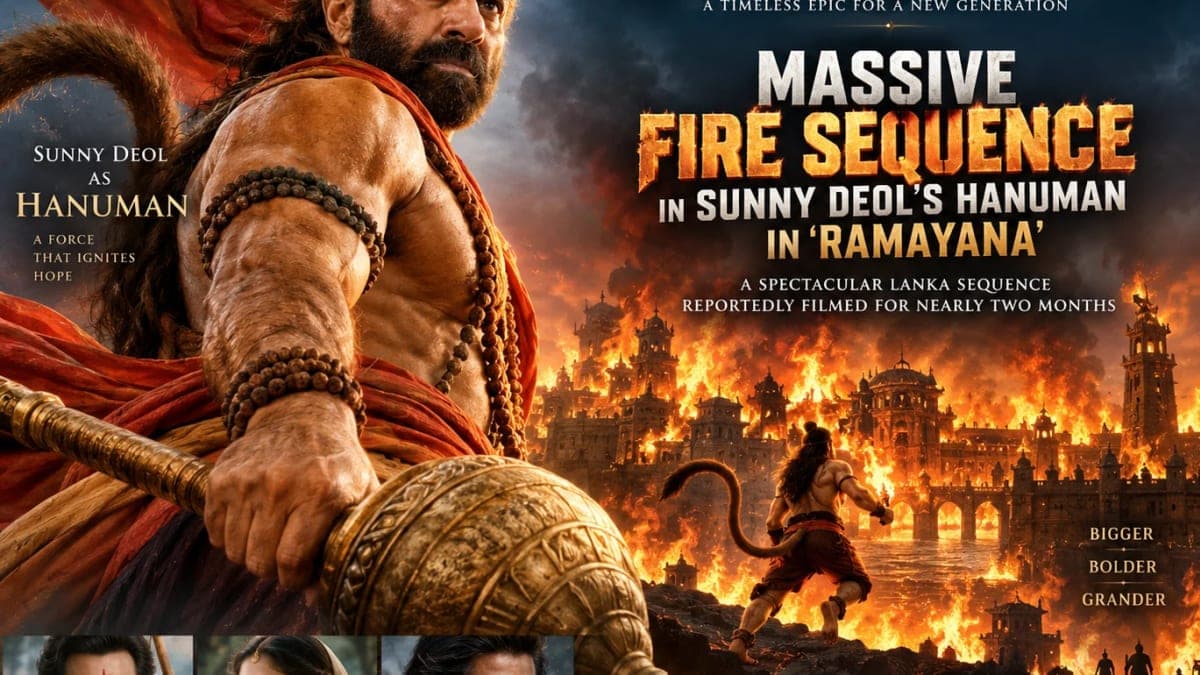
Sunny Deol has barely been seen as Hanuman in the promotional material for Nitesh Tiwari’s Ramayana. Behind the scenes, however, the production has been working on an extensive set-piece built around the character.
The burning of Lanka reportedly required nearly two months of filming, with the crew using controlled practical flames alongside visual effects. Rishabh Tyagi, who worked on the film’s action and weapons-related production, has described it as the largest fire sequence he has worked on.
Tyagi also suggested that its scale could place it among the biggest fire sequences attempted in Indian cinema. That comparison is his assessment rather than an independently established industry record, but the reported shooting schedule offers some indication of the complexity involved.
Practical Flames Form the Base of Lanka Sequence
Rather than creating the entire spectacle digitally, the production reportedly filmed substantial fire elements on set.
Controlled LPG-based systems were used to produce flames that could be regulated during shooting. That gave the crew practical fire to photograph around sets and performers while retaining greater control over its intensity and timing.
Visual effects are expected to extend those elements in the finished film, particularly where the scale of Lanka and the destruction surrounding Hanuman cannot safely or practically be achieved during live filming.
The approach reflects a broader trend in effects-heavy filmmaking: physical elements provide performers and cinematographers with something tangible on set, while digital work expands the environment beyond the limits of the physical production.
In Ramayana, that combination will be particularly important. The Lanka episode demands not simply a large amount of fire but a convincing sense of an entire city being consumed by it.
Why the Sequence Matters for Hanuman
The scale of the production is also tied to where Hanuman sits within the larger story.
Deol is not expected to dominate the first film. Reports have indicated that his proper introduction may be reserved for the closing portion of Ramayana: Part One, potentially setting up a substantially larger role in the second instalment.
The filmmakers have so far been careful not to reveal much of his appearance.
Footage screened at CinemaCon 2026 in Las Vegas reportedly included a brief look at Deol as Hanuman, but the character was subsequently kept out of the main trailer. The exact point at which he enters the first film has not been officially detailed.
Holding the character back would allow the production to treat Hanuman's arrival as a bridge between the two parts rather than simply another introduction in an already large ensemble.
It would also place sequences such as the burning of Lanka where they naturally carry greater narrative weight.
Months of Planning Before the Cameras Rolled
The fire sequence did not emerge from an improvisational approach on set.
Cinematographer Pankaj Kumar has spoken about the extensive pre-production undertaken for Ramayana, including the use of virtual animation to map scenes before principal photography.
Kumar and Tiwari worked through shots during that process, allowing the team to decide how physical sets, camera movements, performers and later visual-effects work would fit together.
That preparation becomes especially useful for a sequence involving controlled fire. Practical flames introduce restrictions that ordinary dialogue or action scenes do not: actors must work within carefully planned areas, camera positions have to account for safety, and individual shots need to connect with effects that may not be completed until post-production.
For a set-piece reportedly occupying close to two months of filming, much of the work would therefore have been determined long before the flames were switched on.
A Large Ensemble Built Around the Epic
Tiwari’s adaptation has assembled several major names around its central characters.
Ranbir Kapoor plays Ram opposite Sai Pallavi as Sita, while Yash portrays Ravana. Deol takes on Hanuman, with the wider cast also including Ravie Dubey, Lara Dutta, Rakul Preet Singh, Arun Govil and Vivek Oberoi.
The size of the cast is matched by the production's two-film structure, giving the filmmakers considerably more room than a conventional single feature to develop the central conflict and its supporting characters.
That is particularly relevant to Deol. If Hanuman's substantial material is concentrated in the latter stages of the story, audiences may see relatively little of him initially despite the scale of the sequences being filmed for the character.
‘Ramayana’ Begins Its Two-Part Theatrical Run in November
Ramayana: Part One is scheduled for a worldwide theatrical release on November 6, 2026, around the Diwali period in India. The second instalment is planned for Diwali 2027.
Until then, much of the attention surrounding Deol's Hanuman will rest on production accounts rather than finished footage.
The reported Lanka shoot offers a clearer picture of what the filmmakers are attempting. Its importance is not simply that a large amount of fire was used or that filming took weeks. The more consequential choice is the decision to build a substantial physical foundation for a sequence that could easily have been treated primarily as a digital spectacle.
How much of that practical work survives into the finished images will become apparent when audiences finally see Hanuman and Lanka on the big screen.