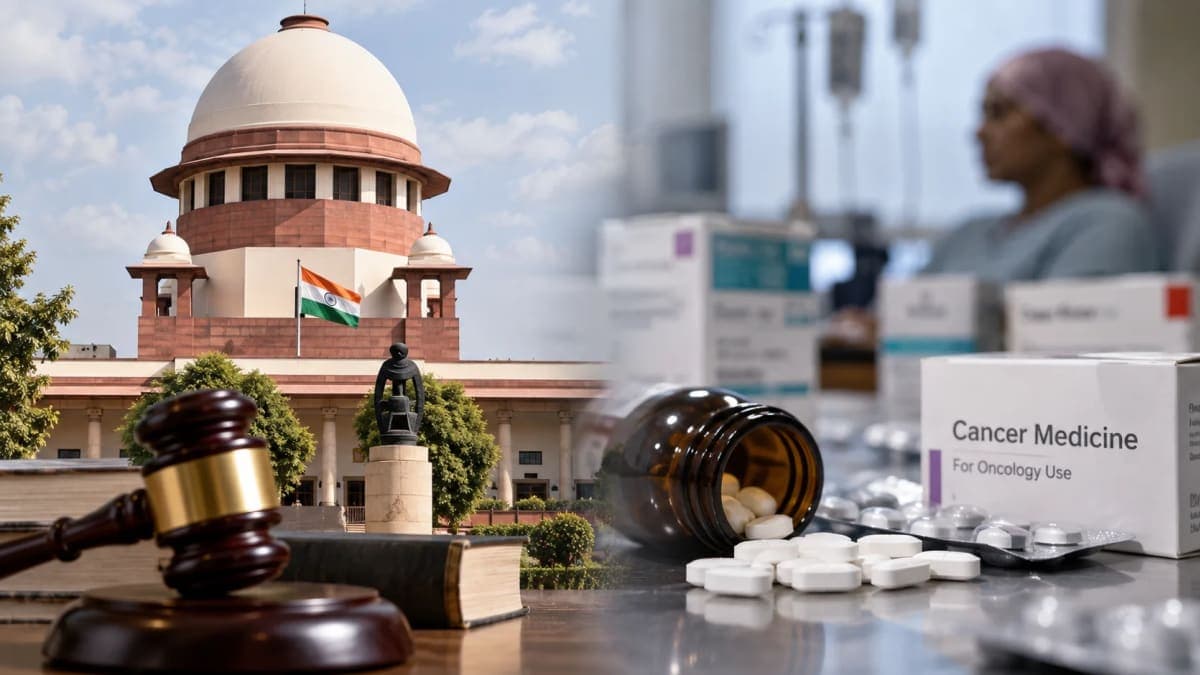
Supreme Court Questions 10x Gap in Cancer-Drug Pricing, Seeks Answers on Price Controls
NEW DELHI, September 23, 2026: The Supreme Court has questioned what it described as an alarming disparity in medicine pricing after being told that an essential cancer drug with a Price to Retailer (PTR) of ₹2,700 carried a Maximum Retail Price (MRP) of ₹27,000 — ten times the retailer price.
A Bench of Justices Vikram Nath and Sandeep Mehta raised the issue on Tuesday while hearing petitions concerning medicine-price regulation, generic prescribing, medical devices and the pricing of drugs that fall outside scheduled price controls.
Justice Mehta described the example before the Court as “broad daylight dacoity with the patients”, questioning how such a large gap could exist for an essential cancer medicine.
The Court's remarks put a spotlight on a broader issue: not simply what a medicine costs at the pharmacy counter, but how its printed MRP is determined and how much room India's regulatory framework leaves for margins across the pharmaceutical supply chain.
₹2,700 PTR, ₹27,000 MRP: What the Court Questioned
The cancer-drug example cited before the Bench showed a particularly striking difference:
Price to Retailer: ₹2,700
Maximum Retail Price: ₹27,000
Difference: ₹24,300
MRP/PTR ratio: 10 times
PTR and MRP are not expected to be identical. PTR generally refers to the price at which a medicine is supplied to a retailer or pharmacy, while the MRP represents the maximum amount that can be charged to the consumer. Distribution and retail margins can therefore create a difference between the two.
The Supreme Court's concern was about the scale of that difference in examples presented during the proceedings. Other examples reportedly placed before the Court included a medicine with an MRP of ₹73 and PTR of ₹22.75, and another carrying an MRP of ₹61 against a PTR of ₹9.65.
Court Highlights Financial Pressure on Cancer Patients
The Bench connected medicine pricing with the severe financial burden that serious illnesses can impose on families.
Justice Mehta remarked:
“People sell their houses, people sell their ornaments for getting the medicines.”
The Court questioned why authorities responsible for addressing the issue had not acted against disparities of the magnitude cited during the hearing.
The observations are particularly significant for cancer treatment, where patients may require multiple medicines and repeated treatment cycles, making even individual drug-price differences financially consequential.
Ayushman Bharat and the Cost to Taxpayers
The Court also examined the implications for publicly financed healthcare.
It observed that when treatment is provided under government health programmes such as Ayushman Bharat, hospitals can purchase medicines and subsequently seek reimbursement. In such circumstances, excessive prices would not affect only individual patients; public funds could ultimately bear the cost as well.
This expands the pricing question beyond affordability for individual patients to the efficiency of government healthcare expenditure.
Scheduled vs Non-Scheduled Medicines: Why It Matters
A major issue in the case concerns India's Drugs (Prices Control) Order, 2013 (DPCO).
Under the current framework, the National Pharmaceutical Pricing Authority (NPPA) fixes ceiling prices for medicines covered by Schedule I of the DPCO, which is linked to the National List of Essential Medicines.
The petitioners, however, focused attention on non-scheduled medicines.
Petitioner Kishan Chand Jain argued before the Court that while subsequent price increases for non-scheduled drugs are restricted, their initial launch prices are not subjected to the same kind of ceiling-price mechanism. He contended that this creates room for high initial MRPs and substantial trade margins.
These are submissions by the petitioner, rather than findings finally determined by the Supreme Court.
Government Says 131 Anti-Cancer Drugs Have Effective Ceiling Prices
Government data provides important context to the debate.
In a March 13, 2026 response, the government said that 131 anti-cancer drugs had effective ceiling prices as of March 9, 2026.
According to the government, these controls had produced an approximately 21% reduction in ceiling prices compared with those fixed under the National List of Essential Medicines 2015 framework, generating estimated annual patient savings of about ₹294 crore.
The government also stated that the NPPA had fixed 58 retail prices in the anti-cancer therapeutic category, covering 31 anti-cancer drugs, 26 anti-neoplastic drugs and one immunosuppressive drug as of March 9.
For non-scheduled anti-cancer formulations, manufacturers cannot increase the MRP by more than 10% of the formulation's MRP during the preceding 12 months, according to the government's description of the existing rules.
That distinction is central to the dispute before the Court: controls on later price increases do not necessarily answer the petitioners' concerns about how the initial price of a non-scheduled medicine is determined.
Pharma Industry Points to Retail and Hospital Margins
The hearing also brought out another side of the pricing debate.
Senior Advocate Kapil Sibal, representing the Indian Pharmaceutical Alliance, argued that pharmaceutical manufacturers themselves were not retaining the large margins being discussed and that the issue needed to be examined at the stockist, retailer and hospital levels.
Sibal told the Court that the price at which medicines are sold to stockists was an important part of understanding where the margins arise.
Justice Mehta, however, pointed to the manufacturer's role in fixing the MRP, highlighting why the Court wanted the entire pricing chain examined.
The exchange is important because a large PTR-to-MRP difference does not by itself establish which participant in the supply chain ultimately receives the entire difference.
Centre Says It Is Open to Improvements
Additional Solicitor General K M Nataraj, appearing for the Union government, told the Court that the Centre was not approaching the proceedings as an adversarial dispute and was willing to consider areas where the system could be improved.
He also referred to the Pradhan Mantri Bhartiya Janaushadhi Pariyojana, which provides lower-cost medicines through Janaushadhi Kendras.
The Court questioned what options remain for patients when the medicine they need is unavailable through those outlets.
Generic Medicines and Medical Devices Also Under Scrutiny
The proceedings extend beyond the specific cancer-drug example.
The petitions raise broader questions involving generic prescriptions, price regulation for non-scheduled medicines, medical-device MRPs and excessive trade margins.
One submission also raised concerns about the quality and reliability of generic medicines and argued that patients should retain a choice between generic and branded products.
The Court has not delivered a final ruling on these broader questions.
What Happens Next?
The Supreme Court has scheduled the matter for further hearing on September 29, 2026, when submissions from the Indian Pharmaceutical Alliance and the Union government are expected to continue.
For now, the ₹2,700-versus-₹27,000 example has brought renewed attention to a fundamental policy question: how should India balance pharmaceutical pricing, distribution margins and commercial considerations while ensuring that essential medicines remain affordable for patients?
The Court's observations are part of ongoing proceedings and should not be treated as a final judicial finding that every cancer drug, or the pharmaceutical industry generally, carries a ten-fold markup.