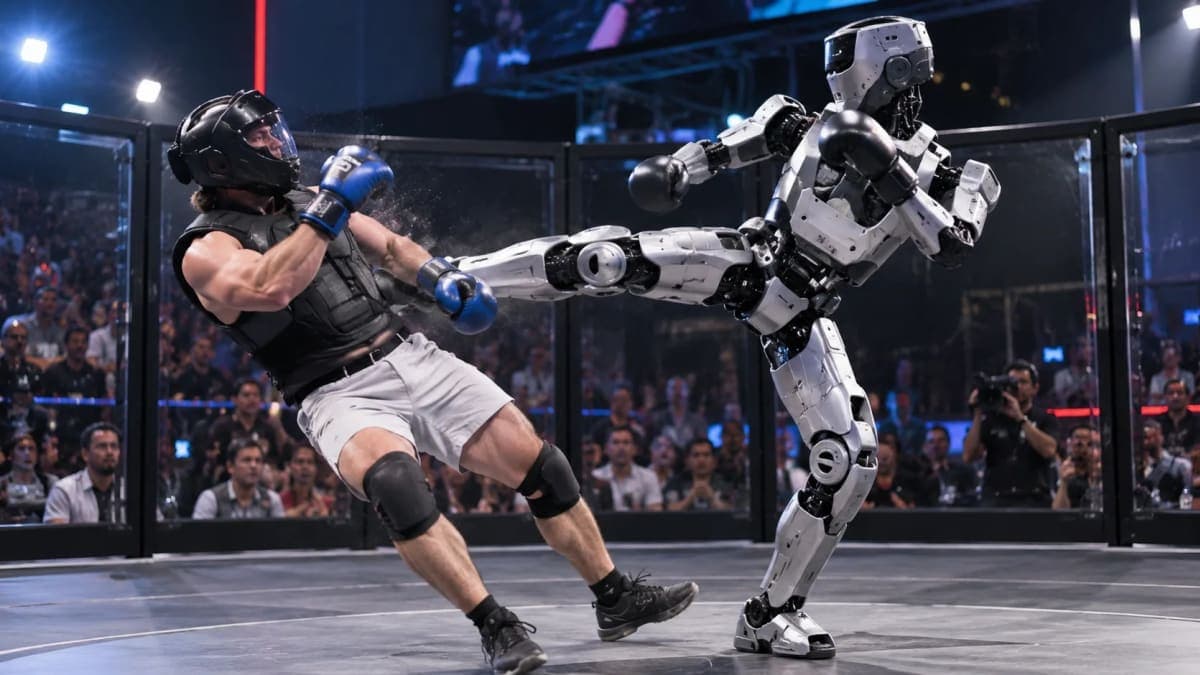
Frankie LaPenna Faces 6-Foot Humanoid Robot in Viral Cage Fight
A striking human-versus-machine confrontation has gone viral after American content creator Frankie LaPenna stepped inside a fighting cage with a roughly six-foot humanoid robot.
Footage released by Robot Entertainment Kombat (REK) shows LaPenna exchanging strikes with the machine as spectators watch from outside the transparent cage. During the encounter, the robot responds to LaPenna's punches with kicks powerful enough to send him backwards across the fighting area.
REK promoted the spectacle as its first human-versus-humanoid robot fight, writing:
“We just made history with the first Human VS Terminator robot fight.”
The company added that LaPenna “gave it his all” and said additional fight footage would be released.
What Happened During the Human vs Robot Fight?
The encounter took place on September 18, 2026, with multiple reports placing the event in San Francisco. LaPenna entered the enclosure wearing protective equipment before confronting the full-size humanoid machine.
The footage shows the robot moving around the cage before the action begins.
LaPenna then attacks with a series of punches. The humanoid responds with punches and kicks of its own. Some of its kicks visibly push or knock LaPenna across the cage, demonstrating the considerable physical force a full-size humanoid can generate.
REK later indicated in a social-media response that LaPenna continued fighting and ultimately “defeated this robot.”
That detail is important because short viral clips showing LaPenna being knocked backwards can create the impression that the robot necessarily won the overall encounter.
The Robot Was Controlled by a Human — Not Autonomous AI
The most important context surrounding the viral footage is that this was not an autonomous artificial-intelligence system independently deciding how to fight LaPenna.
REK's robot-combat concept involves humans remotely operating humanoid robots. The company is developing a combat-entertainment format in which human pilots can control robots in physical competitions.
REK's normal system uses human pilots operating robots through control hardware such as virtual-reality equipment or gamepads, while software can assist with lower-level functions including movement and balance.
That distinction substantially changes what the viral video demonstrates.
The event showcases advances in robot mobility, balance, physical control and teleoperation, but it should not be interpreted as evidence that an autonomous AI independently fought a human.
Was This Really the World's First Human vs Robot Fight?
REK has promoted the event as its first “Human VS Terminator robot fight,” while LaPenna and some media coverage have described the spectacle more broadly as a world's-first human-versus-robot battle.
The broader “world's first” description should be treated as an organiser or participant claim rather than an independently established historical fact.
Humanoid robots have already demonstrated boxing, martial-arts movements and human sparring in other settings. What makes the REK event distinctive is its presentation as a cage-fighting entertainment spectacle involving a full-size humanoid and a human participant.
Was the Robot a Unitree G1?
Some social-media posts discussing the viral fight have referenced Unitree Robotics' G1 humanoid, but that identification should not be assumed from the footage.
Unitree's own specifications show that the standard G1 stands 1,320 mm (1.32 metres) tall and weighs approximately 35 kg with its battery.
That is substantially smaller than the roughly six-foot robot described in reports about LaPenna's fight.
Some secondary reporting has identified the machine as an EngineAI T800, but unless confirmed directly by REK or the robot manufacturer, publishers should be cautious about assigning an exact model solely from visual similarity.
Why REK Is Putting Humanoid Robots in Fighting Cages
The event wasn't simply a technology demonstration.
REK has been developing robot combat as an entertainment format in which human pilots control humanoid machines during physical competitions. The organisation has previously staged robot-versus-robot matches, making the LaPenna event an extension of that concept to a human-versus-machine spectacle.
This approach also offers an unusually direct way to demonstrate what modern humanoids can physically do.
Instead of watching a robot perform a carefully choreographed laboratory demonstration, viewers can compare its size, balance and striking force against a familiar reference — a human body.
What the Viral Fight Actually Tells Us About Humanoid Robots
The footage is eye-catching, but separating the engineering achievement from the social-media framing provides a clearer picture of what happened.
The robot demonstrates that modern humanoid platforms can execute increasingly dynamic movements while interacting physically with their environment. Maintaining balance while moving, striking and recovering is a significant robotics challenge.
At the same time, the human operator remains central to this particular demonstration.
The viral fight therefore isn't evidence of an autonomous “Terminator” capable of independently confronting humans. Instead, it demonstrates something more immediate: humanoid hardware combined with increasingly sophisticated control systems is becoming capable of physically demanding movements that were difficult for robots only a few years ago.
For now, the person behind the controls remains an essential part of that equation.