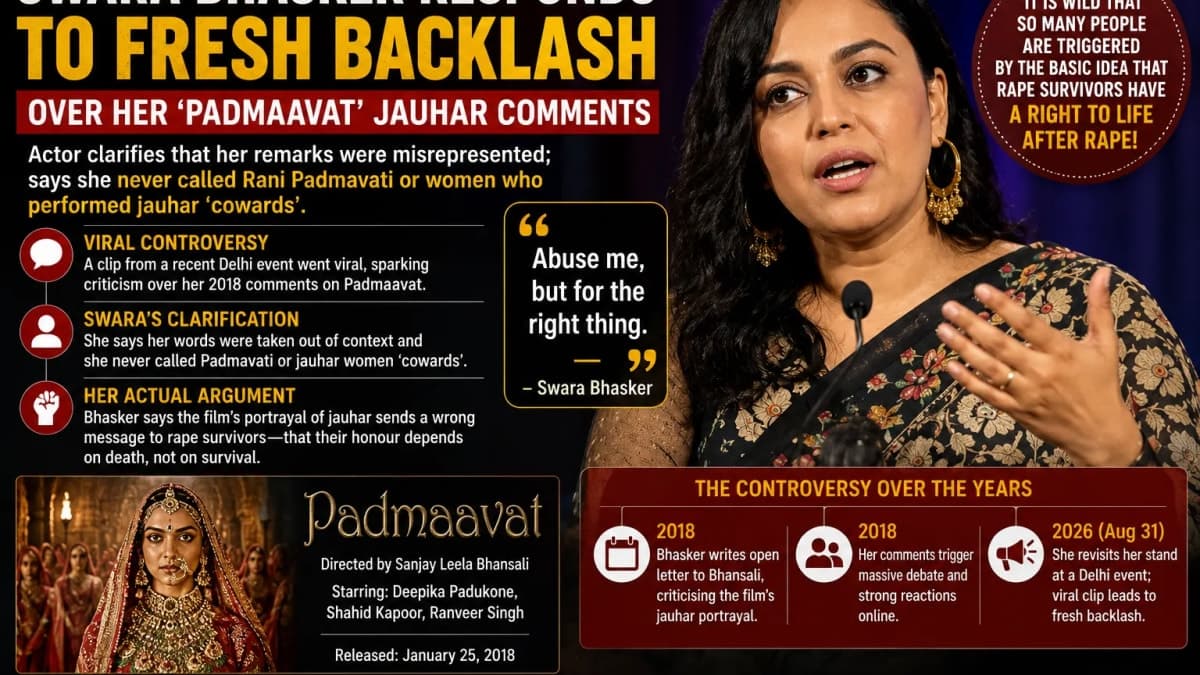
Actor Swara Bhasker has issued a clarification after facing a fresh wave of social-media criticism over her long-standing objections to the climactic jauhar sequence in Sanjay Leela Bhansali’s 2018 film Padmaavat.
The controversy returned after Bhasker discussed her original criticism of the film during the “Woman, Life, Freedom” talk at the India International Centre in New Delhi on August 31.
A video clip from the discussion subsequently circulated widely online, prompting criticism from users who accused her of describing Rani Padmavati and women who performed jauhar as cowardly.
Bhasker has rejected that interpretation.
In a video response, she said she had never called Rani Padmavati or the women who committed jauhar “cowards” and argued that her words were being presented without their intended context.
Her clarification has reopened a debate that first erupted nearly eight years ago—one involving cinema, history, sexual violence, women’s agency and the responsibilities involved in portraying traumatic historical narratives.
Swara Bhasker Says Her Words Were Misrepresented
Responding to the viral discussion, Bhasker said a misleading interpretation of her remarks was being circulated.
She maintained that her criticism was directed at the message of the film’s jauhar sequence, rather than at Rani Padmavati or the women depicted participating in it.
Bhasker said:
“Abuse me, but for the right thing.”
Her argument is that critics should challenge what she actually said rather than attribute a different statement to her.
She also described the controversy surrounding the viral interpretation of her remarks as a false narrative being created around her position.
The distinction is significant because several online posts characterised Bhasker as having directly labelled the historical women involved in jauhar as cowardly.
Bhasker explicitly denies making that argument.
What Swara Bhasker Actually Questioned
During the Delhi discussion, Bhasker revisited why she had been disturbed by the conclusion of Padmaavat.
Her concern centred on what the sequence might communicate to women who survive rape or sexual violence.
Explaining the thought that troubled her after watching the film, Bhasker said:
“God forbid if I was a rape survivor. What is this thing telling me? I would feel like a coward if I didn't kill myself to save my honour.”
Her criticism therefore focuses on the idea that a woman’s honour or worth should not be determined by sexual purity—or destroyed by sexual violence committed against her.
Bhasker questioned whether a survivor of rape should ever be made to feel that continuing to live represents dishonour.
That remains her central argument in the revived controversy.
‘Rape Survivors Have a Right to Life’
After criticism intensified online, Bhasker responded more forcefully on social media.
She wrote:
“It is WILD that so many people are triggered (women included) by the basic idea that rape survivors have a right to life after rape!”
The statement makes clear that Bhasker continues to stand by the central feminist argument behind her original criticism of Padmaavat.
Her position is that surviving sexual violence does not diminish a woman’s dignity, honour or right to continue living.
She has not withdrawn that argument despite the backlash.
Instead, she is contesting the interpretation that criticising the cinematic glorification of death means condemning women who faced extreme circumstances in historical narratives.
Why Did the Controversy Return After Eight Years?
The origins of the dispute go back to the release of Padmaavat in 2018.
Directed by Sanjay Leela Bhansali, the film starred Deepika Padukone as Rani Padmavati, Shahid Kapoor as Maharawal Ratan Singh and Ranveer Singh as Alauddin Khilji.
The film concludes with an elaborate jauhar sequence involving Padmavati and other women choosing mass self-immolation as Khilji’s forces approach.
After watching the movie, Bhasker wrote an open letter to Bhansali criticising the way she believed the sequence had been presented.
Her argument generated widespread controversy at the time.
During the August 31, 2026 discussion in Delhi, Bhasker was asked why she had written that letter.
Her explanation brought the eight-year-old dispute back into public conversation.
Viral Clip Triggers Strong Online Backlash
Once clips from the Delhi event began circulating online, a section of social-media users strongly criticised Bhasker.
Some accused her of ignoring the historical circumstances in which jauhar is described as having occurred.
Critics argued that women facing defeat, captivity and the threat of sexual violence during warfare were confronting circumstances fundamentally different from those faced by survivors of sexual assault in contemporary society.
Some users therefore argued that Bhasker’s comparison failed to account adequately for the historical context.
Others defended jauhar, within that historical framework, as an act undertaken in the face of extreme brutality rather than an expression of cowardice.
These are arguments advanced by Bhasker’s critics and should not be confused with independently established conclusions about the historical events represented by Padmaavat.
Some online responses also became personal and abusive, moving beyond disagreement with her interpretation of the film.
Swara: I Never Called Padmavati a Coward
Bhasker’s latest clarification focuses particularly on one accusation.
She says she never called Rani Padmavati a coward.
Instead, she says she had imagined herself in the position of a rape survivor watching the film and questioned whether the glorification of death could make such a survivor feel ashamed for choosing to live.
That difference between the two statements is central to understanding the controversy.
Saying that a survivor could be made to feel cowardly for surviving is not the same as saying that the women who chose jauhar were cowards.
Bhasker argues that the two ideas have been conflated in the viral discourse surrounding her remarks.
Why Bhasker Originally Objected to ‘Padmaavat’
Bhasker’s disagreement with Padmaavat has always extended beyond whether jauhar historically occurred.
Her criticism concerns how cinema frames such an act.
The issue, from her perspective, is whether a visually grand cinematic presentation can transform an act rooted in extreme violence and desperation into an ideal of feminine honour.
This creates a broader question about representation.
A filmmaker can depict a historical or legendary event without necessarily endorsing it. At the same time, viewers can interpret cinematography, music, dialogue and emotional framing as celebration, condemnation or something more ambiguous.
Bhasker’s argument is essentially that she interpreted the film’s climax as romanticising jauhar and found that message troubling from the perspective of women who survive sexual violence.
Others strongly disagree with that reading.
Critics Say Historical Context Cannot Be Ignored
Those challenging Bhasker’s argument have focused heavily on historical context.
They contend that jauhar cannot be evaluated solely through the framework of modern individual choice because accounts of the practice are connected with warfare, defeat, threatened captivity, sexual violence and enslavement.
From this perspective, critics argue that the women involved were responding to an extreme situation in which ordinary alternatives were unavailable.
That argument explains why some social-media users objected strongly to the analogy involving contemporary rape survivors.
However, Bhasker’s counterargument is not that women facing those historical circumstances should be condemned.
She says her concern is about how their deaths are represented and interpreted by audiences today.
The dispute is therefore partly a disagreement over two different questions: what choices women may have faced historically, and what meaning a modern film should attach to those choices.
‘Padmaavat’ Was Controversial Even Before Its Release
The renewed controversy also arrives against the backdrop of the extraordinary disputes surrounding Padmaavat itself.
Before its January 2018 release, the film faced protests from groups that accused the production of disrespecting Rani Padmavati.
Bhansali and the filmmakers rejected claims that the movie contained objectionable material involving the queen and Alauddin Khilji.
The controversy led to protests, threats and intense debate before audiences had even seen the finished film.
The movie was originally titled Padmavati before being released as Padmaavat.
After release, another debate emerged—this time over the film’s politics, gender representation and treatment of jauhar.
Bhasker’s open letter became one of the most widely discussed interventions in that second debate.
History, Legend and Cinema Make the Debate More Complicated
Another important layer is that Padmaavat is a cinematic work rather than a historical documentary.
The story of Padmavati is closely associated with Malik Muhammad Jayasi’s 16th-century epic poem Padmavat, written centuries after the period in which Alauddin Khilji ruled.
Historians and scholars have long debated the historical foundations of the Padmavati narrative and the relationship between literary tradition and verifiable history.
That distinction matters when evaluating claims surrounding the film.
Discussions about Padmaavat often combine three separate subjects: the historical practice of jauhar, the literary legend of Padmavati and Bhansali’s modern cinematic interpretation.
Treating all three as identical can oversimplify the controversy.
The Bigger Question: Can Depiction Become Glorification?
The renewed argument around Bhasker ultimately raises a question larger than one actor or one film.
When does depicting a historical practice become glorifying it?
Cinema frequently portrays war, suicide, violence, sacrifice and oppression.
The presence of those acts on screen does not automatically mean a filmmaker endorses them.
But presentation matters.
Music, visual grandeur, dialogue, camera movement and emotional framing influence how audiences understand what they see.
Bhasker interpreted Padmaavat’s jauhar sequence as problematic because she believed its emotional and visual presentation risked turning death into a symbol of feminine honour.
Her critics interpret the same sequence differently—as an attempt to portray the extreme circumstances and choices faced by women within the story.
Both readings explain why the scene remains contentious eight years after the movie’s release.
Why the Fresh ‘Padmaavat’ Debate Matters
The latest controversy demonstrates how easily debates around historical cinema can shift from the original argument to disputes about what someone supposedly said.
In this case, the most important factual distinction is straightforward:
Swara Bhasker continues to criticise the way Padmaavat portrays jauhar, but she says she did not call Rani Padmavati or the women who committed jauhar cowards.
Her stated concern is about survivors of sexual violence and the idea that a woman’s honour should never depend on whether she dies rather than survives rape.
Her critics, meanwhile, argue that interpreting jauhar through that framework overlooks the specific historical circumstances associated with warfare, captivity and sexual violence.
The disagreement is unlikely to disappear because it involves fundamentally different ways of interpreting history, cinema and women’s agency.
Eight years after Padmaavat first sparked debate, the latest controversy shows that its final sequence—and the questions surrounding how cinema represents honour, survival and violence against women—continues to generate sharply divided reactions.