Tata Sons Listing Could Unlock SP Group’s Biggest Asset — and Change the Math on Its ₹60,000 Crore Debt
A regulatory decision involving Tata Sons has unexpectedly put the finances of another century-old business group back in focus.
The Reserve Bank of India has rejected Tata Sons’ request to surrender its registration as a core investment company, according to Reuters and other reports, keeping the Tata Group holding company within the regulatory framework that has pushed it towards a stock-market listing. Tata Sons has been classified as an Upper Layer non-banking financial company, a category subject to tighter regulatory requirements.
For the Shapoorji Pallonji Group, the implications could be substantial.
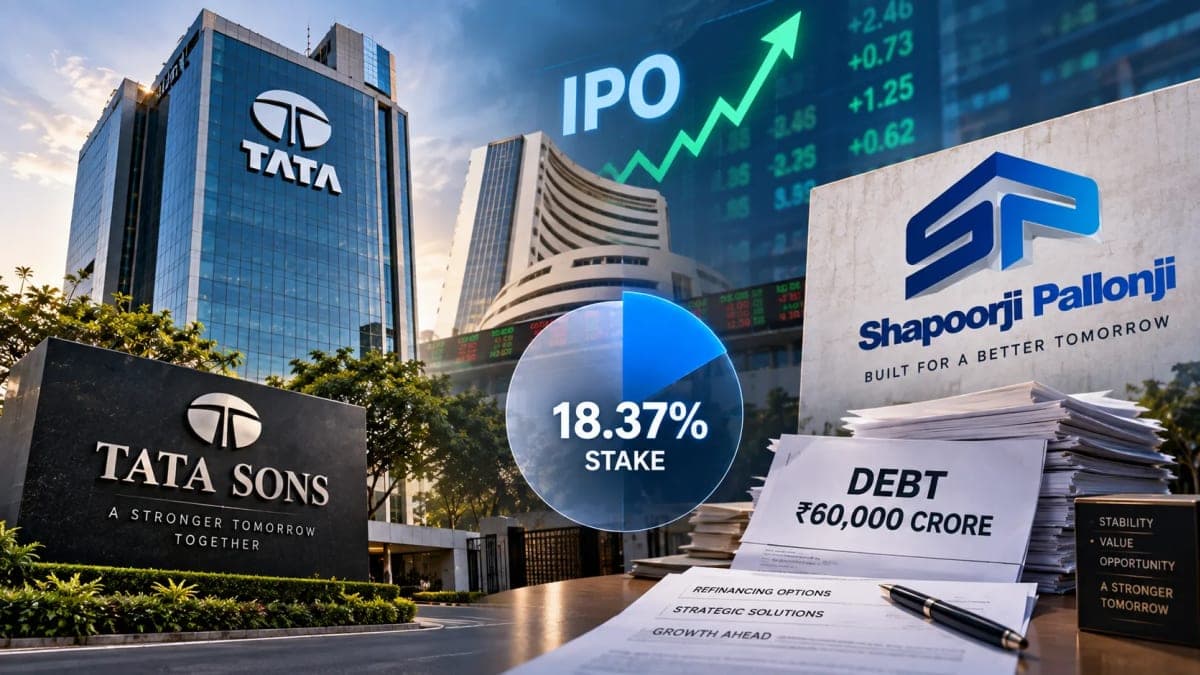
The Mistry family-controlled group owns 18.37% of Tata Sons, its single most important financial asset. Yet because Tata Sons is privately held, turning even a small part of that stake into cash has been difficult and has repeatedly become entangled in valuation, governance and transaction-structure disputes.
That constraint matters because SP Group has spent years refinancing expensive borrowings. The group is estimated to carry about ₹60,000 crore of debt, while another roughly ₹3,500 crore repayment is due by the end of September 2026, according to recent reports.
A Tata Sons listing would not erase those liabilities. It could, however, change the financial tools available to address them.
Why RBI’s decision matters
Tata Sons had sought to move outside the regulatory structure that created pressure for a public listing.
That route has now become more difficult.
The RBI retained Tata Sons on its 2026-27 list of Upper Layer NBFCs in August. The central bank said its inclusion was without prejudice to the then-pending deregistration application. Reuters subsequently reported on September 12 that the RBI had rejected the application.
The development does not mean Tata Sons shares will begin trading immediately.
A listing would require corporate, regulatory and transaction steps, and Tata Sons could still examine legal or structural alternatives. The Tata Group has historically sought to keep its holding company private.
What has changed is the probability around the listing debate: the regulatory route that might have allowed Tata Sons to sidestep the requirement has suffered a major setback.
For SP Group, that has direct financial consequences.
Why 18.37% of Tata Sons matters so much to SP Group
SP Group is the largest minority shareholder in Tata Sons, behind the Tata Trusts.
Its 18.37% holding gives the Mistry family economic exposure to a holding company sitting above businesses including Tata Consultancy Services, Tata Motors, Tata Steel and numerous other Tata companies.
It is an extremely valuable stake.
It is also difficult to sell.
Tata Sons is unlisted, so there is no continuously observable stock-market price at which SP Group can dispose of shares. Any private transaction requires agreement on valuation, structure and potential buyers.
That problem has been visible for years.
In discussions over ways to reduce SP Group debt, options have reportedly ranged from Tata Sons buying shares to exchanging part of the Mistry family’s holding for shares in listed Tata companies.
Recent talks have included a possible monetisation of about 7% of Tata Sons, with the proceeds potentially used for debt reduction. Valuation has remained one of the principal obstacles.
A public market could change that.
What a listing could actually do for Shapoorji Pallonji
The immediate benefit would be price discovery.
Instead of Tata Sons and SP Group negotiating around different private valuations, publicly traded shares would create a market reference price.
That would not necessarily mean SP Group could sell its entire holding immediately. Lock-in requirements, shareholder arrangements, market capacity and regulatory conditions could all affect how much could be sold and when.
But listed shares would generally create more financing possibilities than an unlisted minority stake.
SP Group could potentially:
sell part of its holding over time;
use listed shares as clearer collateral for borrowing;
refinance existing debt against a more transparent asset value;
negotiate with lenders from a stronger liquidity position;
or combine market sales with a negotiated settlement with Tata Sons.
For creditors, the key issue is not just how valuable the asset is. It is how reliably that value can be converted into cash.
That distinction sits at the heart of the SP Group debt story.
The debt itself shows why liquidity matters
In July, SP Group launched a large refinancing through Eqyizen Investment, using its Tata Sons holding as collateral.
The proposed ₹25,500 crore bond structure was priced at an 18.95% yield, according to transaction details, and was intended largely to refinance existing obligations. The group later completed a roughly ₹21,500 crore refinancing exercise.
Those are unusually expensive financing costs for debt backed by an asset of such substantial estimated value.
The reason is partly the gap between asset value and asset liquidity.
An investor may accept that an 18.37% Tata Sons stake is worth a large amount. But if selling that stake quickly is legally, commercially or practically difficult, lenders demand compensation for that uncertainty.
That compensation appears in borrowing costs.
A Tata Sons listing could narrow that gap.
SP Group’s latest financing already anticipates a liquidity event
One of the clearest indicators of how important Tata Sons monetisation has become appears in SP Group’s own refinancing structure.
Terms associated with the Eqyizen bonds require a liquidity solution within roughly 18 months, either through a Tata Sons IPO or through a settlement enabling SP Group to monetise its ownership.
That links the Tata Sons question directly to SP Group’s debt strategy.
The listing debate is therefore not simply a dispute over corporate governance or whether one of India’s best-known holding companies should remain private.
For SP’s creditors, Tata Sons represents the collateral behind billions of dollars of financing.
The easier that collateral becomes to value and sell, the stronger the potential repayment visibility.
A ₹3,500 crore September deadline adds urgency
SP Group also faces a more immediate challenge.
Around ₹3,500 crore is due by the end of September, according to people familiar with its financing arrangements cited in recent reports.
The group has been examining alternatives that could include fresh funding or an extension of the repayment timetable.
A Tata Sons IPO cannot realistically solve a September payment by itself if a listing process has not even begun.
That is an important limitation.
The near-term repayment and the longer-term Tata Sons liquidity event operate on different clocks.
The immediate obligation will still need to be addressed through SP Group’s existing liquidity, refinancing or arrangements with creditors.
What RBI’s decision may change is how those creditors assess the group’s future repayment prospects.
Could SP Group’s borrowing costs fall?
Potentially, but this is not guaranteed.
Financial Express reported that SP Group borrowings have carried costs in the 18-19% range, with the group seeking eventually to bring financing costs closer to 12%.
A listed Tata Sons stake could make refinancing easier because lenders would have a clearer value for their collateral and, subject to restrictions, a more practical route to monetisation.
Bond yields could therefore decline if investors conclude that repayment risk has fallen.
But several things would still matter: Tata Sons’ eventual market valuation, restrictions on SP Group share sales, the amount of debt outstanding when a listing occurs and the broader state of credit markets.
Listing alone does not automatically produce cheap financing.
How much could SP Group’s Tata Sons stake be worth?
This is where the numbers become eye-catching — and where caution is necessary.
Recent banker estimates cited by the Economic Times place a possible Tata Sons IPO valuation in a broad range of roughly ₹9 lakh crore to ₹12.5 lakh crore. These are estimates, not an announced IPO valuation.
At those theoretical valuations, an 18.37% holding would correspond arithmetically to roughly:
Hypothetical Tata Sons valuation18.37% stake value₹9 lakh crore~₹1.65 lakh crore₹10 lakh crore~₹1.84 lakh crore₹12.5 lakh crore~₹2.30 lakh crore
These figures should not be read as the amount SP Group could immediately realise.
A large block can be subject to holding-company discounts, transaction discounts, market-impact considerations, taxes, contractual restrictions and limits on the pace at which shares can be sold.
Still, the comparison explains why creditors pay so much attention to Tata Sons.
Even the lower end of that theoretical range is several times SP Group’s estimated ₹60,000 crore debt.
The challenge has been accessing the value.
Why Tata Sons itself may still resist a listing
What benefits SP Group financially does not necessarily align with the preferences of Tata Sons’ controlling shareholders.
Tata Trusts hold roughly two-thirds of Tata Sons and have historically favoured keeping the holding company private.
A public listing would bring new minority shareholders, greater disclosure obligations and continuous market scrutiny to the apex company of the Tata empire.
It could also reshape governance dynamics around one of corporate India’s most unusual ownership structures.
That is why the issue cannot be viewed solely through SP Group’s balance sheet.
SP would gain liquidity. Tata Sons would acquire public shareholders and a new regulatory relationship with the market.
Those interests are not identical.
Could Tata Sons and SP still reach a private settlement?
Yes.
A listing is not the only theoretical route to unlocking the stake.
The two groups have held discussions about alternative arrangements, including a share swap under which SP Group could exchange part of its Tata Sons holding for shares in listed Tata companies.
Such a structure could give SP Group liquid securities without requiring a large cash payment from Tata Sons.
Other structures, including partial buybacks and investment-fund arrangements, have also been discussed in reports.
The common objective is the same: convert part of SP Group’s illiquid Tata Sons ownership into assets or cash that can be used to reduce leverage.
The main difficulty has repeatedly been valuation.
A stock-market listing would not eliminate every negotiation between the two sides, but it would give both parties a public benchmark that currently does not exist.
What would a Tata Sons IPO mean for ordinary investors?
The prospect of investing directly in Tata Sons would inevitably attract attention because the company sits at the centre of one of India’s largest corporate groups.
But no IPO terms have been announced.
There is currently no confirmed issue size, offer-for-sale structure, price band, listing date or retail allocation.
Investors should therefore distinguish between three separate facts:
Tata Sons is an RBI-regulated Upper Layer NBFC.
Its deregistration request has reportedly been rejected.
An actual IPO has not yet been formally launched.
That distinction is especially important as speculative valuations begin circulating.
The bigger story is not the IPO size
Much of the eventual coverage of a Tata Sons IPO would naturally focus on whether it becomes one of India’s largest listings.
For SP Group, the more consequential question is different.
Can an asset that has long been valuable on paper finally become liquid enough to repair the balance sheet?
The Mistry family’s 18.37% stake has supported enormous borrowing capacity, yet the high yields on recent financing show that lenders still attach a substantial cost to the difficulty of realising that collateral.
A successful Tata Sons listing could address part of that problem by creating price discovery and a tradable security.
It would not make SP Group debt disappear.
But it could turn the group’s strongest asset into something far more useful for paying it down.