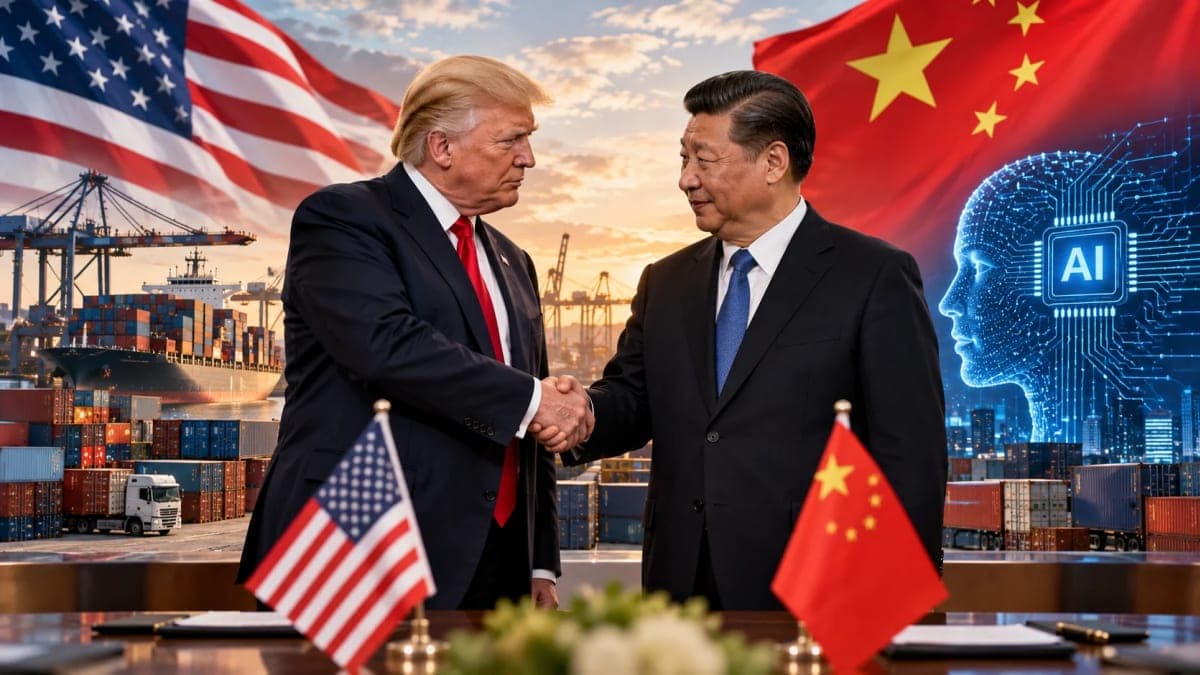
US and China reach new trade and AI agreements
The United States and China have agreed on a new package of trade and technology measures following Chinese President Xi Jinping's state visit to Washington, including tariff relief covering $30 billion worth of non-sensitive goods in each direction and a formal mechanism for dialogue on artificial intelligence.
The measures form part of a broader effort by the world's two largest economies to stabilise a relationship that remains strained by tariffs, technology restrictions, market access disputes and geopolitical differences.
According to a White House fact sheet released on September 25, President Donald Trump and Xi operationalised the U.S.-China Board of Trade and U.S.-China Board of Investment, mechanisms first chartered during their May 2026 summit in Beijing.
Under the Board of Trade, the two countries reached consensus on recommendations for more favorable tariff treatment covering $30 billion of non-sensitive goods moving in each direction.
The development was also reported by Reuters on September 26 as part of an eight-point consensus reached during Xi's US visit.
What does the $30 billion tariff agreement actually mean?
The $30 billion figure requires an important distinction.
It does not mean Washington and Beijing are cutting tariffs by $30 billion in cash or tariff revenue.
Instead, the agreement covers $30 billion worth of goods exported in each direction that could receive more favorable tariff treatment.
The White House said products covered on the US export side include agricultural goods, fish and seafood, logs and wood products, cosmetics and medical devices.
The two countries are therefore creating a category of non-sensitive trade where tariff barriers can be reduced without necessarily resolving their larger disputes over strategically important products and technologies.
The Board of Trade has also established a working group aimed at addressing agricultural market-access barriers.
Why the tariff deal matters
The agreement provides a limited avenue for easing trade barriers while leaving many of the most contentious parts of the US-China economic relationship unresolved.
Before Xi's visit, the two governments had already been discussing reciprocal tariff reductions covering $30 billion of goods.
The concept emerged from agreements reached during Trump's May meeting with Xi in Beijing and was intended to focus on goods considered non-strategic.
The latest announcement therefore represents the implementation of an earlier framework rather than a complete reset of US-China trade relations.
The two sides also extended their existing trade truce, according to US Treasury Secretary Scott Bessent, as reported by Reuters. The extension gives negotiators additional time to address broader economic disputes.
Washington and Beijing establish AI dialogue
Artificial intelligence was the second major area of agreement.
The White House said the countries established a bilateral dialogue to exchange views on the risks and benefits associated with advanced AI technologies and agreed to create a communication channel for serious AI-related incidents.
The next exchange is expected by November 2026, according to the White House.
The agreement follows negotiations held ahead of the summit involving Bessent and Chinese Vice Premier He Lifeng.
During those talks, the US proposed a notification mechanism that could allow the countries to communicate about AI incidents reaching a national-security threshold.
The objective, according to Bessent's comments reported by Reuters before the summit, was to increase transparency between the two countries as their AI capabilities continue to expand.
Xi calls for cooperation despite AI competition
China's official account of the Trump-Xi meeting also confirmed that AI cooperation was discussed.
Xi acknowledged that China and the United States compete in artificial intelligence but argued that there are also areas where the countries can cooperate.
According to China's Foreign Ministry, Xi said the two sides could continue discussions about AI's risks and benefits and work to prevent misuse and abuse of the technology.
He also called for AI systems to remain under human control.
Trump, according to the same Chinese government readout, said the United States and China should maintain dialogue and strengthen cooperation on AI.
The agreement is notable because Washington and Beijing remain strategic competitors in advanced technology.
US restrictions on China's access to sophisticated AI chips and semiconductor manufacturing equipment remain an important source of friction between the countries.
The new AI mechanism therefore represents a channel for risk management and communication rather than an end to their broader technological competition.
What remains unresolved?
Despite the new agreements, significant economic and geopolitical differences remain.
Tariffs outside the newly identified category of non-sensitive goods have not disappeared.
Technology restrictions, advanced semiconductors, agricultural purchases, market access and other trade issues continue to form part of the broader economic relationship.
Reuters reported after the summit that the extension of the trade truce effectively gives negotiators additional time rather than resolving the central disputes between the countries.
The tariff agreement should therefore be viewed as a targeted reduction in barriers affecting a limited category of bilateral trade, rather than a comprehensive US-China trade agreement.
Trade, AI and geopolitical issues converge
The Washington summit extended beyond trade.
According to the White House, Trump and Xi also discussed international issues including Iran, Russia and North Korea.
The United States also welcomed Chinese actions involving controls on chemicals associated with illicit fentanyl production, while Washington urged Beijing to take further measures.
The two governments additionally agreed to support each other as hosts of upcoming G20 and APEC meetings.
These developments fit into a broader attempt by Washington and Beijing to create mechanisms capable of preventing economic and technological competition from escalating into a larger confrontation.
What happens next?
Implementation will now be critical.
The Board of Trade will have to translate the tariff recommendations into practical changes affecting the identified categories of goods.
Businesses and exporters will therefore be watching for detailed product lists, tariff rates, implementation dates and customs guidance.
On artificial intelligence, attention will shift to the next bilateral exchange expected by November and to how the proposed incident-communication mechanism operates in practice.
The agreements create new channels for cooperation, but they do not eliminate the fundamental competition between the United States and China over trade, technology and geopolitical influence.
Sources
The White House — September 25, 2026 fact sheet: Primary US source for the Board of Trade, tariff treatment covering $30 billion of goods in each direction and bilateral AI mechanism.
Ministry of Foreign Affairs of China — September 25, 2026: Primary Chinese source for the Trump-Xi talks and statements concerning AI cooperation.
Reuters — September 26, 2026: Reporting on the eight-point consensus, tariff arrangement and AI dialogue.
JantaScope Editorial Note
The $30 billion figure refers to the value of goods in each direction covered by recommendations for more favorable tariff treatment; it should not be interpreted as a $30 billion reduction in tariff revenue. JantaScope has cross-checked the central announcements against official US and Chinese government statements and Reuters reporting. © 2026 JantaScope. All rights reserved.


