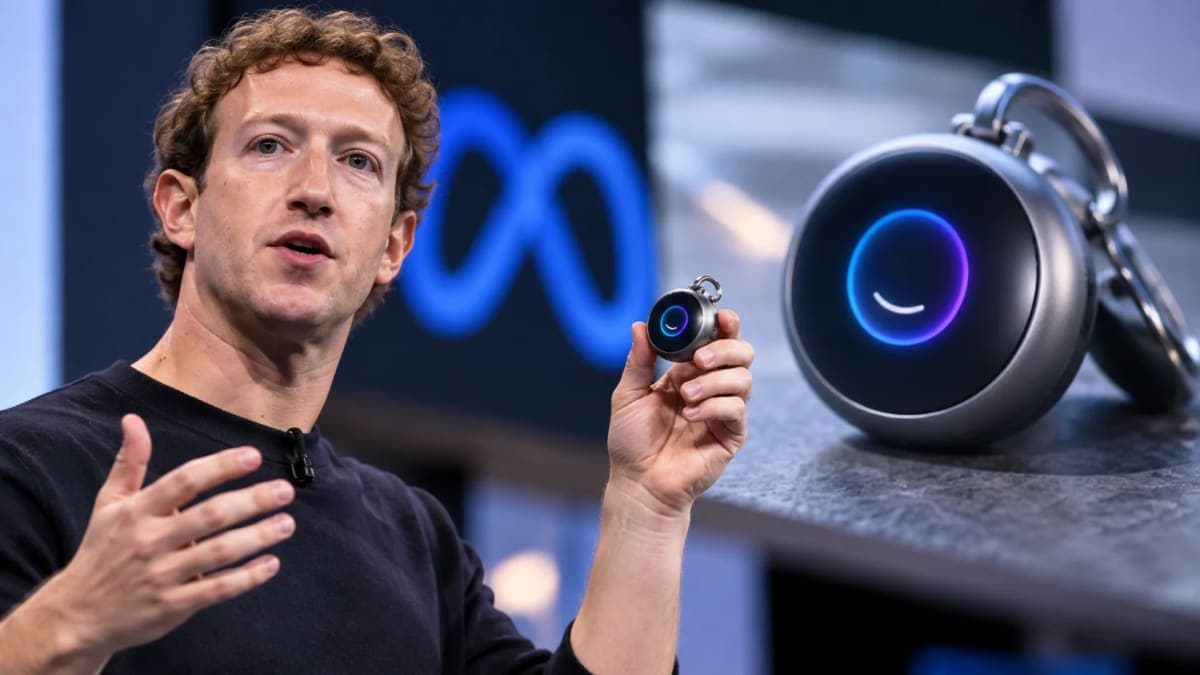
Meta unveils a new kind of AI device
Meta CEO Mark Zuckerberg used the closing moments of Meta Connect 2026 to reveal an unexpected piece of hardware: a tiny AI device designed to put the company’s Muse assistant within immediate reach.
Called Muse Charm, the pocket-watch or keychain-sized gadget is built around Muse rather than conventional smartphone functions. Users can tap its fingerprint sensor and begin interacting with the AI without first unlocking a phone or opening an app.
The surprise launch is more significant than its diminutive size suggests. Charm offers a glimpse of where Meta wants to take consumer computing as Zuckerberg increasingly shifts his focus from the metaverse toward AI-powered devices and what he describes as “personal superintelligence.”
What is Muse Charm?
Muse Charm features a roughly 2-inch (5-cm) touchscreen designed for thumb navigation, with a customisable Muse character displayed at its centre.
The device also includes built-in 5G connectivity, allowing users to access Muse when Wi-Fi is unavailable. It is not, however, designed to make conventional phone calls.
Zuckerberg said Meta managed to fit the entire Muse experience — including its real-time voice capabilities and avatar system — into a device small enough to attach to a keychain.
The product remains under development. Zuckerberg said Meta still has to finalise elements including the finishing material and component arrangement, while promising additional details later. Meta is targeting a December 2026 holiday-season release.
Pricing has not yet been disclosed in the reporting reviewed.
Why Charm matters to Zuckerberg’s AI strategy
The hardware reveal came alongside a much broader statement about Meta’s future.
Zuckerberg said Meta now sees personal superintelligence as arriving sooner — and ultimately becoming more important — than the metaverse.
“It is actually quite clear personal superintelligence will not only come first; it will be much bigger and more important.”
Meta has consequently shifted its focus toward building devices intended to deliver these AI experiences directly to consumers, Zuckerberg said.
That makes Charm more than another AI accessory.
For years, Meta has operated some of the world’s largest consumer platforms while remaining dependent on smartphone operating systems controlled by Apple and Google. A successful AI hardware ecosystem could give Meta a more direct relationship with users at the device level.
Muse is becoming Meta’s AI centrepiece
Charm arrives at a particularly important moment for Muse.
The AI agent has attracted millions of users since its recent launch, according to reporting around Meta Connect. Zuckerberg expects Muse eventually to develop into an AI system capable of understanding individual goals and working continuously on a user’s behalf.
Meta also announced additional Muse capabilities at Connect, including live video interactions, real-time voice conversations with custom voice options and an individual email address for a user’s agent.
The company is expanding Muse into commerce as well, announcing integrations or partnerships involving retailers and services including Walmart, Best Buy, Gap, Sephora and Wayfair.
Muse is also coming to Meta’s AI glasses in the coming months, meaning Charm is one part of a wider hardware strategy rather than a standalone experiment.
Charm targets people who may not want AI glasses
Meta’s decision to build a handheld device also addresses a practical limitation of its wearable strategy: not everybody wants to wear smart glasses.
IDC research director Jitesh Ubrani told Reuters that Charm could appeal to consumers who either do not want glasses or have concerns about them. He also compared the product’s potential appeal to Tamagotchi, the virtual-pet phenomenon of the late 1990s.
Analysts see younger users as one potential audience.
Linda Sui, founder of Smart Analytics Global, said the combination of AI, fashion and personalisation could attract Gen Z and younger consumers, particularly if Meta makes Charm affordable and straightforward to use.
That positioning could prove important. Instead of trying to replace a smartphone immediately, Meta could make Charm a persistent AI companion — something users can quickly reach for when they want to talk to Muse.
But dedicated AI gadgets have struggled before
Charm enters a product category with a difficult recent history.
The Rabbit R1, another compact generative-AI device, generated considerable attention when it launched in 2024 but struggled after its real-world performance failed to match expectations surrounding its capabilities.
That precedent raises a fundamental question for Meta: What can Charm do sufficiently better or faster than the smartphone already in a user’s pocket?
Sui cautioned that mass adoption could prove difficult unless Charm provides capabilities that smartphones, smartwatches, earbuds or smart glasses cannot easily replicate. Otherwise, she said, it could remain primarily a product for early adopters.
That is an analyst assessment rather than an established outcome for the unreleased device.
Privacy becomes central as AI gets more personal
An AI designed to understand users deeply also creates obvious privacy questions.
Zuckerberg devoted part of his Connect presentation to Meta’s security architecture. Muse already operates using what the company calls Muse Secure VM, a dedicated virtual computing environment.
Meta also plans a Muse Confidential VM, which Zuckerberg said is designed so that even Meta cannot see the protected information processed within it.
The company is developing private processing for its AI glasses as well, beginning with live translation before expanding to other capabilities. These are Meta’s stated privacy designs; their practical performance and safeguards will become clearer as the technology rolls out.
From the metaverse to AI hardware
Charm also illustrates how Zuckerberg’s long-term technology thesis has evolved.
Meta famously changed its corporate name from Facebook in 2021 as Zuckerberg positioned immersive virtual worlds as the next major computing platform. The company subsequently spent heavily on virtual and augmented reality.
AI has since moved much closer to the centre of Meta’s strategy.
Rather than abandoning hardware, Meta appears to be combining those ambitions: AI assistants delivered through smart glasses and now a miniature dedicated device could give the company multiple ways to reach consumers without requiring them to begin with a traditional smartphone app.
Muse Charm is therefore an unusually small product carrying a much larger strategic bet.
Its real test will come after Meta discloses the final specifications, price and launch details — and, eventually, whether consumers find enough value in carrying a dedicated AI companion alongside devices they already own.