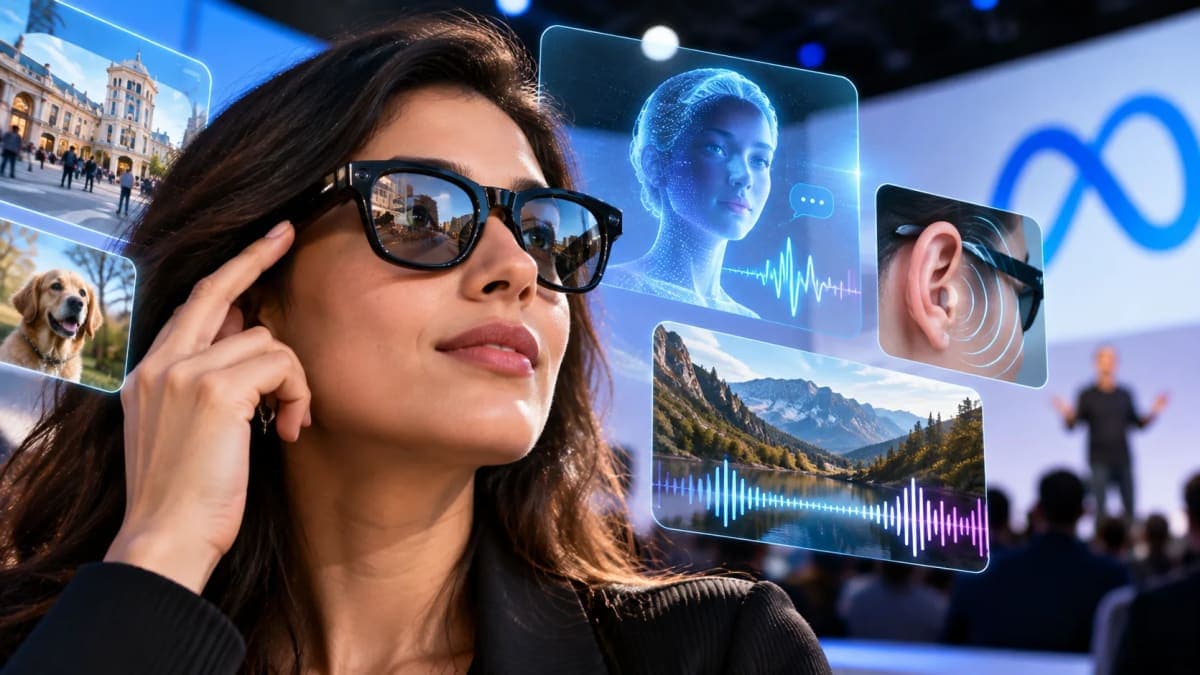
Meta is pushing its smart glasses beyond hands-free cameras and voice assistants, positioning the devices as a platform for personal AI, accessibility and immersive media.
At Meta Connect 2026 in Menlo Park, California, the company unveiled an expanded glasses portfolio that includes the third generation of Ray-Ban Meta, the new camera-free Ray-Ban Meta Audio and additional frame styles.
One of the biggest software announcements is that Muse, Meta's recently launched personal AI agent, is coming to the company's AI glasses.
The partnership between Meta and EssilorLuxottica is also expanding significantly. The companies say that by the end of 2026 their portfolio will offer more than 100 styles of AI glasses.
Muse Moves From Phones and Computers to Your Glasses
Muse differs from a conventional question-and-answer assistant because Meta is positioning it as an agent capable of carrying out multi-step tasks on a user's behalf.
Meta says wearers will be able to talk to Muse through their glasses while going about everyday activities. A user could give the agent a task and allow it to continue working in the background before returning with the result, reducing the need to pull out a phone or computer.
Examples given by Meta include using Muse for shopping, fitness and other everyday tasks. Muse can also work across connected services, subject to the permissions users grant it.
The glasses integration is particularly significant because the wearable's cameras and microphones can provide visual and audio context. Meta says its AI is also being upgraded to provide more context-rich answers about what the wearer is looking at.
Muse is currently rolling out in the US, and its AI-glasses integration is also initially a US offering.
Hearing Enhancement Turns Compatible Glasses Into an Accessibility Device
Meta also announced Hearing Enhancement, an accessibility feature aimed at adults with perceived mild-to-moderate hearing loss.
The company describes it as FDA-cleared software. Rather than introducing a separate traditional hearing aid, the feature uses compatible Meta glasses to help enhance sound for the wearer.
It is expected to become available in the US later in 2026 through a Meta One subscription or as a $149 one-time add-on for compatible glasses.
Meta is additionally introducing audio-balancing controls that can shift sound between the left and right ears, including an option to direct all audio to one side.
The feature illustrates a broader change in Meta's wearable strategy: the glasses are increasingly being developed not only as cameras and AI interfaces but also as accessibility tools.
Meta AI Glasses Become Dolby Atmos Capture Devices
Another major upgrade involves audio recording.
Meta and Dolby announced that Meta AI glasses will become the first global consumer device capable of capturing audio in Dolby Atmos.
Dolby Atmos Capture records spatial audio along with video, allowing a captured moment to preserve a stronger sense of where sounds were located around the wearer. Those recordings can subsequently be shared through platforms such as Instagram.
This is different from simply playing Dolby Atmos content through headphones or speakers. The glasses themselves capture compatible spatial sound while recording.
Meta says the resulting videos can then reproduce a more immersive representation of the original environment.
Camera Upgrades: Dynamic Photo and Landscape Crop Mode
Meta is also improving how its camera-equipped glasses capture photos and videos.
Dynamic Photo records multiple frames around the moment a picture is taken. Meta AI can then help select a preferred frame.
Landscape Crop Mode, meanwhile, gives users an easier way to create horizontal photos and videos suitable for displays beyond the predominantly vertical format associated with social platforms.
The feature supports photos as well as videos, hyperlapses and slow-motion footage.
Private Processing Addresses a Key AI-Glasses Concern
As glasses gain increasingly capable cameras, microphones and AI, privacy inevitably becomes a bigger part of the product discussion.
Meta says it plans to introduce Private Processing for AI glasses later in 2026. The feature is intended to enable certain AI functionality without Meta accessing the user's underlying data.
The company has separately maintained physical privacy protections for camera-equipped glasses. A visible white capture LED indicates when a wearer is taking a photograph or recording video, and Meta says the camera is disabled if the glasses detect that the capture LED has been blocked.
These protections are increasingly relevant as Meta gives its wearable AI more contextual information about what users see and hear.
Ray-Ban Meta Audio Removes the Camera Entirely
Meta also introduced Ray-Ban Meta Audio, its first audio-only AI glasses.
Unlike camera-equipped Ray-Ban Meta models, Meta Audio does not include a camera. The glasses are instead designed around audio, calls, music, translation and interaction with Muse.
The camera-free design potentially opens the category to consumers who want hands-free AI and audio functionality without continuously wearing a camera-equipped device.
Ray-Ban Meta Gen 3 Leads the Next Hardware Generation
Meta and EssilorLuxottica also introduced the third generation of Ray-Ban Meta.
The broader collection includes additional styles, including Zena, a cat-eye design, alongside Wayfarer options in standard and large sizes. Meta's expanded glasses collection will also add Capri and Nova styles as the companies push into a wider range of designs and audiences.
The strategy underscores the importance Meta places on making AI glasses resemble conventional eyewear rather than visibly technological headsets.
Meta Ray-Ban Display Gets Navigation and a 'Hologram'
Meta's display-equipped glasses are receiving a separate collection of upgrades.
Meta Ray-Ban Display is adding hands-free cycling directions and real-time public-transit information. A new Explore experience will provide access to apps designed specifically for the glasses.
Meta is also introducing a feature called Hologram, which creates a photorealistic digital representation of the wearer for video calls and infers facial expressions using their voice.
Meta says Hologram will begin rolling out in Early Access through WhatsApp to Meta Ray-Ban Display users in the US later this fall.
Meta's Bigger Bet: Making AI Wearable
Taken together, the Connect 2026 announcements show that Meta's glasses strategy is moving in several directions simultaneously.
Camera-equipped models are becoming more capable content-creation devices. Meta Audio offers a camera-free route into wearable AI. Display models are gaining navigation and communications capabilities. Hearing Enhancement adds an accessibility dimension.
Muse is the technology intended to connect many of those experiences.
Instead of requiring users to repeatedly open an AI application on a smartphone, Meta's longer-term idea is to make an AI agent available through something people can wear throughout the day.
Whether consumers embrace that model will depend not only on AI capability but also on comfort, battery life, pricing, privacy and how useful these features prove outside controlled demonstrations.
But Connect 2026 makes Meta's direction increasingly clear: the company wants AI glasses to evolve from smartphone accessories into an everyday interface for personal AI.