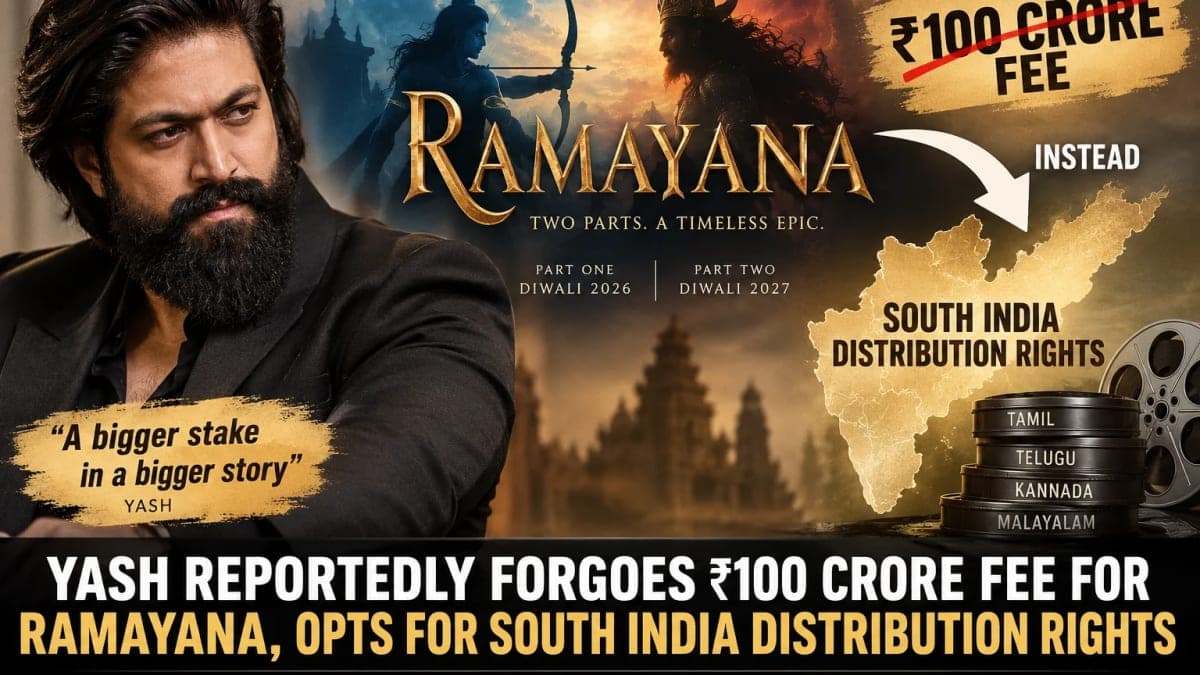
Yash appears to be taking a different approach to one of the biggest projects of his career. The actor, who plays Ravana in Nitesh Tiwari’s Ramayana, has reportedly opted against receiving a fixed acting fee and instead chosen the South Indian theatrical distribution rights for both instalments of the epic.
Earlier reports had placed Yash’s remuneration for the two films at approximately ₹100 crore. The latest reports, however, suggest that the actor will not receive that conventional payment and will instead have a commercial stake tied to the films’ theatrical business in southern India.
The arrangement has not been publicly detailed by Yash or the filmmakers, so the precise financial terms should be treated as reported rather than officially confirmed.
Yash Reportedly Chooses Distribution Rights Over Fixed Fee
According to recent reports, Yash will receive the South Indian theatrical distribution rights for Ramayana Part One and Part Two as part of his compensation arrangement.
That would represent a significant shift from earlier reports surrounding his remuneration. In 2025, reports had suggested that Yash could receive around ₹100 crore for portraying Ravana across the two films.
Under the newly reported structure, his financial outcome would instead depend more directly on how strongly Ramayana performs across the southern theatrical markets.
It potentially offers greater upside than a predetermined acting fee if the films generate exceptional business, while also exposing Yash to more of the commercial risk associated with theatrical performance.
Yash Is More Than an Actor on Ramayana
Yash already has a deeper financial connection to the project than a conventional cast member.
His production company, Monster Mind Creations, is associated with Ramayana as a co-producer alongside Namit Malhotra-led Prime Focus Studios. The reported distribution arrangement would therefore extend Yash’s involvement from acting and production into the theatrical business surrounding the films.
That distinction is important. Rather than simply collecting remuneration for playing Ravana, the reported structure would give Yash a stake in how the film performs in markets where he has established considerable recognition through the success of the KGF franchise.
Why South India Matters to the Deal
The commercial logic behind such an arrangement lies in Ramayana’s pan-India ambitions and Yash’s existing audience base.
Yash became one of Indian cinema’s most recognisable pan-India stars following the KGF films, with particularly strong visibility in southern markets. A major event film such as Ramayana therefore gives him an opportunity to participate directly in theatrical revenue rather than limiting his compensation to a fixed amount.
However, distribution rights are not automatically equivalent to guaranteed earnings. Their ultimate value depends on factors including theatrical demand, distribution costs, revenue-sharing arrangements and the film’s ability to sustain business after its opening.
For that reason, comparing the reported rights directly with a ₹100 crore acting fee before the films are released would be premature.
Ramayana Brings Together a Major Ensemble
Directed by Nitesh Tiwari, Ramayana is being developed as a two-part adaptation of the Hindu epic.
Ranbir Kapoor leads the film as Lord Rama, while Sai Pallavi plays Sita and Yash portrays Ravana. Sunny Deol is part of the ensemble as Hanuman, while Ravi Dubey plays Lakshman. Veteran actor Arun Govil is also associated with the project as King Dasharath.
The combination of major Hindi and South Indian stars reflects the scale of the production and its attempt to reach audiences across linguistic and regional markets.
Ramayana Part One Set for 2026 Release
Ramayana: Part One is scheduled for release in the 2026 Diwali period, with the second instalment expected to follow during Diwali 2027.
The first film will arrive with substantial commercial expectations, driven by the scale of the production, the cultural familiarity of its source material and its star-heavy cast.
For Yash, the reported compensation structure makes that performance particularly significant. If the distribution-rights arrangement is confirmed, his return from Ramayana would no longer be defined primarily by an upfront acting cheque but by the films’ ability to attract audiences in some of India’s largest theatrical markets.
That makes the reported decision less a waiver of compensation than a change in how that compensation could ultimately be earned.