Rahul Gandhi Seeks Fadnavis' Intervention
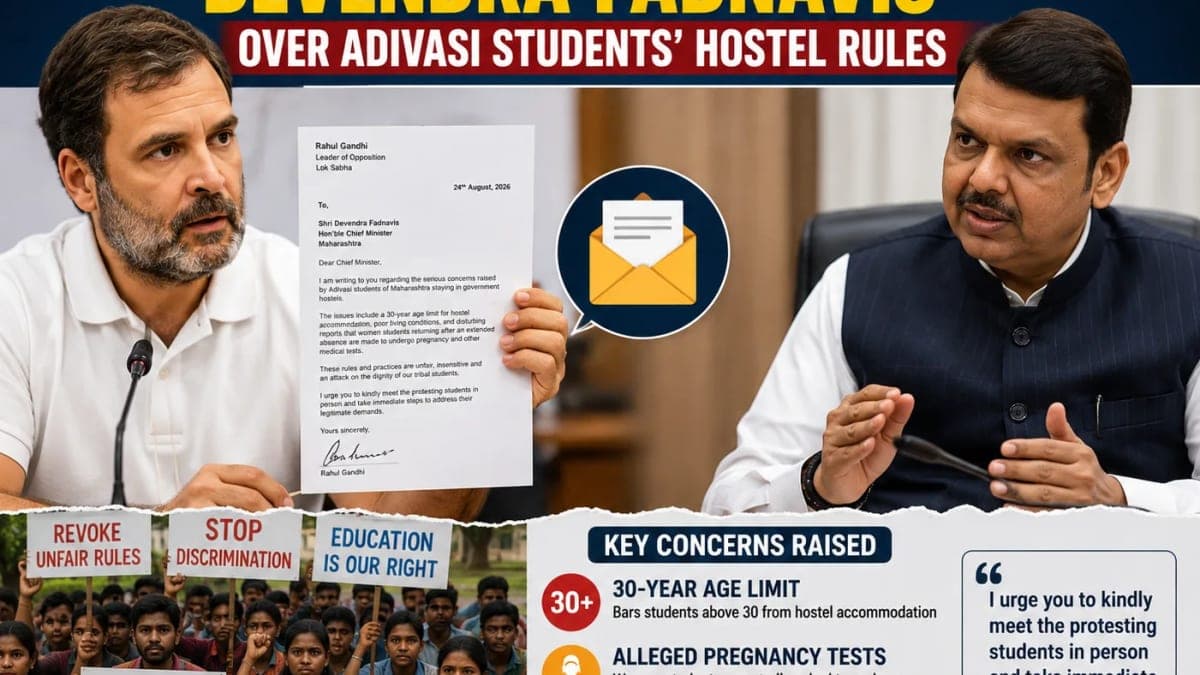
Rahul Gandhi has asked Maharashtra Chief Minister Devendra Fadnavis to intervene in a protest by Adivasi students over government hostel regulations and living conditions.
In his August 24 letter, Gandhi called on Fadnavis to personally meet representatives of the protesting students and work towards an immediate resolution of their grievances. The students had been on hunger strike for more than 10 days when Gandhi wrote the letter.
The issue gained wider political attention after Gandhi interacted with tribal students during a student programme in Pune. Students raised concerns about hostel accommodation, educational facilities, healthcare and safety.
30-Year Age Limit Becomes a Key Issue
One of the central concerns highlighted in Gandhi's letter is a rule that prevents people above the age of 30 from staying in the government hostels concerned.
Gandhi argued that such a restriction could affect students who are still completing their education or preparing for examinations and who depend on affordable government accommodation while studying in cities.
The issue is particularly significant for students arriving from remote areas, where access to higher education institutions and competitive-examination preparation may be limited.
For these students, government hostels can serve as more than accommodation: they can be an important part of the infrastructure that makes continued education financially possible.
Alleged Pregnancy Tests for Women Students Draw Concern
The most sensitive allegation raised in the controversy concerns female hostel residents.
Gandhi said he had been informed that women returning to hostels after an extended absence were required to undergo pregnancy tests along with other medical examinations to establish their fitness.
The reported requirement raises broader questions about privacy, dignity and whether hostel administration rules are proportionate to their stated purpose.
It is important, however, to distinguish between allegations and independently established facts. The pregnancy-testing requirement has been raised by protesting students and repeated by Gandhi in his letter; the reports cited here do not establish a detailed official explanation from the Maharashtra government regarding the rationale or implementation of the provision.
Students Also Raise Safety and Infrastructure Concerns
The dispute extends beyond individual hostel regulations.
Students have complained about problems involving food, sanitation, medical facilities and safety at government-run residential institutions. During Gandhi's interaction in Pune, concerns were also raised about drinking water, beds, healthcare and food arrangements.
A recent snakebite tragedy involving tribal girl students in Gadchiroli was also cited during the discussion as protesters demanded stronger medical and safety arrangements at residential educational institutions.
Together, these complaints have turned the protest into a wider debate about the standard of residential infrastructure available to tribal students.
Protesters Seek Changes to Government Decisions
Reports say protesting students have sought the cancellation of two state government resolutions issued on August 5 and August 14, 2026. They have also called for an older November 2011 government resolution to be updated to reflect present circumstances, including changes to financial assistance.
The demands suggest that the dispute is not limited to one controversial provision but concerns the broader framework governing accommodation and assistance for tribal students.
Why Government Hostels Matter for Adivasi Students
The controversy has significance beyond the immediate political exchange between Congress and Maharashtra's BJP-led government.
Students from remote tribal communities may need to relocate considerable distances to access universities, colleges, coaching facilities or other educational opportunities. Affordable government accommodation can therefore have a direct bearing on whether they can remain in education.
Rules determining who qualifies for hostel accommodation can consequently influence educational access.
At the same time, hostel administrations have legitimate responsibilities involving safety, occupancy, student welfare and the effective use of limited public resources. The challenge for policymakers is to design rules that fulfil those administrative objectives without unnecessarily restricting educational opportunity or compromising personal dignity.
Political Dimension of Rahul Gandhi's Letter
Gandhi's intervention also comes amid heightened political exchanges between him and Fadnavis.
The Maharashtra chief minister recently criticised Gandhi over a women-focused interaction in Pune, while Gandhi has used his engagements with students to raise questions around women's autonomy and social equality.
The Adivasi hostel dispute therefore has an unavoidable political dimension.
However, the underlying questions—hostel eligibility, living conditions, medical procedures and student safety—can ultimately be assessed independently of party politics.
Balanced Analysis: Focus Will Now Shift to Government Response
Rahul Gandhi's letter has significantly increased national attention on a protest that centres on the everyday educational circumstances of tribal students.
Some of the concerns, particularly the allegation involving pregnancy testing, raise serious questions of privacy and dignity if implemented as described. The age restriction, meanwhile, presents a policy question about balancing limited hostel capacity against the needs of students whose education or examination preparation extends beyond conventional age expectations.
But political allegations alone cannot resolve those questions.
A transparent response from the Maharashtra government explaining the disputed rules, their purpose, their implementation and whether changes are being considered would provide greater clarity.
Direct engagement between officials and protesting students could also help separate disputes over specific regulations from broader deficiencies in infrastructure and welfare.
Ultimately, the importance of the controversy lies less in the exchange between two prominent political leaders and more in whether the debate produces measurable improvements in educational access, safety and living conditions for Adivasi students.
This article is based on reporting published by TOI.