Priyanka Kakkar Joins Congress After Leaving AAP
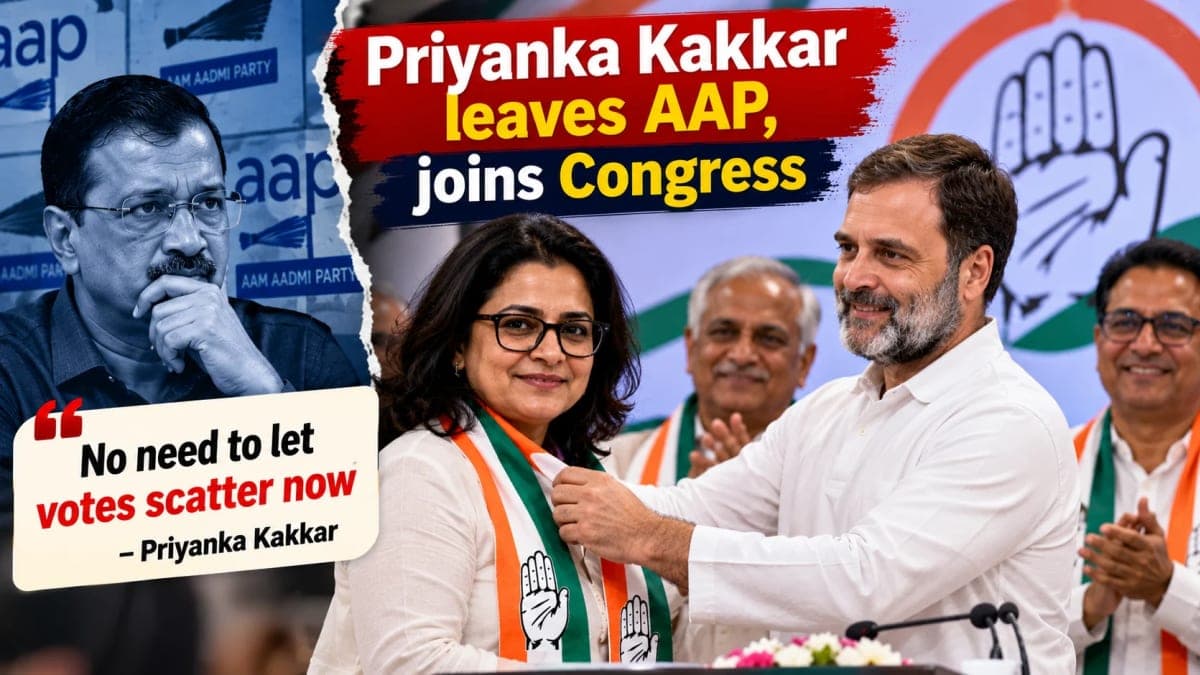
In a notable political development in Delhi, former AAP chief national spokesperson Priyanka Kakkar has joined the Congress.
Kakkar joined the party at the All India Congress Committee (AICC) headquarters in New Delhi on Saturday, October 3.
Former MLA Shyam Sundar Sharma and journalist Rajat Rakesh Tandon also joined the Congress alongside her.
The Congress publicly announced their induction into the party.
‘No Need to Let Votes Scatter Now’
After joining the Congress, Kakkar linked her decision partly to the fragmentation of opposition votes.
According to Hindustan Times, she said there was now no need to allow votes to scatter.
The remark is politically significant because AAP and Congress have long competed against each other in Delhi, even though the two parties have also participated in broader opposition cooperation against the BJP at the national level on some occasions.
Kakkar’s statement reflects her own political assessment. It should not be interpreted as evidence of how voters will behave in future elections.
Kakkar Explains Why She Chose Congress
Speaking after joining the party, Kakkar said she wanted to see the Delhi she remembered from her childhood.
She described her preferred vision for the capital as green, clean, progressive and safe.
Kakkar said that after more than a decade of political experience, she believed the Congress could work towards such goals.
That remains her political assessment. Different parties in Delhi have competing claims about their governance records, policies and priorities.
Kakkar Raises Questions About Her Former Party
Kakkar also made several critical claims about AAP after leaving the party.
She said AAP had initially attracted many talented and committed people but later failed to retain several of them.
She also referred to what she described as a gap between the party’s early public messaging and the lifestyles of some of its leaders.
Kakkar said she eventually reached a point where she found it difficult to defend some decisions taken by the party.
These are allegations and political opinions expressed by Kakkar. They should not be treated as independently established facts, particularly where a detailed response from AAP to the specific remarks was not immediately available in the initial reporting.
Kakkar Also Praises Rahul Gandhi
Kakkar also spoke positively about Rahul Gandhi, the Leader of the Opposition in the Lok Sabha.
She indicated that she had been impressed by his political approach and public positions.
Kakkar also referred to issues involving voting rights and the Election Commission that Gandhi has raised.
Political allegations concerning electoral processes and the Election Commission have been disputed, with institutions and political parties presenting differing positions. Kakkar’s comments therefore represent her political perspective rather than independent confirmation of those claims.
Who Is Priyanka Kakkar?
Priyanka Kakkar had been associated with the Aam Aadmi Party for more than a decade.
She joined AAP in 2013 and gradually took on several organisational and communication responsibilities.
In 2023, AAP appointed her its national chief spokesperson.
According to a profile released around her appointment, Kakkar served as the party’s Telangana observer between 2017 and 2019.
She also worked as legal head for the South Delhi parliamentary constituency and was associated with Raghav Chadha’s Lok Sabha campaign.
Kakkar had also served as an adviser to Rajya Sabha MP Sanjay Singh.
Kakkar Has a Legal Background
Apart from her political career, Kakkar is a lawyer.
Information shared by AAP when she was appointed chief national spokesperson in 2023 said she had completed a Master’s degree in Law from the University of Pennsylvania and had extensive legal experience.
She subsequently became one of AAP’s recognisable faces in television debates and media interactions.
Her departure is therefore notable not merely as another change in party membership, but as the exit of someone who had regularly represented AAP’s positions publicly.
What Does Her Entry Mean for Congress?
With Kakkar’s induction, Congress gains a political communicator who has significant experience inside AAP’s organisational and media structure.
However, the electoral impact of one political leader switching parties cannot be determined immediately.
The significance of her move will partly depend on what organisational or campaign responsibilities Congress gives her and whether she is able to build political influence within her new party.
What Does Her Departure Mean for AAP?
For AAP, Kakkar’s departure is notable because of her previous position as chief national spokesperson.
She had regularly represented the party in television debates and media interactions.
However, the departure of a spokesperson or senior political figure should not automatically be interpreted as evidence of a broader shift among voters.
Politicians changing parties is a recurring feature of Indian politics, and the electoral consequences vary significantly depending on local circumstances.
AAP and Congress Have a Complicated Political Relationship
AAP and Congress have had a complex relationship in Delhi, shaped by both electoral competition and periods of opposition cooperation.
AAP’s rise came at a time when Congress, after governing Delhi for several years, was losing political ground in the capital.
AAP subsequently established a substantial electoral base in Delhi, while Congress saw its representation in the Assembly decline sharply.
At the national level, however, efforts to build broader opposition cooperation against the BJP have at times brought the two parties onto a common political platform.
That background gives additional context to Kakkar’s statement about preventing votes from being divided.
Will the Move Change Delhi Politics?
It is too early to draw that conclusion.
Kakkar’s switch to Congress is a notable organisational development, but an individual defection does not automatically translate into a corresponding movement of voters.
Three developments will help clarify its significance: the role Congress assigns to Kakkar, AAP’s response and the future organisational strategies adopted by the two parties in Delhi.
For that reason, the move is better viewed as a development in the evolving relationship between Delhi’s political parties rather than evidence of an immediate electoral realignment.
Balanced Analysis
Priyanka Kakkar’s move from AAP to Congress attracts attention because she was not a peripheral party worker. She had been associated with AAP since 2013 and became one of its prominent public spokespersons.
For Congress, her induction brings an experienced political communicator familiar with AAP’s organisational environment. For AAP, it represents the departure of a recognisable former national spokesperson.
At the same time, Kakkar’s criticisms of AAP and her positive assessment of Congress and Rahul Gandhi are her own political claims and opinions.
They do not by themselves establish how Delhi voters view either party or what impact her move may have on future elections.
What is confirmed for now is that Kakkar has ended a political association with AAP lasting more than a decade and begun a new chapter with the Congress.