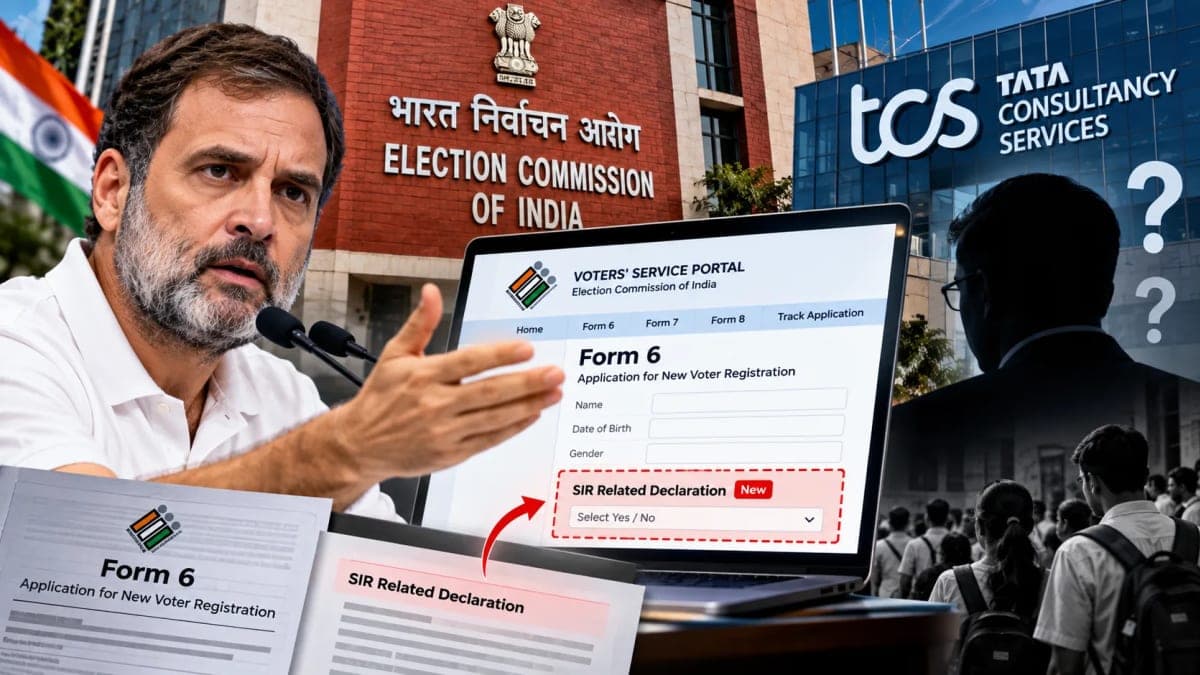
Rahul Gandhi Raises Questions Over Form 6
Leader of Opposition in the Lok Sabha Rahul Gandhi on Thursday, October 1, questioned the Election Commission of India (ECI) and Tata Consultancy Services (TCS) over changes made to the online version of Form 6, which is used by eligible citizens seeking enrolment as new voters.
Gandhi alleged that the online form had been changed improperly and asked who within the Election Commission authorised TCS to implement the modification. He also asked who at TCS approved the change and whether the company had faced pressure to carry it out.
His questions follow reports of objections within the Election Commission itself over the way an additional declaration connected with the Special Intensive Revision (SIR) of electoral rolls was incorporated into the online voter-registration process.
Gandhi's suggestion that TCS may have been pressured is a question he has raised publicly; it should not be treated as an established fact. Current reports reviewed for this article do not establish that TCS was coerced into making the modification.
What Was Changed in Online Form 6?
Form 6 is the statutory application used by eligible Indian citizens seeking inclusion in an electoral roll as new voters.
The Election Commission's current citizen portal describes Form 6 as the form for people registering as new electors. The statutory PDF identifies it as the "Application Form for New Voters" under the Registration of Electors Rules, 1960.
The controversy concerns an additional SIR-related declaration that appeared in the online registration process.
According to an investigation by The Indian Express, the online process required applicants to provide information connected to the last Special Intensive Revision. Applicants were asked to indicate whether they themselves appeared on the electoral roll during the previous SIR, whether a parent or grandparent appeared on it, or whether neither did.
The report said the section was not labelled mandatory, but an applicant could not proceed with the online submission without responding to it.
Two Election Commissioners Had Raised Objections
The controversy became more significant after The Indian Express reported that Election Commissioners Sukhbir Singh Sandhu and Vivek Joshi had objected internally to the change.
According to the newspaper's investigation of internal records, Joshi recorded an objection in May to modifying Form 6 through the SIR framework. Sandhu also supported concerns about the proposal.
The reported objection centred on whether a statutory electoral-registration form could be altered in this manner without formally amending the relevant rules.
The report said the commissioners characterised the change as unauthorised and raised concerns about the potential burden on young and first-time voters.
These internal objections form the basis for Gandhi's latest questions about how the digital modification was authorised.
Election Commission Removes Declaration in Some States
The dispute took another turn when the Election Commission removed the additional SIR declaration from the online Form 6 process in states where the revision exercise had already been completed.
Reports on September 30 said the declaration was removed from ECINet and relevant Chief Electoral Officer portals in those states.
The development does not by itself establish Gandhi's allegation about how the original modification was authorised. It does, however, make the decision-making process behind the digital change an important question in the wider debate.
What Does the Official Form Say?
The distinction between the statutory Form 6 and its online implementation is central to the controversy.
The Election Commission's published Form 6 asks applicants for standard information required for enrolment, including name, details of a relative, contact information where available, Aadhaar-related information, gender, date of birth and ordinary residence.
The Election Commission's online portal separately provides SIR-related services, including facilities to search for a person's name in electoral rolls from the previous intensive revision.
This means the dispute is not about whether the Election Commission can conduct electoral-roll revisions. The specific controversy concerns how additional SIR requirements were incorporated into the digital process for submitting Form 6 and whether the required procedure was followed.
Why TCS Has Entered the Political Debate
Gandhi specifically named Tata Consultancy Services while asking who was responsible for implementing the digital modification.
That brings a private technology provider into what is fundamentally a dispute about the administration and legal framework of voter registration.
However, responsibility needs to be carefully distinguished.
A technology contractor can implement technical requirements provided by a client, while decisions about the legal or administrative basis for an electoral-registration requirement involve the relevant electoral authorities.
Gandhi has asked who at TCS approved the modification and whether pressure was involved. Those questions require evidence or responses from the organisations concerned before conclusions can be drawn about the company's role.
Form 6 Dispute Is Part of a Wider SIR Controversy
The Form 6 issue comes amid a broader political dispute over the Election Commission's Special Intensive Revision of electoral rolls.
The Election Commission has been conducting SIR exercises aimed at updating electoral rolls and verifying voter eligibility.
Official ECI documents show that, under the SIR framework, Electoral Registration Officers have been instructed to process new enrolment claims through Form 6 together with specified declaration requirements in relevant circumstances.
At the same time, internal disagreements reported within the Election Commission have generated questions about aspects of implementation, digital systems and decision-making procedures.
The Commission has maintained more broadly that its electoral-roll processes operate within the statutory framework. It has also recently announced measures addressing some concerns surrounding ECINet and electoral-roll administration.
Opposition Intensifies Pressure on Election Commission
Gandhi's latest remarks also come against the backdrop of a broader campaign by opposition parties over electoral-roll management.
The INDIA bloc has announced protests over alleged irregularities in the electoral process and has raised concerns surrounding the SIR.
The BJP, meanwhile, has rejected wider allegations made by Gandhi and opposition parties against the Election Commission. BJP leaders have accused the opposition of spreading misleading claims and attempting to undermine confidence in constitutional institutions.
These competing political positions should be distinguished from the documented procedural issue involving Form 6.
The existence of internal objections from two Election Commissioners is a reported matter based on Commission records. Broader claims that those disagreements establish deliberate electoral manipulation or wrongdoing require separate evidence.
Why the Form 6 Issue Matters
The dispute raises a broader question about the relationship between election law and digital administration.
Moving voter services online can make registration faster and more accessible. But software does not operate independently of election law.
When an online system requires voters to provide information, the legal authority for that requirement matters just as much as the technical design of the website.
That is particularly significant for voter registration because a difference between the legally prescribed form and the practical requirements of its digital version could affect whether eligible applicants are able to complete enrolment.
The issue therefore extends beyond the immediate political argument between Congress and the Election Commission.
It raises questions about who authorises changes to election software, how those decisions are documented, and whether digital workflows accurately reflect statutory electoral procedures.
Balanced Analysis: Questions Remain, but Allegations Need Evidence
There are two separate issues at the centre of the controversy.
The first concerns the Form 6 modification itself. Reporting based on Election Commission records indicates that two commissioners raised objections to adding the SIR-related requirement without formally changing the underlying rules.
The second concerns responsibility for implementing that change.
Gandhi has asked whether TCS was instructed or pressured to alter the online process. At present, those questions should remain exactly that—questions—unless documentary evidence or official responses establish what happened.
The distinction is important.
An internal procedural disagreement within the Election Commission can justify scrutiny of how a decision was taken without automatically proving political interference, intentional voter suppression or misconduct by a technology contractor.
Likewise, removing the additional declaration from the online process in certain states does not by itself answer who originally authorised its implementation.
Greater disclosure about the approval process could therefore help clarify the dispute.
What Happens Next?
Attention is likely to focus on whether the Election Commission or TCS provides a detailed response explaining the chain of authorisation behind the online modification.
The issue could also feed into the wider debate over ECINet, the SIR process and institutional decision-making within the Election Commission.
For voters, the most immediate consideration remains the registration process itself.
The Election Commission's official voter-services portal continues to provide Form 6 for new voter registration alongside SIR-related facilities.
For the broader electoral system, however, the controversy presents a more fundamental governance question: as election administration becomes increasingly digital, there needs to be clarity about how changes to voter-facing software are authorised and how those changes correspond with election law.


