SP Fields Dhanraj Nathwani for Rajya Sabha
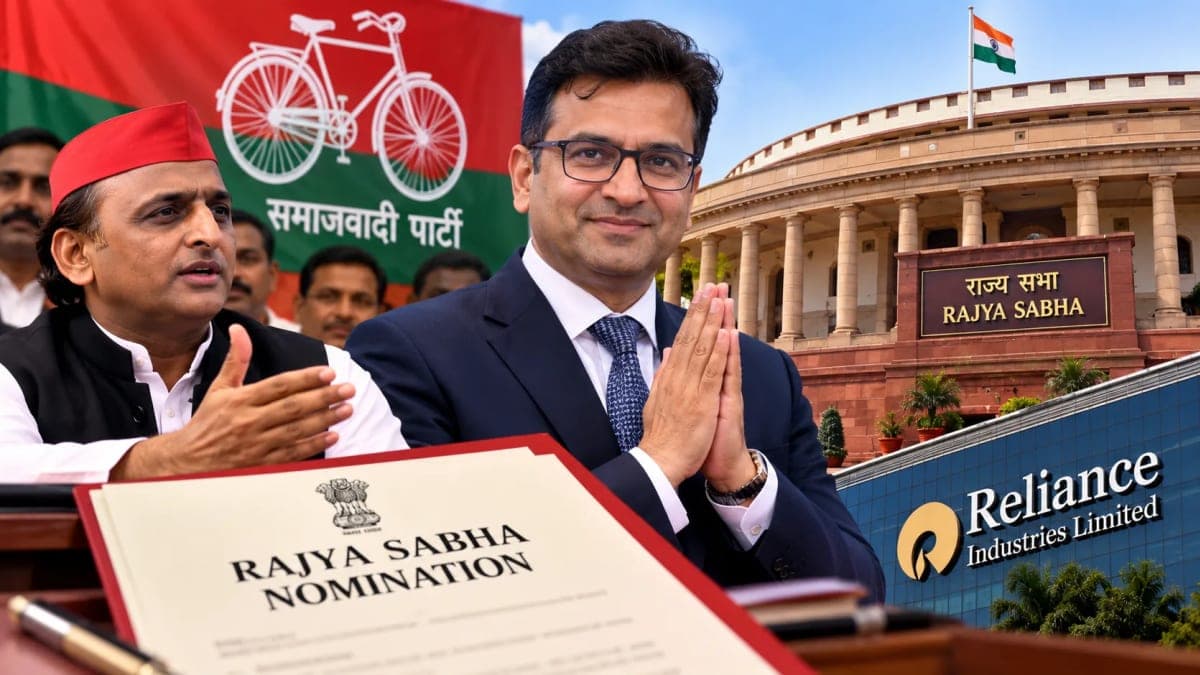
The Samajwadi Party has chosen Dhanraj Parimal Nathwani, a senior Reliance Industries executive, as one of its candidates for the upcoming Rajya Sabha election from Uttar Pradesh, making an unconventional addition to the party’s parliamentary lineup.
Nathwani and veteran SP leader Ram Gopal Yadav filed their nomination papers in Lucknow on September 30 in the presence of party president Akhilesh Yadav. Ten Rajya Sabha seats from Uttar Pradesh are scheduled to go to polls on October 16.
The selection has attracted particular attention because Nathwani's professional and institutional background differs from the career paths of many established SP politicians.
Who Is Dhanraj Nathwani?
Nathwani is a group president at Reliance Industries and holds responsibilities spanning several of the conglomerate's operations. He is also president of the Gujarat Cricket Association and has been associated with other institutional, religious and environmental bodies.
His nomination therefore brings a senior corporate executive into an electoral contest conducted through the Uttar Pradesh Legislative Assembly.
After filing his papers, Nathwani publicly thanked Akhilesh Yadav for nominating him and described the development as a new phase in his public life.
Why Has His Selection Attracted Attention?
There are several factual reasons why Nathwani's candidature has generated discussion.
Unlike Ram Gopal Yadav, Nathwani does not come to the contest primarily through a long career within the Samajwadi Party. He has strong professional links to Gujarat and the corporate sector, while the SP's principal political base is Uttar Pradesh. The Indian Express reported that the selection also surprised some within party circles.
His family background has added another dimension.
Dhanraj is the son of Parimal Nathwani, a senior Reliance executive and sitting Rajya Sabha member. Parimal Nathwani secured another term in June 2026 from Jharkhand as an NDA-backed Independent.
That means father and son have reached—or are seeking to reach—the same parliamentary chamber with backing from different political formations.
Rajya Sabha Numbers in Uttar Pradesh
The arithmetic of the Uttar Pradesh Assembly is important to understanding the contest.
According to the current Assembly numbers reported by The Indian Express, the NDA has an effective strength of 294 when support from the two Jansatta Dal (Loktantrik) MLAs is included. The Samajwadi Party has 101 MLAs, while Congress has two.
On those numbers, contemporary analyses indicate that the BJP-led alliance has sufficient strength for eight of the 10 seats, while the SP, with Congress support, has the numbers for two.
Nathwani is one of those two SP nominees announced alongside Ram Gopal Yadav.
Candidate Choice Comes Ahead of 2027 UP Election
The timing adds political significance to the nomination.
The Rajya Sabha election is taking place months before Uttar Pradesh's next Assembly election, meaning candidate selections are being scrutinised for indications of how political parties are positioning themselves ahead of the larger state contest.
However, the precise strategic reasoning behind Nathwani's selection should not be assumed without an explicit explanation from the Samajwadi Party.
Some political reporting has interpreted the choice as an effort to broaden SP's relationships beyond its conventional political networks. That remains an interpretation rather than a formally stated party rationale.
Corporate Background Creates an Unusual Contrast
Nathwani's professional profile makes the candidature noteworthy in another respect.
The Samajwadi Party has historically identified itself with socialist politics and has built much of its electoral organisation around social coalitions and grassroots politics in Uttar Pradesh. Nathwani, by contrast, arrives with substantial experience in corporate management, infrastructure and institutional administration.
That contrast has prompted questions about what kind of representation the party expects him to provide in Parliament.
It would nevertheless be premature to conclude that his nomination signals a fundamental ideological change within the SP. One candidate selection alone does not establish a broader shift in party policy.
Opposition Questions SP's Candidate Selection
The nomination has also provided an opening for political criticism.
Uttar Pradesh minister and Suheldev Bharatiya Samaj Party leader Om Prakash Rajbhar criticised the SP's choices while referring to the party's emphasis on its PDA — Pichhda, Dalit and Alpsankhyak — formulation. His remarks sought to question whether the candidates reflected the social groups highlighted by the SP.
Such criticism represents a political argument from an opponent rather than an independent assessment of Nathwani's candidature.
The SP's selection can therefore be viewed through competing political narratives: its opponents can challenge whether the nomination matches the party's stated representational priorities, while the party is entitled to choose candidates based on a wider range of political, professional or parliamentary considerations.
Why the Nomination Matters
Rajya Sabha nominations can reveal more than who will represent a party in Parliament. They can also demonstrate how parties balance internal leadership, social representation, professional expertise and relationships beyond their traditional political structures.
Nathwani's candidature is especially unusual because it brings together several different worlds: corporate India, Gujarat's institutional landscape and Uttar Pradesh opposition politics.
His father's position as an NDA-backed Rajya Sabha member makes that combination even more distinctive.
But claims that the nomination proves a specific arrangement between the Samajwadi Party, Reliance or other political actors would require evidence. The publicly established fact is that the SP selected Nathwani and he filed his nomination with Akhilesh Yadav present.
Balanced Analysis: An Unconventional Pick, With Strategy Still Unclear
Dhanraj Nathwani's nomination represents a departure from what might have been expected if the Samajwadi Party had selected another established party politician or a figure directly associated with its traditional electoral constituencies.
His corporate experience could bring a different professional perspective to the party's parliamentary representation. At the same time, his selection invites legitimate questions about how the decision fits with the SP's political messaging and representational priorities.
What cannot yet be established from the nomination alone is the larger strategic calculation behind it.
Unless the party provides a detailed explanation, interpretations involving corporate outreach, electoral strategy or political alliances should be presented as analysis or speculation rather than fact.
The October 16 Rajya Sabha election will provide the immediate electoral context, while the longer-term significance of Nathwani's entry into politics will depend on the parliamentary and political role he takes on afterward.