What Is Rahul Gandhi’s ‘Satyagraha’ Platform?
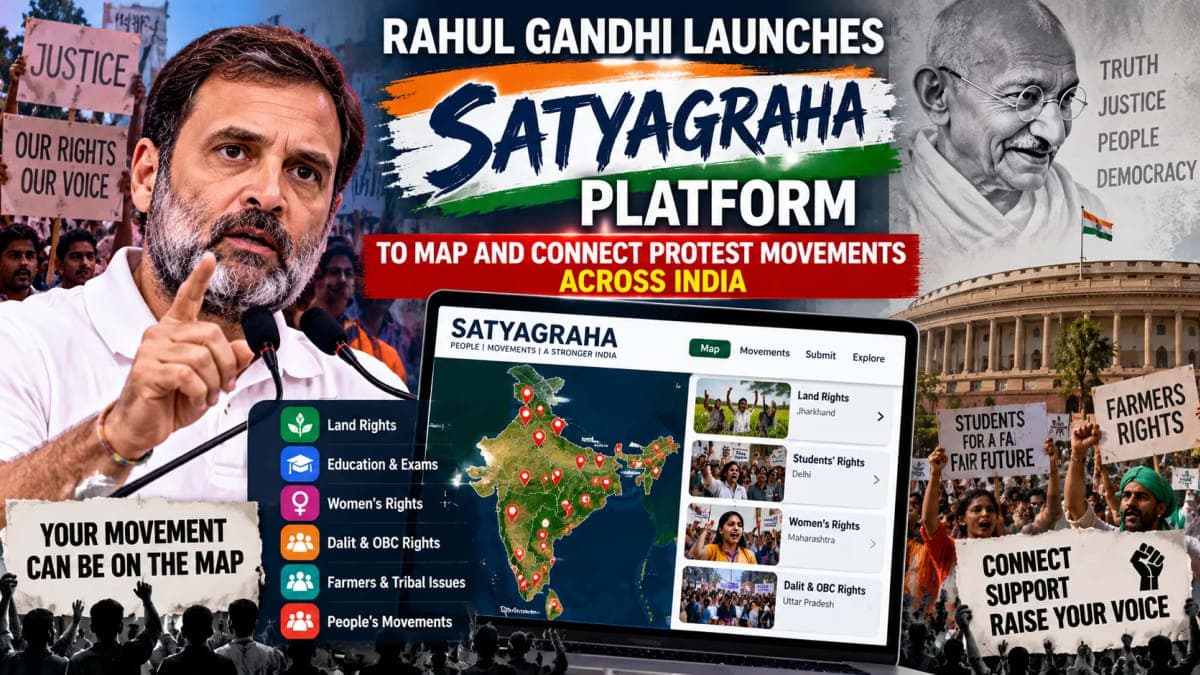
Congress leader Rahul Gandhi launched the Satyagraha digital platform on October 3, 2026, presenting it as a way to connect people involved in different public movements across the country.
The platform is designed to collect information about campaigns and protests concerning issues such as land rights, education, examinations, women’s rights, and the rights of Dalits and OBCs.
People involved in such movements can submit details of their cause to the platform. These submissions can then be displayed on an interactive map, allowing users to identify similar movements taking place in other parts of India.
What Did Rahul Gandhi Say?
While announcing the initiative, Gandhi said people across the country were fighting for different rights and causes but often remained disconnected from others facing similar issues.
He linked the initiative to the broader idea of “Satyagraha,” associated historically with Mahatma Gandhi’s philosophy of truth and non-violent resistance.
Rahul Gandhi also said the platform was intended to support people in places where, in his words, “truth is being crushed.” This characterization reflects Gandhi’s political position and should be understood as his claim rather than as an independently established description of conditions across India.
How Will Satyagraha Work?
According to details released around the launch, people participating in a movement can register information about their campaign on the website.
The platform can then place the issue on its digital map, helping users see where similar movements are taking place.
Gandhi has encouraged people to enrol their movements and seek assistance through the platform. His team would then examine the information submitted and explore what form of support could be provided.
The initiative therefore goes beyond simply creating an online directory of protests. It is being presented as a potential link between local movements and political representation.
Gandhi Says Support Could Extend From Parliament to the Streets
As Leader of Opposition, Gandhi said he would seek to support relevant causes through different democratic channels, including raising issues in Parliament, participating in public action or writing to the appropriate authorities.
This gives Satyagraha a clear political dimension. While the platform collects information from citizens and movements, Gandhi is also positioning it as a mechanism through which some of those concerns could potentially receive political attention.
How often submissions lead to concrete interventions, however, will only become clear as the platform develops.
Which Groups and Issues Have Been Highlighted?
During the launch, Gandhi referred to groups including students, farmers, tribal communities, Dalits, women and younger citizens.
Examples cited in connection with the initiative include movements involving land, education, examinations, women’s rights, and Dalit and OBC rights.
Initial media reports said the platform had already received more than 150 submissions, including dozens under the education category. These were early figures and may change as more users join the platform.
Why Is It Called ‘Satyagraha’?
The initiative was announced immediately after Gandhi Jayanti, observed on October 2.
Mahatma Gandhi used the term Satyagraha for a philosophy and method centred on truth and non-violent resistance during India’s freedom struggle and other political campaigns.
Rahul Gandhi’s platform adopts the historic term as a symbolic reference. However, the modern digital platform and Mahatma Gandhi’s historical Satyagraha movements are distinct and should not be treated as equivalent.
Why Does the Initiative Matter Politically?
The platform could provide Rahul Gandhi and the Congress with a structured channel for identifying local and issue-based movements across different parts of India.
If widely adopted, its interactive map could help identify patterns—for example, whether similar concerns about examinations, land or other issues are emerging simultaneously in multiple states.
At the same time, the initiative has an explicit political context. It has been launched by the Leader of Opposition, and Gandhi has said he could raise issues submitted through it in Parliament and other public forums.
That means the platform may function both as a tool for civic mobilisation and as a channel connecting public campaigns with opposition politics.
Digital Mobilisation Meets Grassroots Politics
Political parties and leaders already rely heavily on social media for communication and campaigning. Satyagraha attempts a somewhat different model by asking users to submit structured information about their movements rather than simply consuming or sharing political content.
The interactive map is a notable part of the concept because it could allow participants in one region to discover people campaigning on similar issues elsewhere.
However, the long-term usefulness of such a crowdsourced political platform will also depend on how submissions are verified, how misleading information is moderated, how user data is handled and what follow-up is provided after a grievance is registered.
What Happens Next?
The key test will be whether Satyagraha develops from a digital mapping initiative into a platform capable of generating sustained engagement around the issues submitted to it.
Its reach, verification process, transparency and the number of cases that receive meaningful follow-up will provide a clearer picture of its impact over time.
For now, the initiative represents Rahul Gandhi’s attempt to create a digital network linking different public movements while offering a route through which some of their concerns could potentially be raised in political and parliamentary forums.