THIRUVANANTHAPURAM, October 1, 2026 — A political confrontation between organisations associated with the Congress and CPI(M) has intensified tensions in Kerala, highlighting the complicated relationship between two parties that compete fiercely within the state while cooperating through the INDIA opposition bloc at the national level.
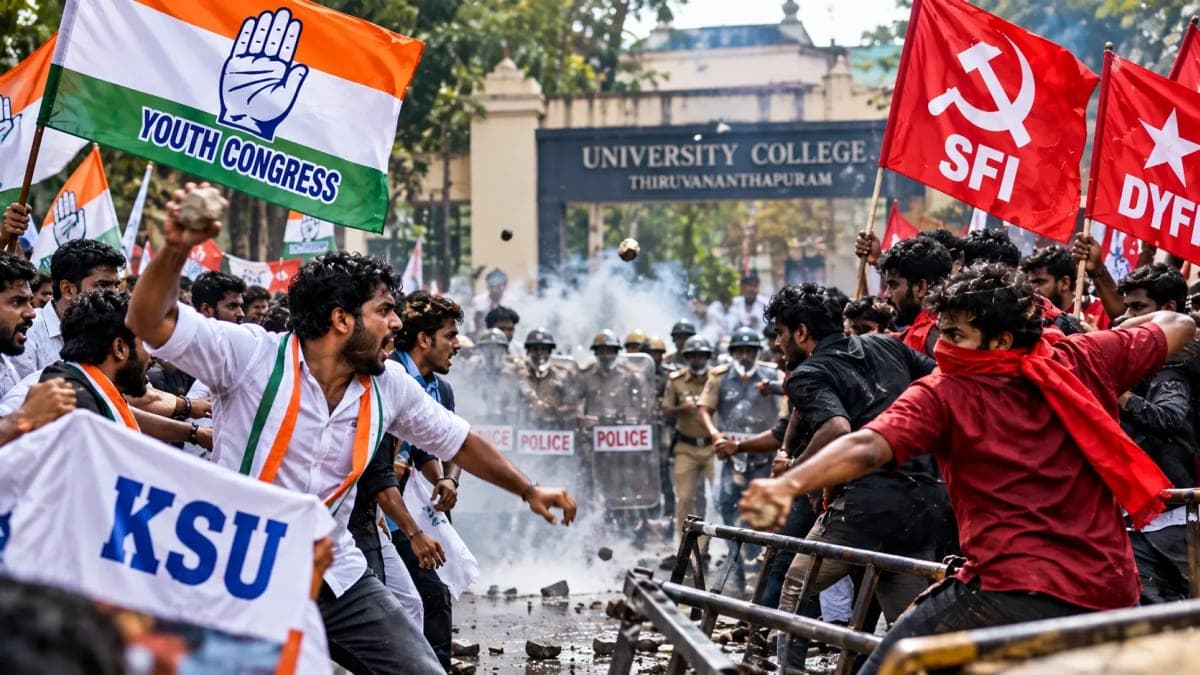
The violence began on Wednesday evening near the University College and University Men's Hostel area in Palayam, Thiruvananthapuram, during a Youth Congress protest demanding the removal of Chief Election Commissioner Gyanesh Kumar.
Youth Congress and Kerala Students Union (KSU) activists came into confrontation with activists associated with the Students' Federation of India (SFI) and Democratic Youth Federation of India (DYFI), organisations linked to the CPI(M).
Stones and other objects were thrown during the confrontation, while burning torches were also thrown towards the hostel premises. Police eventually intervened, using tear gas and baton charges as they attempted to disperse the groups and bring the situation under control. Several students, activists and police personnel were reported injured.
Both Sides Blame Each Other for Starting Violence
The precise sequence that triggered the confrontation remains disputed.
Youth Congress representatives alleged that stones and bottles were thrown from the hostel towards their procession. They said their workers reacted after coming under attack.
SFI representatives offered a different account, accusing Youth Congress-KSU activists of provoking the confrontation and attacking the hostel.
Available reporting therefore establishes that a violent confrontation occurred, but the competing claims about who initiated it should be treated as allegations rather than settled fact.
Police subsequently entered the hostel premises and carried out a baton charge. SFI criticised the police action and announced a class boycott in protest.
Political Confrontation Spreads Beyond Thiruvananthapuram
The dispute did not remain confined to Kerala's capital.
On Thursday, Kerala Sports Minister and Youth Congress state president O J Janeesh's vehicle was allegedly blocked and damaged during protests involving DYFI workers while he was attending events in Kannur and Kasaragod.
Janeesh accused CPI(M) and DYFI activists of deliberately provoking political violence. That allegation is contested and should not be treated independently as an established explanation for the incidents.
The developments indicate that what began around a protest march in Thiruvananthapuram was developing into a wider political confrontation between the two camps.
National Allies, Kerala Rivals
The timing gives the confrontation broader political significance.
Congress and CPI(M) participate nationally in the opposition INDIA bloc, even though the two parties remain major political competitors in Kerala.
That arrangement has long required them to maintain different political relationships at the national and state levels.
The latest confrontation occurred shortly after INDIA bloc parties agreed on a coordinated campaign over concerns surrounding the Election Commission and the Special Intensive Revision, or SIR, of electoral rolls.
Opposition parties have announced "Save Democracy" marches from October 2 to October 8, district-level demonstrations and a planned march by opposition MPs to the Election Commission on October 6.
The Kerala clashes therefore expose the practical difficulty of maintaining national opposition coordination while Congress and the Left continue to confront one another locally.
Why Opposition Parties Are Targeting the Election Commission
The dispute surrounding Chief Election Commissioner Gyanesh Kumar has become a major political issue for several opposition parties.
Congress, CPI(M) and other opposition groups have raised allegations concerning the functioning of the Election Commission and the Special Intensive Revision of electoral rolls.
CPI(M) and four other Left parties issued a joint statement on September 24 demanding Kumar's removal, a halt to the SIR process and restoration of voting rights for people they say were wrongfully excluded from electoral rolls. Those are the parties' allegations and demands, rather than independently established findings against the CEC.
Congress has separately challenged the Election Commission's handling of the controversy and criticised its response to reports about internal disagreements within the poll body.
The Election Commission's own website continues to identify Gyanesh Kumar as India's Chief Election Commissioner and provides services relating to the 2026 Special Intensive Revision.
CPI(M)'s Position Highlights the Kerala Contradiction
The confrontation is particularly striking because CPI(M) itself has been actively campaigning against Kumar.
On September 29, Left parties held a demonstration outside Election Commission headquarters in New Delhi. CPI(M) said participants were detained during the protest, which demanded Kumar's removal, suspension of the SIR process and restoration of eligible voters allegedly excluded during the revision exercise.
That means Congress and CPI(M) organisations were protesting broadly around the same national political controversy while simultaneously clashing with each other in Kerala.
The episode illustrates how national alliances in Indian politics do not necessarily eliminate state-level competition.
Why the Kerala Clash Matters
The immediate issue is law and order, but the political implications extend further.
Congress and CPI(M) have a shared interest nationally in challenging the BJP and coordinating opposition campaigns. Yet Kerala remains a state where their organisations compete directly for political influence.
Violent confrontations between their youth and student organisations can therefore complicate the public presentation of opposition unity.
CPI(M)'s own Central Committee acknowledged earlier in 2026 that disagreements with Congress in Kerala had affected relations even while describing the party as part of the broader opposition effort against the BJP-RSS.
The latest violence brings that structural tension back into focus just as opposition parties are attempting to coordinate demonstrations nationally.
Balanced Analysis: Can State Rivalry Coexist With National Cooperation?
The Kerala confrontation does not by itself mean that Congress-CPI(M) cooperation at the national level has collapsed.
Indian political alliances frequently involve parties that cooperate in one arena while competing against each other elsewhere. The INDIA bloc itself contains parties with substantially different regional interests and political histories.
Congress and CPI(M) can therefore share certain national objectives while continuing to contest Kerala politics aggressively.
The difficulty arises when political competition turns violent.
If confrontations between their organisations continue, national leaders may face increasing pressure to explain how coordinated INDIA bloc campaigns can operate while their state units remain in direct conflict.
At the same time, the immediate responsibility for the Thiruvananthapuram violence should not be assigned solely on the basis of partisan allegations. Congress-linked organisations and CPI(M)-linked organisations have offered competing versions of how the confrontation began, and further police findings would be needed to establish responsibility for specific acts.
The episode ultimately demonstrates the unusual political reality facing the opposition: Congress and CPI(M) can stand together over national institutional disputes while remaining determined political opponents on the ground in Kerala.


