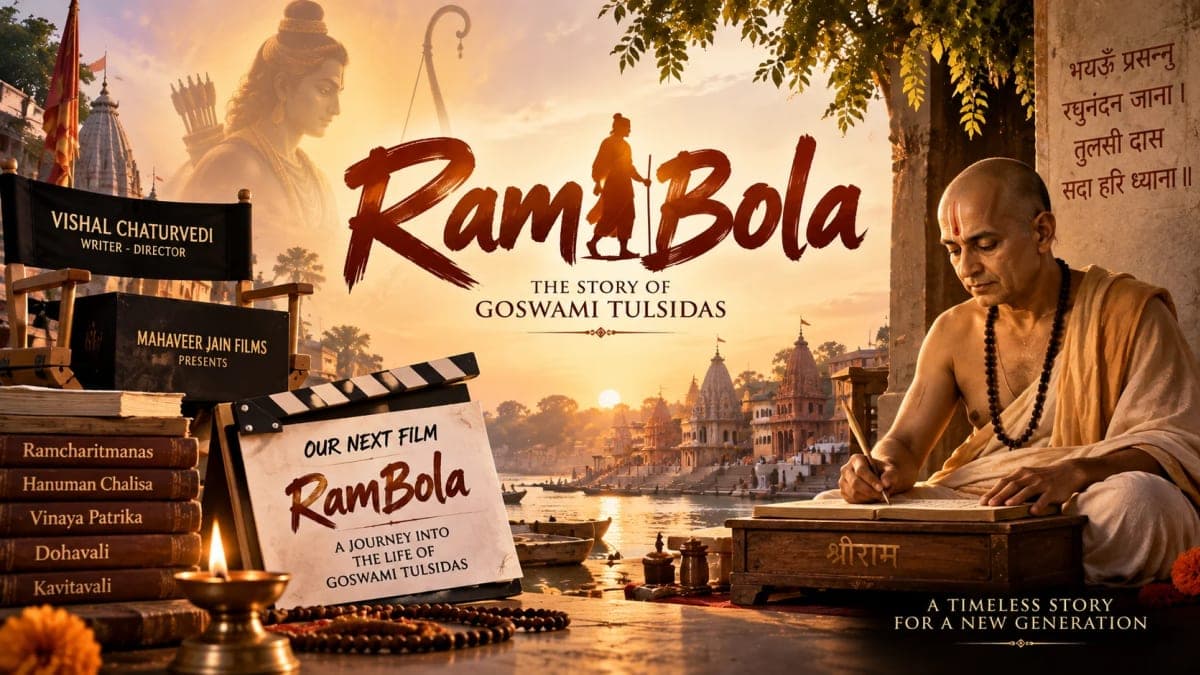
‘RamBola’ Announced: ‘Hanuman Ansh’ Director Vishal Chaturvedi to Bring Goswami Tulsidas’ Life to the Screen
After the unexpected theatrical success of Hanuman Ansh, writer-director Vishal Chaturvedi is staying within the world of Indian devotional history for his next film.
Chaturvedi and Mahaveer Jain Films announced RamBola on September 14, a new film centred on the life and spiritual journey of Goswami Tulsidas, one of the most influential poet-saints in the Indian devotional tradition.
The announcement establishes the subject and creative team, but several major details remain under wraps. The makers have not yet confirmed the lead actor, full cast, release date or a detailed production timeline.
That makes RamBola an early-stage announcement rather than a film whose release plans are already fixed.
Why is the film called ‘RamBola’?
The title has a direct connection to Tulsidas.
Traditional accounts of the poet-saint’s life identify Rambola as his childhood name. Tulsidas later became one of the central literary figures associated with devotion to Lord Rama.
That gives the film a title rooted in its subject rather than simply naming the project Tulsidas.
It may also offer a clue to the filmmakers’ approach. A title such as RamBola potentially allows the story to begin with the person behind the revered historical figure and follow the journey that eventually produced his enduring literary and devotional legacy.
The makers, however, have not yet released a detailed synopsis, so the precise period of Tulsidas’ life that the screenplay will cover should not be assumed.
Vishal Chaturvedi will write and direct
Vishal Chaturvedi is set to both write and direct RamBola.
The project continues his collaboration with Mahaveer Jain Films following Hanuman Ansh.
Chaturvedi has described his filmmaking interest in the context of India’s Sant Parampara, or saint tradition, and RamBola moves that interest toward a historical figure whose influence extends across literature, religious practice and popular culture.
That makes the new project considerably different in scale from simply making another devotional film.
Tulsidas is not remembered only as a saint. His writings became part of the cultural vocabulary of large parts of northern India.
Who was Goswami Tulsidas?
Tulsidas was a poet-saint associated above all with devotion to Lord Rama.
His most famous work is the Ramcharitmanas, his retelling of the story of Rama in Awadhi. By presenting the narrative in a language accessible beyond the Sanskrit-reading elite, the work became deeply embedded in North Indian religious and literary culture.
Tulsidas is also traditionally credited with composing the Hanuman Chalisa, one of the most widely recited devotional compositions dedicated to Lord Hanuman.
His other works include Vinaya Patrika, Dohavali, Kavitavali and Gitavali.
That literary legacy gives RamBola material extending well beyond the conventional structure of a biographical drama.
The filmmakers could potentially explore his personal transformation, devotion to Rama, literary development and the cultural environment in which his writings emerged.
Which of those threads will dominate the film has not yet been disclosed.
‘RamBola’ follows the remarkable rise of ‘Hanuman Ansh’
The timing of the announcement is significant because Chaturvedi arrives at RamBola after Hanuman Ansh became an unusual theatrical success.
Hanuman Ansh, based around the spiritual journey associated with Neem Karoli Baba, began its theatrical run on a comparatively small scale before expanding through word of mouth.
Recent reporting has put its India box-office total above ₹200 crore, an extraordinary result given the film’s modest beginnings.
Its success is especially notable because it did not follow the conventional route of a major Hindi release driven by a huge star, nationwide opening-day screen count and expensive promotional campaign.
Instead, audience response expanded the film after release.
That context inevitably creates greater attention around Chaturvedi’s next project.
But RamBola should not automatically be expected to reproduce Hanuman Ansh’s commercial performance. No budget, distribution strategy or release scale has been announced for the new film.
Why Tulsidas is a much bigger storytelling challenge
Turning Tulsidas’ life into a feature film presents a particular problem: historical record and devotional tradition frequently overlap.
Many stories surrounding medieval saints have been transmitted through religious texts, oral traditions and later biographies. Details about Tulsidas’ early life, transformation and spiritual experiences can therefore differ across traditions.
A responsible historical drama has to decide how it will distinguish documented history from devotional belief.
That question becomes especially important when portraying events regarded as sacred by millions of viewers.
The makers have not yet explained how RamBola will navigate that line.
For Chaturvedi, this could become one of the film’s defining creative choices.
The success of devotional cinema is changing its commercial position
RamBola also arrives at an interesting moment for Hindi cinema.
Religious and mythological subjects have always existed in Indian filmmaking, but recent theatrical successes have shown that spiritually rooted stories can reach audiences well beyond what was once considered a specialist devotional market.
Hanuman Ansh is particularly relevant because its expansion was driven by audience response rather than the conventional machinery associated with a large commercial release.
Its performance does not prove that every devotional film will succeed.
What it does show is that exhibitors and producers now have fresh evidence that a spiritually centred film can scale theatrically if viewers respond strongly enough.
That makes the decision to move from Neem Karoli Baba to Tulsidas commercially noteworthy as well as creatively consistent.
Is ‘RamBola’ a sequel to ‘Hanuman Ansh’?
No sequel has been announced.
The connection between the two films is primarily creative: Vishal Chaturvedi is behind both projects, and the filmmakers are continuing to explore stories rooted in Indian spiritual traditions.
RamBola is centred on Goswami Tulsidas rather than continuing the narrative of Hanuman Ansh.
It should therefore be treated as a separate film, unless the makers later announce a broader connected format.
Who will play Tulsidas?
For now, that is one of the biggest unanswered questions.
The announcement confirms the film and its central subject, but no actor has officially been named as Goswami Tulsidas in the information released so far.
The same caution applies to supporting cast reports unless they are subsequently confirmed by the production.
Casting will be particularly important because the story potentially spans different stages of Tulsidas’ life.
Until Mahaveer Jain Films or Chaturvedi announces the actor, speculative names should not be presented as confirmed casting.
When will ‘RamBola’ release?
There is no confirmed theatrical release date yet.
The announcement also does not establish a final shooting schedule.
That means readers should be cautious about social-media posts attaching an unverified year, festival date or release window to the project.
For now, the confirmed development is straightforward: RamBola has been announced, Vishal Chaturvedi will write and direct it, Mahaveer Jain Films is involved, and the film will focus on Goswami Tulsidas.
Casting, production and release details are the next announcements to watch.
Why ‘RamBola’ could attract attention beyond the box office
The most interesting question around RamBola may eventually be how it presents Tulsidas to viewers who know his works but know much less about the person behind them.
Ramcharitmanas and the Hanuman Chalisa remain deeply familiar in Indian religious life. A film about their traditionally recognised author therefore begins with a level of cultural recognition most biographical dramas do not have.
That familiarity is also a responsibility.
The filmmakers will have to transform a figure surrounded by centuries of devotion, literary scholarship and traditional narratives into a coherent cinematic character without reducing his legacy to a collection of familiar episodes.
After Hanuman Ansh, Chaturvedi has an audience willing to pay attention.
With RamBola, the challenge will be turning that attention into a film capable of doing justice to a far older and more complex story.