AI Is Getting a Friendlier Face
As artificial intelligence becomes more capable—and, for many users, more complicated—technology companies are experimenting with an old marketing technique: the mascot.
Instead of presenting AI agents purely as technical software, companies are increasingly surrounding them with colorful characters, expressive faces and customizable personalities.
The strategy reflects a broader challenge facing the AI industry. Companies want people to trust AI systems with increasingly consequential tasks, from searching the web and writing code to handling calendars, shopping and other personal workflows. Yet public concerns about AI include employment disruption, privacy, misinformation and safety.
Cute characters offer one way to make that transition feel less intimidating.
OpenAI’s Dots Bring Characters to AI Agents
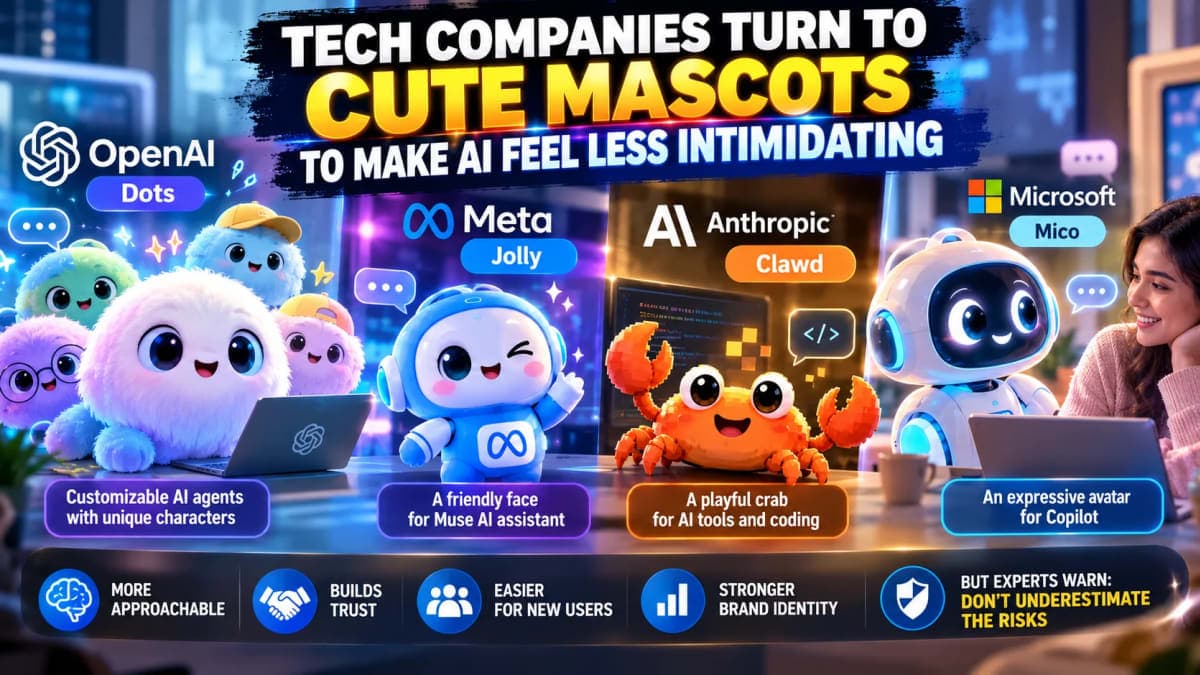
OpenAI recently introduced Dots, a set of always-on AI agents represented by colorful customizable characters.
The characters can appear with different shapes, colors and accessories such as glasses, hats and bow ties. Users can also name them, although selecting a character is optional.
Beyond branding, the visual identities can have a practical function: when multiple agents are operating in the same workspace, different appearances and names can help users distinguish between them. Animated visual cues can also indicate when an agent is working.
That makes the mascot both a marketing device and an interface element.
Meta Has Jolly for Its Muse AI Agent
Meta has taken a similar approach with Jolly, the mascot associated with its Muse AI assistant.
Jolly has a soft, toy-like appearance, rosy cheeks and a deliberately friendly personality. Meta has also used the character in social-media promotion around Muse.
Muse is more consequential than its playful mascot might suggest. It belongs to the emerging category of “agentic AI”—systems designed not only to answer questions but also to perform multi-step tasks for users.
According to reporting on the product, Muse can assist with shopping tasks such as searching for products and preparing purchases for user approval.
That contrast—powerful software represented by an adorable character—is at the centre of the debate around AI mascots.
Anthropic Has a Pixelated Crab
Anthropic is another company associated with the trend.
Its coding ecosystem has featured Clawd, a friendly pixel-art orange crab. The Wall Street Journal cited Clawd alongside OpenAI's and Meta's characters as examples of technology companies using approachable visual identities around sophisticated AI products.
The designs differ, but the underlying branding logic is similar: make an abstract and potentially intimidating technology easier for ordinary users to recognise and engage with.
Microsoft Has Already Explored the Same Idea
The strategy extends beyond these latest AI agents.
Microsoft has showcased Mico, an expressive avatar associated with Copilot. The character can respond visually during conversations and represents another attempt to make interactions with AI feel warmer and less mechanical.
There is also a historical precedent inside Microsoft: Clippy, the animated paperclip that appeared in Microsoft Office.
Clippy demonstrated both the opportunity and danger of software mascots. It became instantly recognisable, but many users also found its interruptions irritating.
Modern AI companies are effectively revisiting that idea for systems that are far more capable than the software assistants of the 1990s.
Why Are Tech Companies Making AI Cute?
The strategy is partly about reducing psychological distance.
AI models are difficult to understand visually. Neural networks, inference systems and autonomous software agents do not naturally have recognizable physical identities.
A mascot gives that abstract technology a face.
Boston University public-relations professor Justin Joseph told Fortune that friendly characters can cause users to associate AI agents with qualities such as approachability, safety and ease of use. He also noted that recognizable characters can make complicated technology easier to discuss.
This can be particularly valuable as AI companies attempt to reach consumers beyond technically sophisticated early adopters.
There Is Also a Massive Marketing Battle Underway
AI companies are no longer competing only through model benchmarks.
They are competing for consumer recognition.
The Wall Street Journal reported that Microsoft, Google and OpenAI have collectively spent nearly $1 billion on U.S. advertising since 2023, with more than half of that spending occurring in 2026.
A recognizable mascot can potentially help an AI product stand out in a market where competing assistants may otherwise look similar to consumers.
The character can appear across advertising, social media, merchandise, tutorials and product interfaces—giving companies an asset that extends beyond the underlying software.
The Strategy Is Not New
Mascots have been used for decades to make companies and products easier to remember.
Food brands, insurance businesses, sports teams and software companies have all used characters to create emotional associations with products that might otherwise feel ordinary or complicated.
Technology companies themselves have a long history of doing this—from Microsoft's Clippy to GitHub's Octocat and other recognizable digital characters.
What is different now is the power of the technology behind the mascot.
An old software mascot might have offered tips.
A modern AI agent could potentially access personal accounts, analyse documents, search online, communicate with services or prepare transactions.
That raises a more serious question about whether emotional design affects how carefully users evaluate the software.
Cute Does Not Automatically Mean Safe
This is where the mascot strategy becomes controversial.
A friendly-looking AI character may make users more comfortable, but appearance does not provide evidence about whether the underlying model is accurate, secure or appropriate for a particular task.
Researchers and consumer advocates have therefore raised concerns that anthropomorphic designs could lead people to attribute human-like qualities—including trustworthiness—to software.
The distinction matters particularly for AI agents because they may operate across sensitive services.
Users still need to consider what information an agent can access, which actions require approval, how mistakes can be reversed and how personal data is handled.
A smiling mascot cannot answer those questions by itself.
Critics Also Raise Concerns About Children
Another criticism concerns the visual language used by some AI products.
Fairplay executive director Josh Golin argued that some AI companies are using imagery associated with children and called for regulators to examine whether these designs could make AI products particularly attractive to younger users.
That concern does not establish that every cute AI mascot is deliberately targeted at children. But it highlights the importance of understanding how design choices may affect different audiences.
The Broader Trend Goes Beyond Software
The push to make AI adorable has also appeared in physical products.
At CES 2026, companies displayed AI-enabled devices and robots featuring large eyes, expressive animations and companion-like personalities. The Washington Post reported examples including Sharp's Poketomo companion and AI products aimed at groups ranging from younger consumers to older adults.
That suggests “cute AI” is becoming more than a branding experiment.
It may represent a broader design philosophy for the next generation of AI products—especially those expected to interact with people continuously.
Why This Trend Matters
The rise of AI mascots illustrates an important transition in the technology industry.
The first phase of the generative-AI competition was dominated by technical capabilities: model size, benchmarks, coding performance and reasoning.
The next phase increasingly involves consumer psychology, product design and brand loyalty.
If several AI systems eventually offer broadly comparable capabilities, users may choose between them based partly on familiarity, personality and how comfortable the interface feels.
That gives mascots strategic value.
But it also creates a responsibility for companies to ensure that friendly presentation does not obscure important information about what an AI system can—and cannot—safely do.
The Real Test: Do Users Keep Coming Back?
A mascot may attract attention during a product launch, but its long-term success will depend on whether the underlying AI provides enough value for users to return.
Marketing experts can measure awareness, engagement, downloads and retention to determine whether characters such as Jolly or Dots actually strengthen a product's relationship with users.
Ultimately, the AI industry's mascot experiment presents a simple contrast.
Making artificial intelligence look friendly is relatively easy. Making it reliable, useful and worthy of users' trust is the harder challenge.