SAD Backs Women’s Quota and Delimitation Bills After Modi Meeting
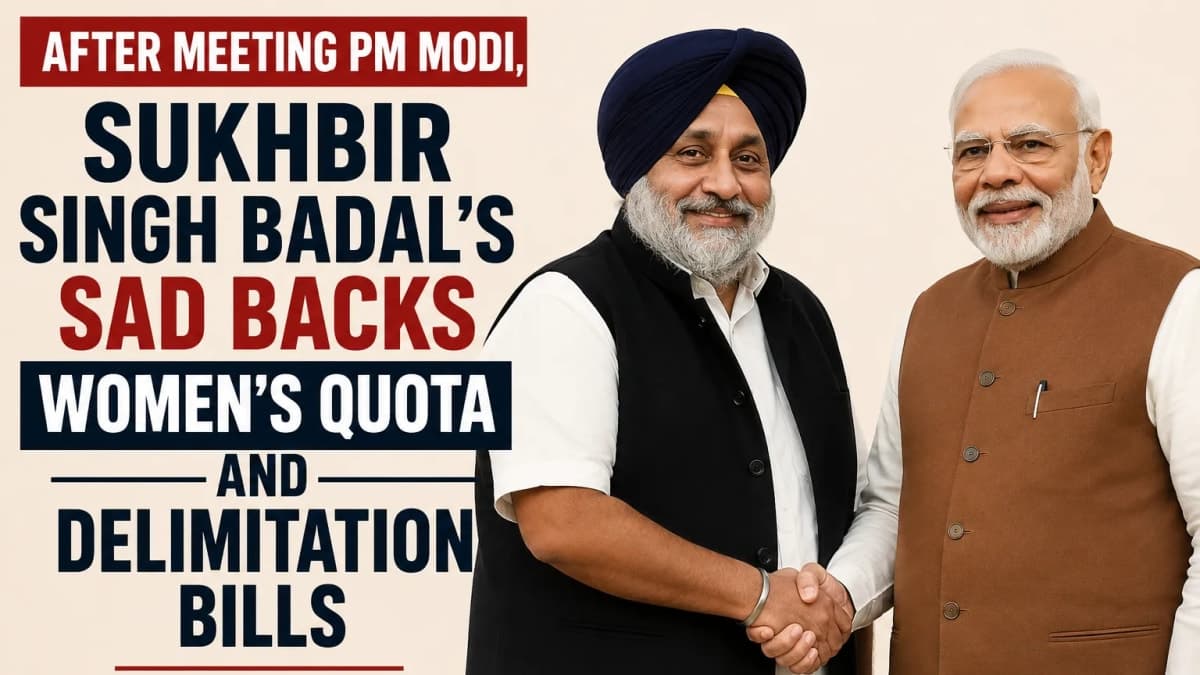
The Sukhbir Singh Badal-led Shiromani Akali Dal (SAD) has backed legislation concerning women’s political representation and delimitation following a meeting with Prime Minister Narendra Modi.
The development signals the party’s support for measures that could have significant implications for political representation and the future composition of elected bodies.
While the headline establishes the sequence of the meeting and SAD’s subsequent support, it does not provide further details about what was discussed between Badal and the Prime Minister. Therefore, it would be premature to attribute the party’s position directly to the meeting without additional information.
Women’s Representation Comes Into Focus
The women’s quota issue is significant because greater representation of women in elected institutions has remained an important subject in Indian politics.
SAD’s decision to support the measure places the Punjab-based regional party behind an initiative aimed at increasing women’s participation in political decision-making.
Beyond individual parties, debates over women’s representation also raise broader questions about how political organizations select candidates and ensure meaningful participation by women in governance.
Why Delimitation Matters
Delimitation is another politically consequential issue because it concerns how electoral constituencies and representation are structured.
Changes resulting from a delimitation exercise can affect the political balance between constituencies and potentially influence how different regions are represented. Consequently, political parties often examine delimitation proposals closely before deciding their positions.
SAD’s backing therefore carries significance beyond a procedural parliamentary decision, particularly because questions surrounding representation can have long-term electoral consequences.
Modi-Badal Meeting Draws Political Attention
The timing of SAD’s announcement after Sukhbir Singh Badal’s meeting with PM Modi is likely to attract political attention.
SAD has historically been an important regional force in Punjab, and its political decisions are closely watched for indications of its broader strategy. A meeting between the SAD leadership and the Prime Minister naturally generates interest about the evolving relationship between regional and national political players.
However, the available information does not establish whether the meeting resulted in any broader political understanding. The development should therefore be assessed on what has been confirmed: the meeting took place, and SAD has backed the two measures.
Support Does Not Automatically Signal Wider Political Alignment
SAD’s backing of the bills may create speculation about whether the party is moving toward closer political cooperation with the BJP-led national government.
Support for specific legislation, however, does not necessarily amount to an electoral alliance or a wider political partnership. Regional parties can support individual government measures while maintaining independent positions on other political and policy questions.
Without an explicit announcement from the parties concerned, interpreting the development as evidence of a broader alliance would go beyond the available facts.
Why the Development Matters
The significance of SAD’s position lies in the intersection of national legislation and regional politics.
Women’s representation has implications for who participates in elected institutions, while delimitation can shape the structure of political representation itself. Support from a prominent regional party therefore adds another dimension to the political debate surrounding both issues.
At the same time, the timing of the announcement following Badal’s meeting with Modi ensures that the development will also be viewed through the lens of Punjab politics and SAD’s future political strategy.
For now, SAD’s support represents a clear position on the two measures, while any larger political implications will depend on subsequent statements and developments.
This article is based on reporting published by Hindustan Times