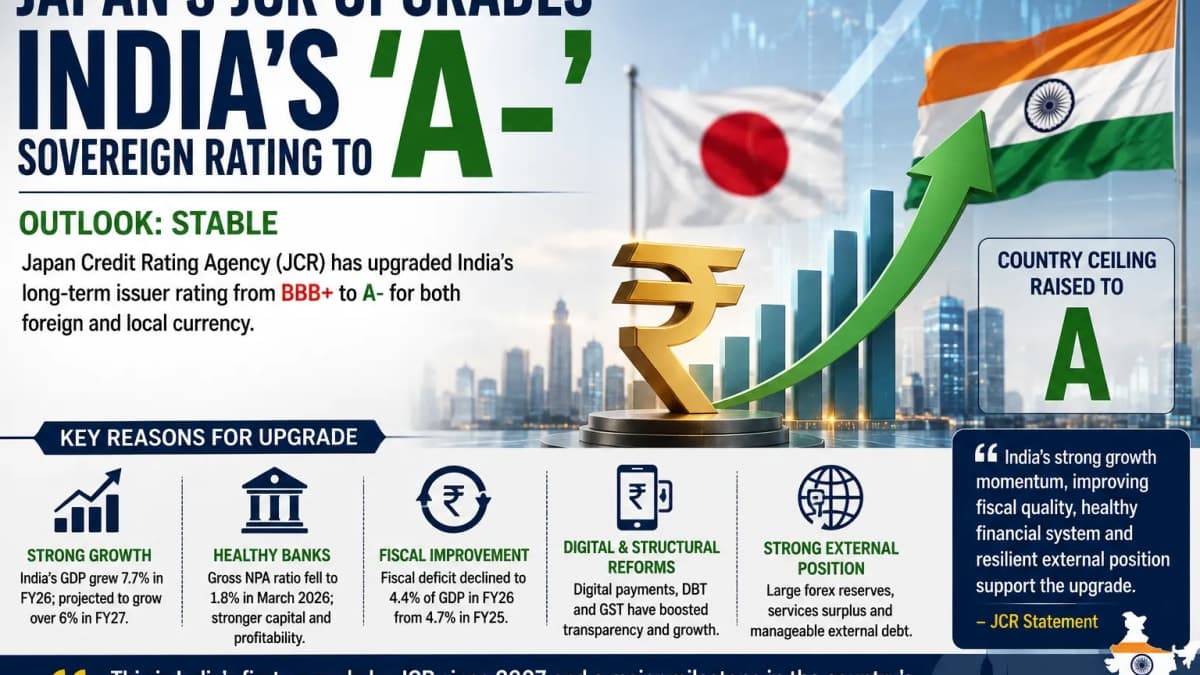
India has received a major sovereign credit rating upgrade from Japan Credit Rating Agency (JCR), which raised the country’s long-term foreign-currency and local-currency issuer ratings by one notch from BBB+ to A- while maintaining a Stable outlook.
JCR announced the decision on September 2, 2026, citing India’s sustained economic growth, policies strengthening the foundations of the economy, improvements in the quality of government expenditure and a substantially healthier financial system.
The agency also upgraded India’s country ceiling from A- to A.
The move is particularly significant because JCR had maintained India at BBB+ since 2007, meaning the latest decision represents the agency’s first upgrade of India in nearly two decades.
Why JCR Upgraded India
JCR’s decision rests on several improvements in India’s economic and financial fundamentals rather than a single factor.
The agency highlighted:
Sustained economic growth of around 7%
Robust private consumption
Strong public investment
Improved quality of government expenditure
Better banking-sector asset quality
Stronger non-banking financial institutions
Digital public infrastructure and GST-led structural changes
Fiscal consolidation
A resilient external position
JCR said India’s economic foundations have strengthened as the government has implemented policies aimed at improving productivity and supporting economic development.
Digital public infrastructure and implementation of the Goods and Services Tax were among the policy developments specifically highlighted by the agency.
India Grew 7.7% in FY2026
Economic growth was one of the central reasons behind the upgrade.
India’s economy expanded by 7.7% in real terms in FY2026, according to JCR.
Private consumption remained robust, supported partly by personal income-tax cuts and reductions in GST rates.
The momentum has continued into the current financial year.
Real GDP expanded by 7.8% in the first quarter of FY2027, demonstrating resilience despite a challenging international environment.
JCR expects India to maintain real economic growth of more than 6% in FY2027.
The agency noted that India’s economy has sustained growth of around 7% over time, supported by private consumption and public investment.
Banking Sector NPA Ratio Falls to 1.8%
The transformation of India’s banking system was another major factor supporting JCR’s decision.
The gross non-performing loan ratio of the banking sector declined to 1.8% at the end of March 2026.
JCR attributed the improvement to several factors, including the introduction of the Insolvency and Bankruptcy Code, government capital support for public-sector banks and stronger financial supervision by the Reserve Bank of India.
Capital adequacy and profitability in the banking sector also remained healthy.
India’s non-banking financial sector has strengthened as well, with improvements in both asset quality and capital adequacy.
Taken together, these developments contributed to JCR’s conclusion that the soundness of India’s financial system has improved significantly.
Digital Payments and Direct Transfers Strengthen Financial System
India’s digital transformation also featured in JCR’s assessment.
The widespread adoption of digital payments and direct transfers of government benefits into bank accounts has helped expand financial inclusion.
JCR also noted that these developments have made parts of the informal economy more visible within the formal financial system.
This matters from a sovereign-credit perspective because a broader and more transparent financial system can strengthen economic participation, improve the transmission of government programmes and increase visibility into economic activity.
Digital public infrastructure has therefore emerged not merely as a technology story but as one component of India’s broader economic reform framework.
Fiscal Deficit Declines to 4.4% of GDP
India’s fiscal position remains a challenge, but JCR recognised improvements in both the deficit and the composition of government spending.
The central government’s fiscal deficit declined from 4.7% of GDP in FY2025 to 4.4% in FY2026.
At the same time, capital expenditure remained elevated.
JCR noted that the government has attempted to restrain the growth of current expenditure, including subsidies, while directing more resources towards capital expenditure — particularly infrastructure.
That shift is important because not all government expenditure has the same long-term economic effect.
Infrastructure investment can potentially increase productive capacity, reduce logistical constraints and encourage private investment, while a persistent rise in recurring expenditure can place greater pressure on public finances.
JCR therefore concluded that the quality of fiscal expenditure has improved.
Government Debt Remains a Key Weakness
The upgrade does not mean JCR considers India's public finances free of risk.
The agency continues to identify government debt and fiscal pressures as structural challenges.
Central government debt stood at 56.1% of GDP at the end of FY2026 and is expected to decline gradually.
However, general government debt — which combines liabilities of the Centre and states — remains high, as does the associated interest burden.
JCR also highlighted challenges arising from India’s federal fiscal structure.
Fiscal transfers designed to reduce disparities among states, complex Centre-state financial relationships and fiscal management that can be influenced by electoral cycles can make deficit reduction more difficult.
These factors remain constraints on India’s sovereign credit profile despite the upgrade.
JCR Will Watch Whether Public Investment Attracts Private Capital
Another important question is whether India's heavy public investment can encourage a stronger private-sector investment cycle.
Government capital expenditure has played an important role in supporting economic growth, particularly through infrastructure development.
But JCR indicated that it will monitor whether this spending increasingly crowds in private investment.
That transition matters for the sustainability of India’s growth model.
If private companies increase capital expenditure in response to better infrastructure and stronger demand, the economy can become less dependent on government investment to maintain high growth.
If private investment remains subdued, however, maintaining the same growth momentum could require continued heavy public spending.
Foreign Exchange Reserves Support India’s External Position
India’s external finances provided another source of strength in JCR’s assessment.
The country continues to run a trade deficit, partly because strong domestic demand drives imports.
However, India’s large services surplus helps contain the current account deficit.
Foreign exchange reserves also remain substantial and are significantly larger than the country’s short-term external debt.
That provides an important buffer against external financial shocks.
For a sovereign rating agency, strong reserve coverage can reduce vulnerability to sudden changes in international capital flows, currency-market stress or external financing conditions.
What Does an ‘A-’ Sovereign Rating Mean?
A sovereign credit rating represents an agency’s assessment of a government's ability and willingness to meet its financial obligations.
Moving from BBB+ to A- takes India from JCR’s BBB category into its A category.
That does not mean India has become risk-free.
Rather, the upgrade indicates that JCR now assesses India’s creditworthiness more favourably than it did under the previous rating.
The Stable outlook is also important.
It indicates that JCR currently sees the balance of factors surrounding the rating as sufficiently steady rather than signalling an immediate likelihood of another upgrade or downgrade.
India’s Country Ceiling Raised to ‘A’
Alongside the sovereign upgrade, JCR raised India’s country ceiling by one notch to A.
A country ceiling generally reflects the maximum level at which certain domestic issuers can be rated after considering sovereign and country-level risks.
The higher ceiling can therefore have implications beyond the government's own borrowing profile.
However, an upgrade does not automatically mean every Indian company or financial institution will receive a higher rating.
Individual issuers continue to be assessed according to their own balance sheets, cash flows, business risks and financial strength.
How India Compares With Other Rating Agencies
JCR’s assessment is now notably stronger than the sovereign ratings India receives from several other major international agencies.
Other agencies continue to place India within the BBB/Baa investment-grade range.
This difference highlights an important point: sovereign ratings are assessments made independently by each agency using its own methodology.
One agency upgrading India does not automatically compel others to follow.
However, JCR’s decision adds to evidence that India’s growth performance, financial-sector repair and fiscal trajectory are increasingly being recognised by international credit assessors.
Any future upgrades from other agencies would depend on their individual assessments, particularly around government debt, fiscal deficits, per-capita income and economic resilience.
Finance Ministry Welcomes Upgrade
India’s Ministry of Finance welcomed JCR’s decision.
The ministry said the upgrade reflects the country’s strong and resilient economic growth, improving fiscal quality, strengthened financial system and robust external position.
The government also highlighted the fact that the decision comes amid a difficult global environment.
For policymakers, the upgrade provides external recognition of reforms and improvements in macroeconomic fundamentals.
For investors, however, the rating is one of several indicators used to evaluate sovereign risk and should be considered alongside fiscal, monetary, external and geopolitical conditions.
First ‘A’ Rating in More Than 35 Years
The upgrade has also drawn attention because of its historical significance.
N. K. Singh, Chairman of the 15th Finance Commission, said India was returning to an A-level sovereign rating after more than 35 years.
He pointed to Moody’s A2 rating in 1988 as the previous instance before India lost that rating around the 1990-91 balance-of-payments crisis.
The comparison should be treated carefully because Moody’s and JCR operate separate rating scales and methodologies.
Still, JCR’s A- rating represents a notable milestone in how at least one international rating agency now assesses India’s sovereign credit profile.
Could the Upgrade Lower India’s Borrowing Costs?
In principle, stronger sovereign credit ratings can improve investor perceptions of credit risk and potentially support more favourable financing conditions.
But the immediate market impact of a single upgrade should not be overstated.
Government bond yields and borrowing costs are influenced by numerous factors, including inflation, RBI monetary policy, domestic liquidity, fiscal borrowing requirements, global interest rates, currency expectations and investor demand.
The more meaningful long-term implication is reputational.
An improved sovereign rating strengthens the case that India's macroeconomic and financial fundamentals have become more resilient.
If that improvement continues — and if other rating agencies eventually reach similar conclusions — the cumulative effect could become more significant for global investors and financing conditions.
What Could Drive the Next Rating Move?
JCR’s assessment provides clues about what will matter next.
Sustaining high economic growth will be important, but growth alone will not determine India’s future rating trajectory.
Fiscal consolidation, declining government debt, continued banking-sector stability and stronger private investment are likely to remain central factors.
The agency will also be watching whether infrastructure-led public investment successfully encourages private capital expenditure.
External resilience will remain important as well, particularly in an environment of volatile energy prices and geopolitical uncertainty.
Why the JCR Upgrade Matters
The significance of the A- rating lies less in the letter itself than in the combination of factors behind it.
India has long combined rapid economic growth with comparatively weak fiscal indicators.
JCR’s upgrade suggests that improvements in banking-sector health, fiscal expenditure quality, economic reforms and external resilience have become substantial enough to outweigh some of those longstanding concerns in the agency’s assessment.
Challenges remain, particularly around high public debt and structural fiscal pressures.
But the direction of travel has changed enough for JCR to revise India's sovereign creditworthiness upward for the first time since 2007.
That makes the September 2026 decision an important milestone — not an endpoint — in India’s effort to translate rapid economic growth into a stronger sovereign credit profile.