Zerodha Gets SEBI Clearance for Merchant-Banking Licence, Opening Door to IPO Management
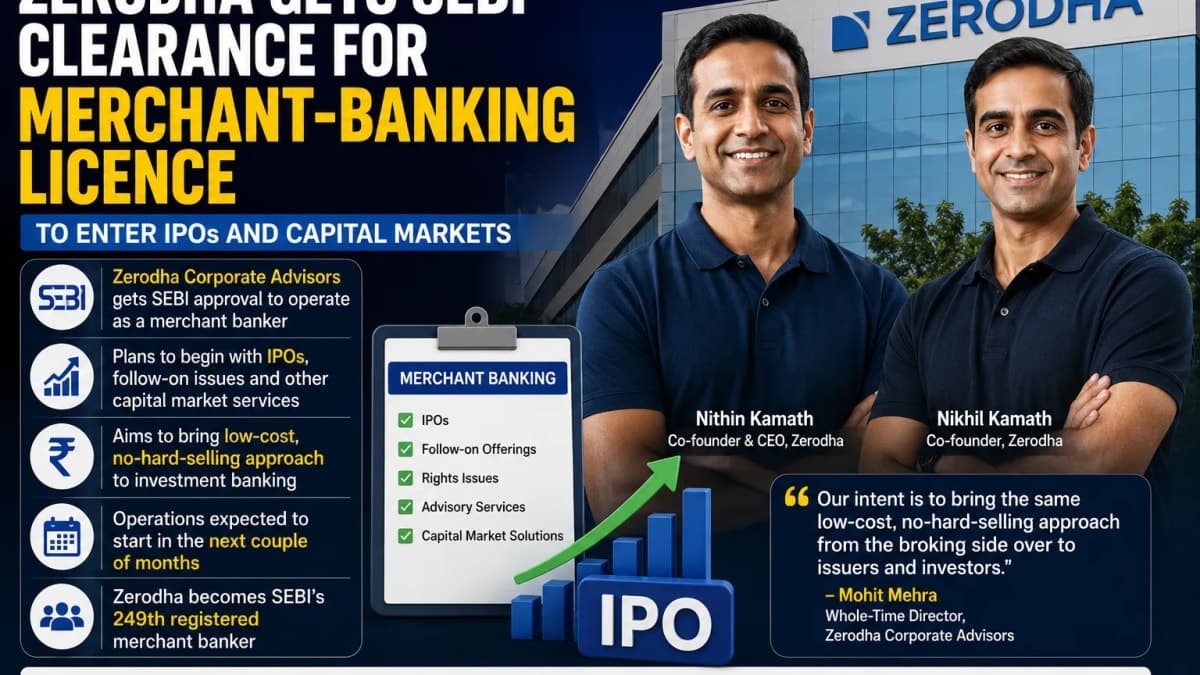
Zerodha is preparing to enter India's investment-banking business after its merchant-banking arm received regulatory approval from the Securities and Exchange Board of India (SEBI), marking a significant expansion for one of India's biggest discount-broking businesses.
The approval was granted to Zerodha Corporate Advisors Private Limited, which had submitted its application to SEBI on April 27, 2026. SEBI's intermediary records list 249 registered merchant bankers as of September 1, while reports citing the regulator's latest data say Zerodha's registration carries perpetual validity.
The move means Zerodha is expanding from primarily serving investors trading securities toward helping companies raise money from capital markets.
Zerodha Plans to Start Operations Within Months
Zerodha Corporate Advisors Whole-Time Director Mohit Mehra confirmed that the company plans to move relatively quickly following the regulatory approval.
“We've received the licence and will start operations over the next couple of months.”
Mehra said Zerodha will initially concentrate on equity capital markets, including IPOs, follow-on offerings and associated advisory work.
That gives a clearer picture of Zerodha's immediate ambitions: rather than attempting to enter every investment-banking segment simultaneously, its first push will be closely connected to public equity fundraising.
What the Merchant-Banking Licence Allows Zerodha to Do
The approval substantially broadens the role Zerodha can play in India's capital markets.
Until now, the group has been best known for providing the infrastructure through which retail and other investors buy and sell securities.
Merchant banking moves it to another part of the transaction.
Zerodha Corporate Advisors can participate in activities including initial public offerings (IPOs), follow-on public offerings (FPOs), rights issues and other capital-market transactions and advisory services.
In simple terms, Zerodha can now work with the companies raising capital, rather than limiting its relationship to investors participating in markets.
That potentially gives the group exposure to both sides of India's capital-market ecosystem.
Zerodha Wants to Bring Its Low-Cost Model to Investment Banking
One of the more interesting questions is whether Zerodha intends to reproduce the strategy that helped it disrupt India's retail brokerage industry.
Mehra indicated that it does.
“Our intent is to bring the same low-cost, no-hard-selling approach from the broking side over to issuers and investors.”
The statement suggests Zerodha intends to compete not merely through its brand or technology but also through pricing and the way it approaches clients.
Whether that model can have the same impact in merchant banking remains to be seen.
Investment banking differs significantly from retail stockbroking. Managing a public issue involves due diligence, regulatory compliance, valuation, investor engagement, underwriting considerations and extensive coordination between companies, lawyers, auditors, exchanges and regulators.
Zerodha will therefore be entering a business where relationships, execution capabilities and regulatory expertise are important alongside cost.
From Discount Broker to Broader Financial-Services Group
The merchant-banking move fits into a wider transformation already underway at Zerodha.
While the company built its reputation around low-cost stockbroking, the group has gradually moved into other areas of financial services, including asset management, lending and proprietary investments.
It has also received registration from the International Financial Services Centres Authority (IFSCA) as a broker-dealer in GIFT City, expanding the range of investment services it can potentially provide.
Merchant banking takes that diversification further because it places Zerodha directly into the corporate fundraising and investment-banking market.
India’s IPO Market Makes the Timing Significant
Zerodha's entry also comes during an important period for India's primary markets.
IPO activity slowed during the first half of 2026 amid market volatility and geopolitical uncertainty, causing some companies to delay listings.
However, activity recovered strongly during July and August, which together accounted for nearly 69% of IPO capital raised in India so far in 2026, according to Moneycontrol. Factors cited for the rebound include companies facing expiring regulatory approvals, more realistic valuations and continued funding requirements in sectors such as infrastructure and manufacturing.
A healthy pipeline of companies seeking public-market capital creates an obvious opportunity for new merchant bankers.
But it also means Zerodha will be entering a competitive industry populated by established Indian investment banks as well as major international institutions.
Zerodha Becomes SEBI’s 249th Registered Merchant Banker
As of August 31, 2026, SEBI had 248 registered merchant bankers, according to Moneycontrol. Zerodha's addition takes that number to 249, consistent with SEBI's September 1 intermediary database.
Competition could increase further.
SEBI's application-status data showed another 10 merchant-banking registration applications being processed, including applications associated with Haitong Securities India, Houlihan Lokey Advisory India and Societe Generale Securities India.
The numbers indicate that Zerodha is entering a segment attracting interest from both domestic financial-services businesses and international firms.
SEBI Has Also Tightened Merchant-Banker Requirements
The expansion comes as SEBI strengthens the regulatory framework governing merchant bankers.
Under the revised framework cited by Moneycontrol, the minimum net-worth requirement for Category I merchant bankers has been raised from ₹5 crore to ₹50 crore, while Category II entities are subject to a ₹10 crore threshold.
Category I firms can manage main-board public issues, whereas Category II merchant bankers face restrictions on doing so.
The framework also includes liquid net-worth requirements and limits aggregate underwriting commitments to 20 times liquid net worth. Existing merchant bankers are being given time to transition to the higher requirements, while new applicants such as Zerodha must satisfy the applicable rules.
That regulatory backdrop makes Zerodha's approval more consequential than a simple extension of its brokerage operations.
Why Zerodha’s Merchant-Banking Entry Matters
Zerodha helped reshape Indian retail broking by combining technology, transparent pricing and relatively low transaction costs. Merchant banking presents a very different test.
The company will now have to demonstrate whether elements of that operating philosophy can translate into a relationship-driven investment-banking industry.
If Zerodha successfully establishes an IPO and equity-capital-markets franchise, its business could begin spanning a much larger portion of a company's capital-market journey—from helping businesses raise money to providing the trading infrastructure through which investors subsequently transact in their shares.
The regulatory clearance therefore represents more than another financial-services licence. It marks Zerodha's formal move from primarily facilitating investment activity toward participating directly in corporate capital raising.