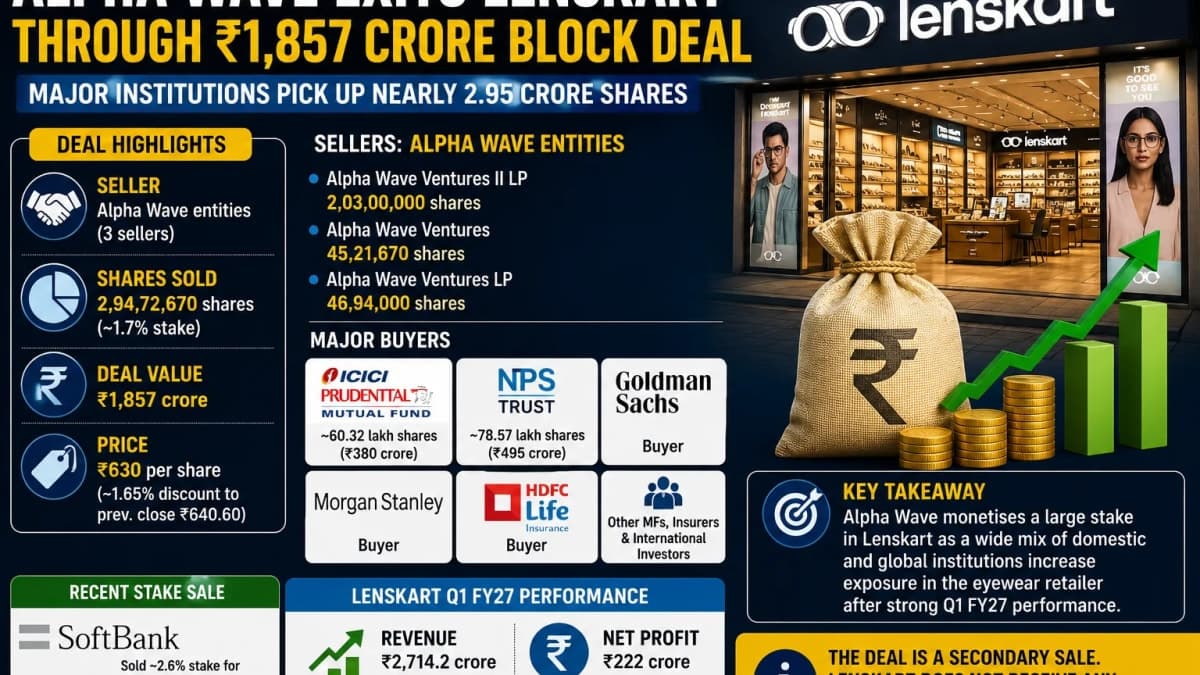
Lenskart Solutions has witnessed another major shift in its shareholder base after Alpha Wave-linked entities sold nearly 2.95 crore shares worth approximately ₹1,857 crore through block deals, transferring a sizeable holding in the eyewear retailer to a broad group of domestic and international institutional investors.
According to transaction data reported from the National Stock Exchange, 2,94,72,670 shares were sold at ₹630 apiece.
The transaction represented approximately 1.7% of Lenskart's equity and involved three Alpha Wave entities.
The buyers included mutual funds, insurance companies, pension funds and global institutional investors, with names such as ICICI Prudential Mutual Fund, NPS Trust, Goldman Sachs Bank Europe SE and Morgan Stanley Asia Singapore appearing in the disclosed transactions.
The deal is significant not because it brings fresh money into Lenskart—it does not—but because it represents another major transfer of ownership from an early institutional backer to public-market investors.
Alpha Wave Entities Sell Nearly 2.95 Crore Shares
The executed transaction was larger than initially expected.
Earlier reports indicated that Alpha Wave Ventures II LP was preparing to sell up to approximately 2.08 crore shares at a floor price of ₹630, potentially raising around ₹1,313 crore.
Final transaction details showed a considerably larger sale.
Three Alpha Wave-linked entities together sold 2,94,72,670 Lenskart shares at ₹630 each.
The sellers included:
Alpha Wave Ventures II LP: approximately 2.03 crore shares
Alpha Wave Ventures: approximately 45.21 lakh shares
Alpha Wave Ventures LP: approximately 46.94 lakh shares
Together, the transactions were valued at roughly ₹1,857 crore.
This distinction is important because initial market reports focused primarily on Alpha Wave Ventures II's proposed sale. The executed block-deal disclosures subsequently revealed participation from additional affiliated entities.
Shares Sold at ₹630 Apiece
All the disclosed transactions were executed at ₹630 per share.
Lenskart had closed at ₹640.60 on August 27, meaning the block price represented a discount of roughly 1.65% to the previous closing price.
Large secondary transactions are frequently executed at discounts to prevailing market prices because buyers are being asked to absorb substantial quantities of shares at once.
Following the transaction, Lenskart shares closed at ₹636.10 on Friday, August 28, down approximately 0.7%.
The relatively limited decline is noteworthy given the size of the supply introduced through the block deal.
ICICI Prudential Mutual Fund Makes Major Purchase
A diverse group of institutional investors absorbed the shares sold by Alpha Wave.
Among the largest disclosed buyers was ICICI Prudential Mutual Fund, which acquired approximately 60.32 lakh shares.
At ₹630 per share, that purchase was worth roughly ₹380 crore.
The transaction represents substantial institutional exposure to Lenskart and demonstrates that Alpha Wave's exit was matched by demand from major domestic investment institutions.
NPS Trust Buys Nearly ₹495 Crore Worth of Lenskart Shares
NPS Trust was another major buyer.
It acquired a combined approximately 78.57 lakh shares across three transactions.
At the ₹630 transaction price, those purchases were valued at close to ₹495 crore.
The presence of a pension-related institutional investor is notable because such investors typically operate with longer investment horizons than short-term traders.
However, participation in the block deal should not by itself be interpreted as a guarantee of Lenskart's future share-price performance.
It confirms institutional demand at the transaction price, not the future direction of the stock.
Goldman Sachs, Morgan Stanley and Insurers Join Buyers
Several other prominent domestic and international investors participated.
Reported buyers included:
WhiteOak Capital Mutual Fund
ICICI Prudential Life Insurance
HDFC Standard Life Insurance
Goldman Sachs Bank Europe SE
Morgan Stanley Asia Singapore
Bajaj Life Insurance
Edelweiss Mutual Fund
Motilal Oswal Mutual Fund
SBI Mutual Fund
Kotak Mahindra Mutual Fund
Nippon India funds
Kuwait Investment Authority
Société Générale
BofA Securities Europe
Susquehanna Pacific
Redwheel funds
The Teachers Retirement System of the State of Illinois and Retail Employees Superannuation Trust were also reported among participating investors.
The breadth of the buyer list means the transaction did more than simply transfer a large stake from one investor to another. It distributed shares among multiple domestic and overseas institutions.
Does Lenskart Receive the ₹1,857 Crore?
No.
This is an important distinction for investors.
The ₹1,857 crore transaction was a secondary share sale, meaning existing shareholders sold shares they already owned to other investors.
The money therefore goes to the selling shareholders rather than to Lenskart Solutions.
Lenskart does not receive ₹1,857 crore of new capital from the transaction.
No new shares were created as part of the block deal, so the transaction itself does not dilute existing shareholders.
Instead, it changes the ownership of existing shares.
That means the deal does not directly increase Lenskart's cash balance or provide additional funding for stores, manufacturing, technology or international expansion.
Alpha Wave’s Exit Part of Broader Early-Investor Selling
The transaction comes amid a broader reshuffling of Lenskart's shareholder base.
Alpha Wave is not the only major early investor to monetise part of its holding.
Earlier in the same week, SoftBank sold approximately 2.6% of Lenskart for around ₹2,888 crore, reducing its stake from roughly 9.86% to 7.28%.
Other early institutional shareholders have also monetised investments over time.
Such exits are not unusual following the public listing of a venture-backed company.
Private equity and venture capital investors generally invest with an eventual exit in mind. Once a company becomes publicly traded and lock-in restrictions permit sales, block transactions offer those investors a way to monetise substantial holdings without placing the entire order into ordinary market trading.
The important question for public investors is therefore not simply whether an early shareholder is selling, but who is willing to buy those shares and at what valuation.
Strong Institutional Demand Provides the Other Side of the Story
Large shareholder exits can initially appear negative because they increase the supply of shares available in the market.
But every completed block transaction also requires buyers.
In Lenskart's case, the presence of major mutual funds, pension investors, insurers and overseas institutions provides the other side of the transaction.
The deal therefore represents two developments simultaneously:
An early investor is monetising its holding.
New institutional investors are willing to acquire substantial exposure to Lenskart at ₹630 per share.
Neither development alone determines whether Lenskart's stock is attractive at its current valuation.
That depends ultimately on the company's ability to grow revenue, profitability and cash generation.
Lenskart Reports Strong Q1 FY27 Growth
The ownership transition comes as Lenskart continues to report substantial business growth.
For the first quarter of FY27, the eyewear retailer reported revenue of approximately ₹2,714.2 crore, representing strong year-on-year growth.
Reported net profit increased sharply to around ₹222 crore.
India remained an important growth engine, while the company's international business also expanded.
Those operating numbers provide important context for the institutional demand seen in the block deal.
Investors buying the stock are effectively making a judgment about whether Lenskart can sustain its growth as it expands its retail network, online operations and international presence.
Valuation Remains a Key Question
Strong growth does not eliminate valuation risk.
Lenskart has commanded a premium valuation since entering the public markets, creating debate over how much future expansion is already reflected in its share price.
At ₹630 per share, the company's equity valuation remains substantial.
That means future returns will depend not only on Lenskart continuing to grow but also on whether that growth meets or exceeds the expectations already embedded in the stock price.
If revenue and profits expand rapidly, investors may be willing to maintain a premium valuation.
If growth slows, valuation multiples could come under pressure even if the underlying business remains profitable.
The Alpha Wave transaction itself does not answer that question.
Why Block Deals Matter for Public Investors
Block deals are designed to facilitate large transactions between institutional participants without forcing huge orders through the regular market.
They can nevertheless influence market sentiment.
A large shareholder selling can create concerns about additional supply, particularly if other early investors also intend to reduce their holdings.
At the same time, distributing shares among a wider range of institutions can improve the stock's public float and trading liquidity.
That makes the identity of both sellers and buyers important.
In this case, the transaction represents a shift from concentrated early-investor ownership toward a broader group of public-market institutions.
Lenskart’s Ownership Transition Accelerates
Taken together with SoftBank's recent sale, the Alpha Wave transaction suggests Lenskart is moving through a significant post-listing ownership transition.
Early financial investors are beginning to realise returns on investments made before the company's public-market phase.
Meanwhile, mutual funds, insurers, pension funds and foreign institutions are increasingly taking the other side.
That is a common evolution for companies that move from venture-backed private ownership into mature public-market structures.
Whether the transition ultimately benefits shareholders will depend less on who is exiting today and more on Lenskart's operational performance in the years ahead.
Conclusion
Alpha Wave's roughly ₹1,857 crore Lenskart block deal marks one of the most significant recent changes in the eyewear retailer's shareholder base.
Three Alpha Wave-linked entities sold approximately 2.95 crore shares at ₹630 each, with the transaction representing around 1.7% of Lenskart's equity.
Major institutions including ICICI Prudential Mutual Fund, NPS Trust, Goldman Sachs, Morgan Stanley and several mutual funds and insurers emerged as buyers.
The transaction should not be confused with fresh fundraising by Lenskart. The company does not receive the ₹1,857 crore because the deal involves existing shares changing hands.
Instead, the development highlights a broader transition: early investors are monetising their stakes while a new generation of institutional shareholders builds exposure to Lenskart.
For investors, the next question is not simply who sold the shares—but whether Lenskart's growth and profitability can ultimately justify the valuation at which those new institutions have bought them.