Uttar Pradesh Launches Startup Policy 2026 With Major Deep-Tech Push
Lucknow: Uttar Pradesh has unveiled its Startup Policy 2026, outlining an ambitious strategy to strengthen the state's startup ecosystem and encourage technology-driven entrepreneurship.
Chief Minister Yogi Adityanath released the Startup Policy 2026 booklet at an event held at Lok Bhavan in Lucknow on August 27, 2026. The Uttar Pradesh Startup Mission Portal was also launched as part of the initiative.
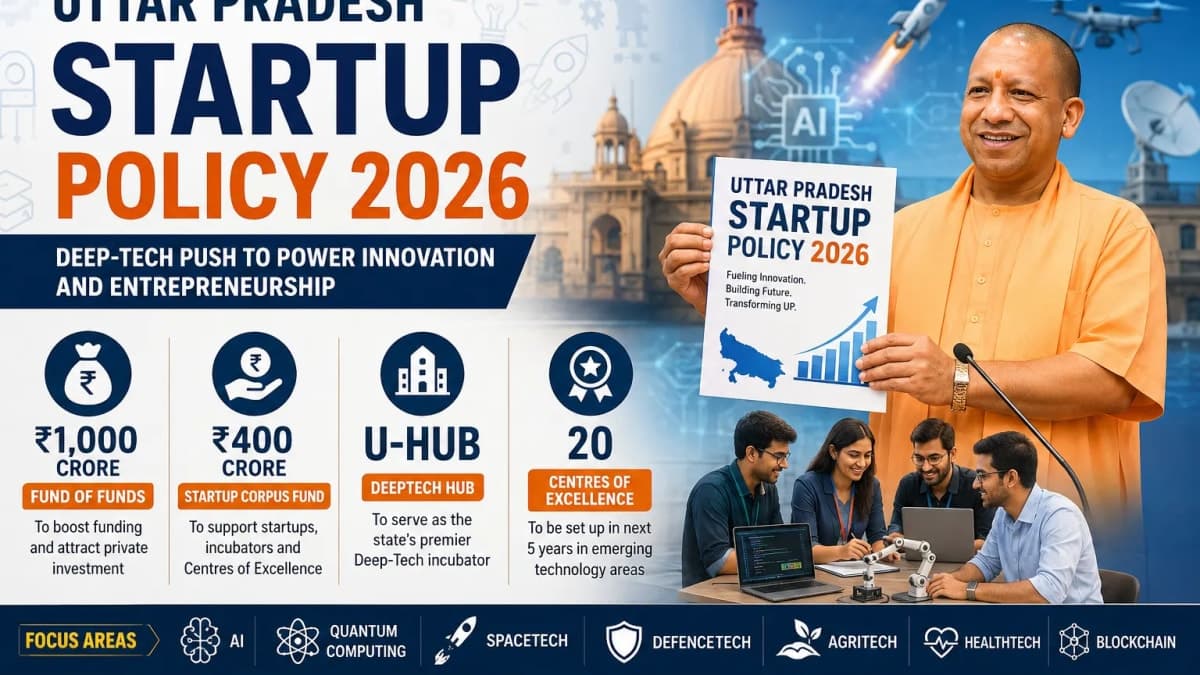
One of the defining features of the new policy is its emphasis on Deep-Tech startups. Businesses working in areas including Artificial Intelligence (AI), Quantum Computing, Blockchain, SpaceTech, DefenceTech, AgriTech and HealthTech are expected to receive targeted financial, research and incubation support.
₹1,000 Crore Fund of Funds to Support Startups
A major financial pillar of the Startup Policy 2026 is a ₹1,000 crore Fund of Funds aimed at improving access to capital for investment-ready startups and attracting greater private investment into Uttar Pradesh's startup ecosystem.
The broader framework also includes a ₹400 crore Startup Corpus Fund designed to support startups, incubators and Centres of Excellence.
The strategy is not limited to companies at the idea stage. It also aims to support promising businesses that have developed viable products and are preparing to scale their operations.
U-Hub to Become a Deep-Tech Innovation Centre
Under the policy, Uttar Pradesh plans to establish U-Hub, a dedicated DeepTech Hub, as a major incubation and innovation centre for technology-focused startups.
The government also plans to establish 20 new Centres of Excellence (CoEs) over the next five years.
These centres are expected to provide technical expertise, research infrastructure and mentorship to companies working in fields such as AI, Quantum Computing, SpaceTech and other emerging technologies.
The state also intends to expand incubation facilities beyond major urban centres through a Hub-and-Spoke model, potentially giving entrepreneurs in smaller cities and districts better access to startup infrastructure.
Special Financial Support for Deep-Tech Startups
Deep-Tech businesses often face challenges that differ significantly from those of conventional digital startups.
Developing advanced technologies can require expensive research, specialised laboratories, highly skilled professionals and several years before a commercially viable product reaches the market.
The Startup Policy 2026 attempts to address some of these challenges through targeted incentives.
Eligible Deep-Tech startups recommended by U-Hub or recognised Centres of Excellence may qualify for up to twice the standard Prototype and Seed Grant limits.
Selected Deep-Tech ventures may also receive up to ₹40 crore per startup in Patience Capital, providing longer-term financial support for businesses that require extended development cycles.
The policy additionally provides for royalty-based matching support of up to 40% of verified R&D expenditure and reimbursement of eligible cloud and data-centre expenses of up to ₹2 lakh annually for computing requirements, subject to applicable conditions.
Financial Incentives for Early-Stage Startups
The Startup Policy 2026 is not restricted to Deep-Tech companies.
Eligible early-stage startups can receive a sustenance allowance of up to ₹20,000 per month for two years during the initial stages of product development.
A Prototype Grant of up to ₹10 lakh is available for product development, while Seed Capital Assistance can generally reach ₹15 lakh.
In special cases, seed-capital proposals of up to ₹50 lakh may be considered.
Eligible startups that secure institutional investment from external investors can also qualify for a matching grant of up to 50% of the investment raised, subject to a maximum of ₹5 crore.
Extra Incentives for Women Entrepreneurs and Underserved Regions
Inclusive entrepreneurship is another important component of the policy.
Eligible women-led startups, ventures led by persons with disabilities, EWS entrepreneurs and transgender entrepreneurs can receive additional support.
Startups operating from Purvanchal and Bundelkhand are also eligible for enhanced incentives.
Such eligible startups may receive a 50% additional incentive on Prototype and Seed Grants.
Priority areas including AgriTech, Circular Economy, Rural Impact, Waste Management, Sustainability, Renewable Energy and Climate Change are also covered under enhanced support provisions.
The approach could help expand Uttar Pradesh's startup ecosystem beyond established centres such as Lucknow and Noida and encourage entrepreneurship in less-developed regions.
Government Distributes Incentives to Startups and Incubators
During the Startup Policy 2026 programme in Lucknow on August 27, Chief Minister Yogi Adityanath distributed more than ₹3.42 crore in incentives to 107 startups.
Another ₹1.79 crore was distributed to nine incubators.
Recognition certificates were also presented to new incubators, while the Startup Mission Portal was formally launched.
StartInUP Portal to Work as a Single-Window Platform
Digital access is another significant part of the government's startup strategy.
The StartInUP Portal is designed to function as a single-window platform where entrepreneurs can access registration services, incentive programmes, mentorship opportunities, investors and other ecosystem partners.
Eligible startups seeking benefits under the policy are required to be registered with DPIIT as well as the StartInUP platform.
Why Startup Policy 2026 Matters for Uttar Pradesh
India has developed into one of the world's largest startup ecosystems, but funding, technology talent and innovation activity remain heavily concentrated in a relatively small number of major cities.
Uttar Pradesh's new policy attempts to broaden that landscape.
The state has a large domestic market, a substantial young population, major educational institutions including IITs and rapidly developing technology and electronics clusters around Noida and Greater Noida.
Connecting these resources with venture capital, research infrastructure, incubators and industry partnerships could help Uttar Pradesh emerge as a stronger destination for technology startups.
The specific inclusion of AI, SpaceTech, DefenceTech and Quantum technologies is particularly significant.
It suggests that the state is looking beyond increasing the overall number of startups and wants to encourage companies capable of developing advanced intellectual property, research-driven products and sophisticated technologies.
Implementation Will Be the Key Challenge
While Startup Policy 2026 contains a broad range of financial incentives, the success of any startup policy ultimately depends on implementation.
One important measure will be how quickly and transparently eligible entrepreneurs can access the announced incentives.
Deep-Tech businesses require more than funding. They often need specialised laboratories, experienced researchers, intellectual-property support, connections with universities, access to global markets and investors prepared to wait several years for commercial returns.
Similarly, establishing incubators across districts will deliver meaningful results only if these centres have capable mentors, strong industry partnerships and genuine connections with investors.
The long-term impact of Startup Policy 2026 will therefore depend on how effectively its programmes are implemented and whether they ultimately produce scalable and sustainable companies.
Conclusion
The Uttar Pradesh Startup Policy 2026 represents an ambitious attempt to move the state's startup ecosystem toward a more technology- and research-driven future.
The ₹1,000 crore Fund of Funds, ₹400 crore startup corpus, U-Hub DeepTech Hub, 20 proposed Centres of Excellence and specialised financial mechanisms for Deep-Tech ventures give the policy a broad framework.
If Uttar Pradesh can effectively implement these programmes while building stronger links between entrepreneurs, universities, investors and established industries, the state could strengthen its position as one of India's important startup and Deep-Tech destinations over the coming years.