Amit Shah Sharpens Attack on Congress
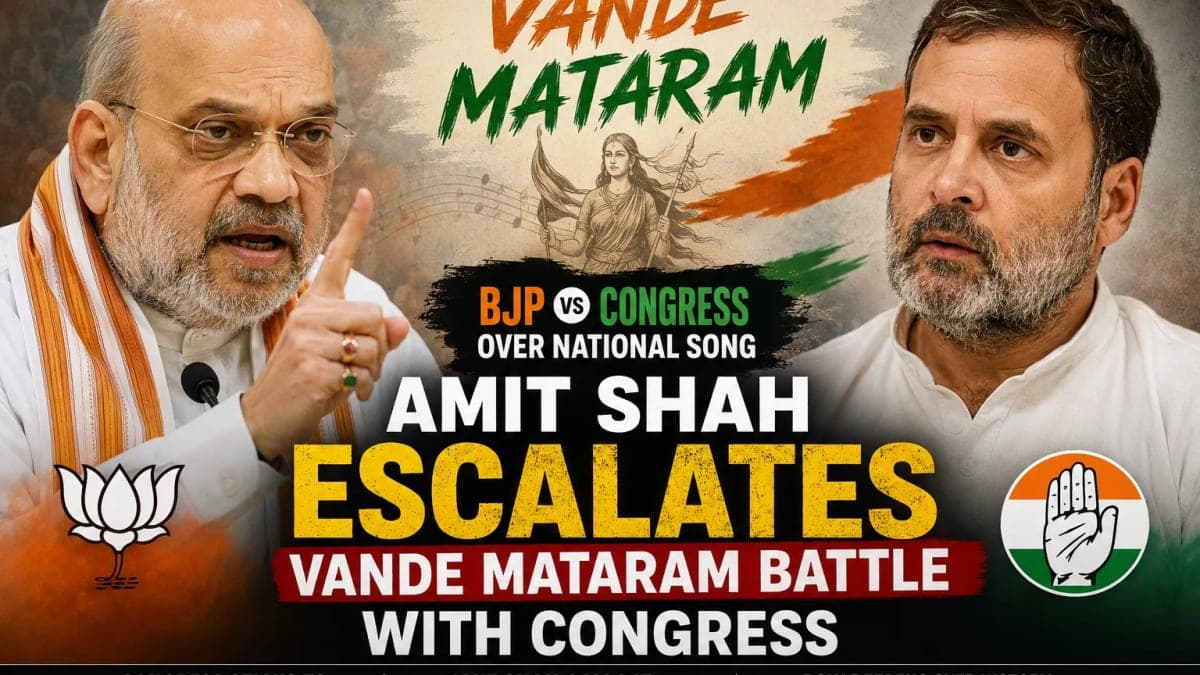
The dispute over Vande Mataram has moved to the centre of the political battle between the BJP and Congress, with Amit Shah strongly criticising a Congress Working Committee decision to maintain the party's practice of reciting the song's first two stanzas.
Shah characterised the Congress decision as “anti-national” and argued that the party was reviving an approach rooted in appeasement politics. His criticism also focused on the historical origins of the Congress position, linking the present controversy with decisions taken by the party leadership in the late 1930s.
The Congress Working Committee, however, has reaffirmed its two-stanza practice, maintaining that its position follows a tradition dating back to 1937.
The clash therefore extends beyond how many stanzas should be sung. It has become a wider argument over history, nationalism and which political tradition can legitimately claim the legacy of symbols associated with India's independence movement.
Independence Day Incident Added Fuel to the Controversy
The latest confrontation follows another dispute arising from the Independence Day programme at the Congress headquarters in New Delhi.
Shah had earlier alleged that Congress leader Sonia Gandhi attempted to have the rendition of Vande Mataram stopped during the programme. He demanded an apology from the Congress and argued that interrupting the song amounted to disrespect toward its historical importance.
The Congress denied that interpretation. Its version was that Gandhi was asking for a chair to be brought for Congress president Mallikarjun Kharge, rather than attempting to stop the song.
That disagreement turned what might otherwise have remained a dispute over an event video into a larger political confrontation.
Why the 1937 Decision Matters
The historical debate surrounding Vande Mataram is considerably older than the current BJP-Congress confrontation.
Written by Bankim Chandra Chattopadhyay, Vande Mataram became closely associated with India's anti-colonial movement. The song later generated debate over portions containing religious imagery.
Congress leaders have cited the party's 1937 position under which the first two stanzas were selected for public use. Congress representatives have argued that this historical decision was made after consultation that included Rabindranath Tagore and that the party's present practice follows that established tradition.
Shah's argument challenges the political meaning of that history. By portraying the decision as a concession driven by appeasement, the BJP is attempting to connect a decades-old controversy with its contemporary criticism of Congress politics.
Congress Hits Back at BJP
Congress has rejected Shah's accusations and sought to reverse the political argument.
Party leaders have said that Congress played a central role in the freedom struggle during the period when Vande Mataram became a powerful expression of resistance against colonial rule. They have accused the BJP of using the controversy to divert attention from other political and governance questions.
Congress general secretary Jairam Ramesh, responding to Shah's earlier demand for an apology, described the controversy as an attempt to distract the public from what Congress considers more pressing issues.
Former Rajasthan chief minister Ashok Gehlot has similarly argued that speeches cannot rewrite history, pointing to the association between Congress, Vande Mataram and the independence movement.
Why the Vande Mataram Battle Matters Politically
The controversy demonstrates how national symbols can become powerful instruments of political messaging.
For the BJP, the issue offers an opportunity to place nationalism and cultural identity at the centre of the political conversation while questioning Congress's historical decisions.
For Congress, the challenge is different. It must defend a position with historical roots without allowing the BJP to frame that position as opposition to the national song itself.
The debate is therefore operating simultaneously on two levels: one concerns the historical treatment of Vande Mataram, while the other concerns how that history is being interpreted for present-day political purposes.
Balanced Analysis
There is a clear difference between the established historical debate surrounding which portions of Vande Mataram have traditionally received official prominence and the political interpretations now being attached to that history.
The BJP argues that limiting the rendition weakens the recognition that should be given to the complete composition and reflects Congress's longstanding approach to identity politics. Congress counters that singing the first two stanzas follows an established historical position and does not amount to disrespecting the song.
Both parties therefore approach the dispute through fundamentally different political narratives.
For the BJP, it is increasingly a question of patriotism and historical correction. For Congress, it is a question of historical continuity and resistance to what it regards as the political appropriation of national symbols.
With both sides escalating their rhetoric, Vande Mataram is likely to remain more than a debate about a song. It has become another arena in the larger contest over India's political history, national identity and the legacy of the freedom movement.