BJP Gets Nearly 80% of Money From 19 Common Donors
Political funding disclosures for FY2024-25 reveal a striking difference in the amount received by BJP and Congress from donors who financially supported both parties.
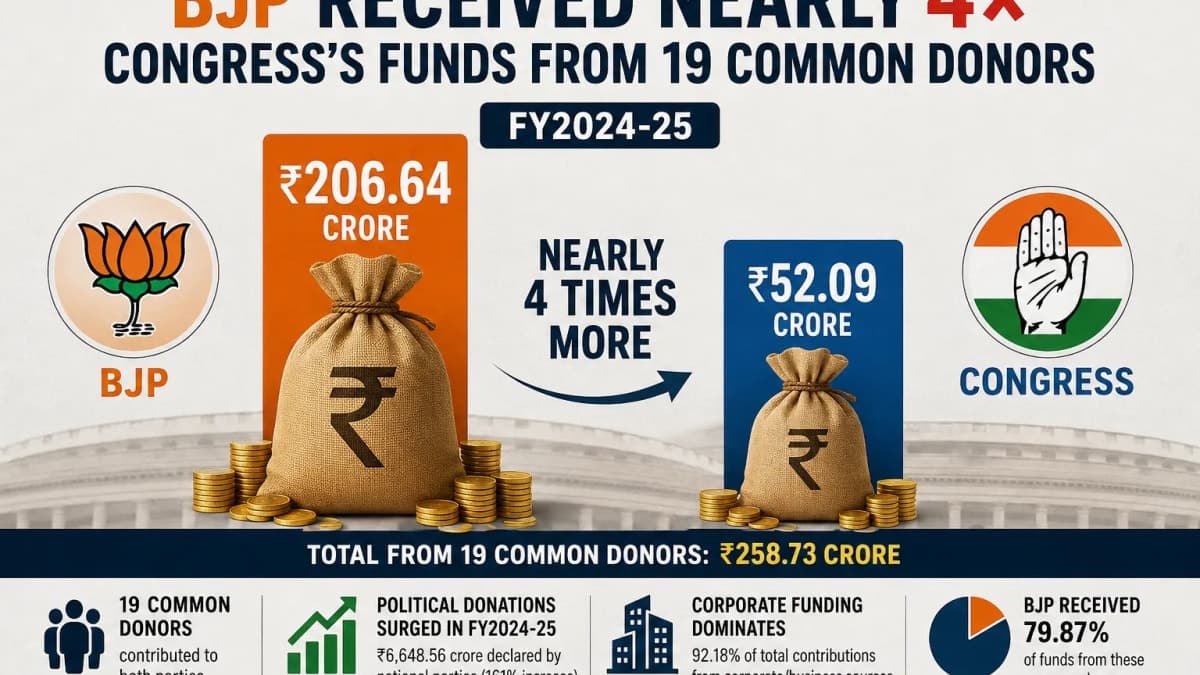
An examination of contribution reports filed by the two parties with the Election Commission identified at least 19 donors whose Permanent Account Numbers appeared in both sets of filings. Those donors collectively contributed approximately ₹258.73 crore to BJP and Congress.
Of that amount, the BJP received about ₹206.64 crore, or 79.87%, while Congress received approximately ₹52.09 crore, or 20.13%. Put another way, the BJP secured almost four rupees for every one rupee that Congress received from this particular group of shared donors.
The numbers do not mean these donors divided all of their political contributions only between BJP and Congress. Some donors also supported other political parties.
Political Donations Rose Sharply in FY2024-25
The common-donor figures form only a small part of a much larger surge in political contributions.
According to an analysis by the Association for Democratic Reforms (ADR), national political parties declared approximately ₹6,648.56 crore from 11,343 contributions exceeding ₹20,000 during FY2024-25. That represented an increase of around 161% compared with the previous financial year.
BJP was by far the largest recipient, reporting roughly ₹6,074.02 crore from 5,522 contributions, compared with around ₹517.39 crore from 2,501 contributions received by Congress. BJP's declared contributions increased about 171% from the previous year, while Congress recorded an increase of roughly 84%.
Other national parties reported considerably smaller amounts.
The scale of the difference illustrates that the gap seen among the 19 common donors is part of a broader financial imbalance between the country's two biggest national political parties.
Corporate and Business Funding Dominates
Corporate and business contributions were a major component of political financing during the financial year.
ADR classified approximately ₹6,128.79 crore—about 92.18% of the contributions received by national parties—as originating from corporate or business categories. Such contributions represented about 94.13% of BJP's declared total and 74.19% of Congress's total.
This concentration makes corporate political giving an important part of the wider debate surrounding transparency, electoral competition and the relationship between businesses and political parties.
However, a contribution by a company or individual should not automatically be interpreted as evidence of wrongdoing or a specific policy arrangement. Political donations can be made for a range of strategic, ideological or institutional reasons.
Five Donors Accounted for Most of the Common-Donor Pool
The distribution within the group of 19 donors was also highly concentrated.
The five largest common donors collectively contributed approximately ₹208.5 crore, representing more than 80% of the ₹258.73 crore received from the group.
Among the largest was Mumbai-based Derive Investments, which contributed ₹53 crore to BJP and ₹5 crore to Congress.
ITC Infotech India Ltd contributed ₹33.5 crore to BJP and ₹11.5 crore to Congress, while ITC Ltd, treated separately because it is a distinct legal entity, contributed ₹39 crore to BJP and ₹4 crore to Congress.
Cotton industry figure Suresh Amritlal Kotak contributed ₹30 crore to BJP and ₹7.5 crore to Congress. Hindustan Zinc Ltd contributed ₹15 crore to BJP and ₹10 crore to Congress.
These figures demonstrate that even among donors supporting both parties, the proportions allocated to each political organisation can differ substantially.
Some Donors Divided Contributions Almost Equally
Not every common donor showed a large preference for one party.
Century Plyboards (India) Ltd contributed ₹5 crore each to BJP and Congress, while Star Cement Ltd gave ₹3 crore to each party.
Micro Labs Ltd also distributed its contributions almost equally, providing ₹2 crore to BJP and ₹2.05 crore to Congress.
Other donors displayed much wider differences in their allocations. Finolex Industries, for example, contributed ₹5 crore to BJP compared with ₹1 crore to Congress.
The variation suggests there is no single pattern governing donors who support multiple parties.
Electoral Trust Donations Were Not Included in the 19-Donor Calculation
An important distinction is that the common-donor calculation concerned direct contributions appearing in the parties' filings.
Electoral trusts—which collect contributions before distributing funds among political parties—were excluded from the calculation because a company's contribution to a multi-donor trust cannot necessarily be directly linked to a specific political party without additional records establishing that connection.
Electoral trusts nevertheless represented a major source of political financing. ADR found that four trusts—Prudent, Progressive, AB General and New Democratic—contributed approximately ₹4,024.43 crore, representing more than 60% of the contributions covered by its analysis.
Why This Matters
Political funding affects the resources parties have available for campaigning, organisation, advertising, voter outreach and election-related infrastructure.
A substantial financial advantage does not automatically translate into electoral victory. The 2024 Lok Sabha election provides an important example: despite its financial dominance, BJP won 240 seats, below the 272 needed for an outright majority, and relied on NDA allies to form the government.
That distinction matters because campaign finance is only one factor shaping elections. Candidate selection, alliances, regional dynamics, voter sentiment, government performance and local issues can all influence electoral outcomes.
At the same time, a persistent financial gap between major parties can raise broader questions about competitive equality and the ability of political organisations to fund nationwide campaigns.
Balanced Analysis: What the Common Donors Tell Us
The presence of donors contributing to competing parties can be interpreted in several ways.
Businesses operating across India may seek working relationships with governments and political organisations regardless of which party holds power. Supporting more than one political formation can therefore represent diversification rather than ideological alignment.
For critics of India's political-finance system, however, the scale of corporate contributions strengthens arguments for greater disclosure and easier public scrutiny of who finances political parties.
The data also needs to be interpreted carefully. The 19 common donors represented only around 3.4% of BJP's total declared contributions, compared with approximately 10.1% of Congress's declared contributions.
Therefore, while the nearly four-to-one split is notable, it does not by itself explain the much larger overall funding difference between BJP and Congress.
The broader significance lies in what the disclosures reveal about modern political financing: large donors may support multiple parties simultaneously, but the amounts distributed among those parties can remain highly unequal.
This article is based on reporting published by TOI.