BJP Criticises Congress Leaders' Tributes
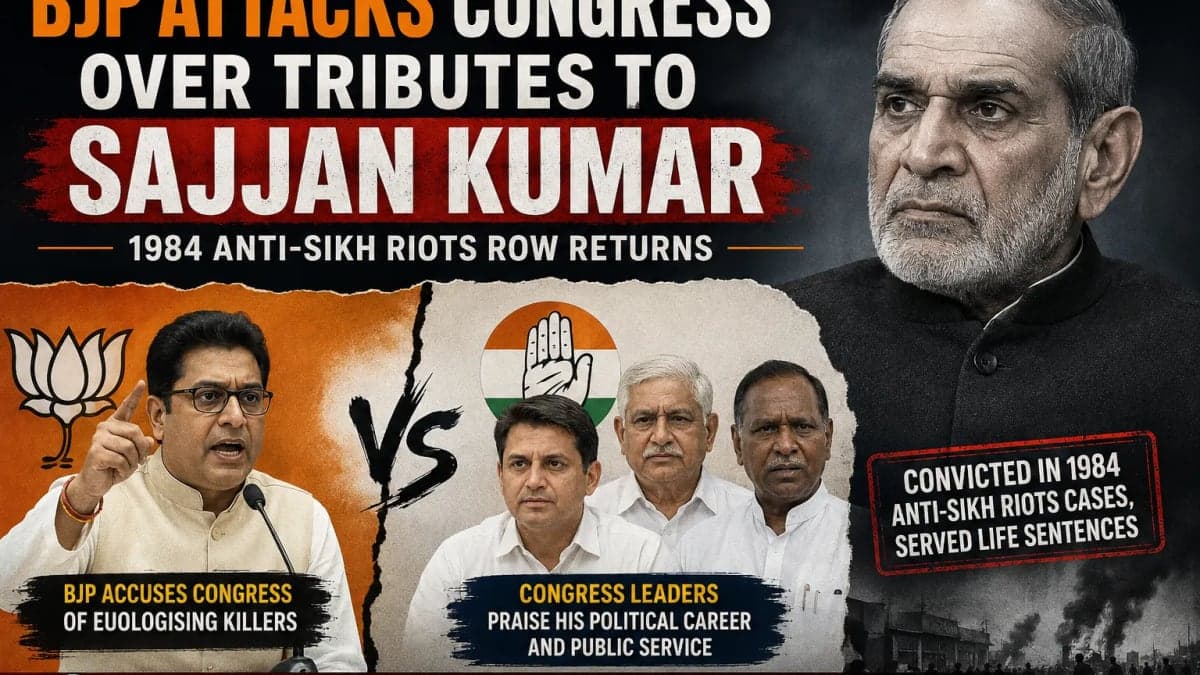
A fresh political confrontation erupted on Friday after BJP leaders objected to condolence messages issued by Congress figures for Sajjan Kumar.
Congress MP Deepender Singh Hooda described Kumar's death as a major political loss and highlighted his long-standing connection with people in Delhi, rural Delhi and other parts of northern India. Senior Congress leader Bhupinder Singh Hooda remembered Kumar as a close friend, while Congress leader Udit Raj reportedly described his death as a significant loss and referred to his work for poorer sections of society.
The BJP argued that such tributes could not be separated from Kumar's criminal convictions arising from the 1984 anti-Sikh violence.
BJP spokesperson Pradeep Bhandari accused Congress leaders of glorifying a person convicted in cases involving Sikh victims. He also invoked Rahul Gandhi's political messaging around his "Mohabbat Ki Dukan" theme to argue that the tributes contradicted the Congress's public emphasis on social harmony.
Why Sajjan Kumar Remained a Controversial Political Figure
Sajjan Kumar was once an influential Congress politician in Delhi, but his political career became inseparable from allegations and subsequent convictions linked to the violence that followed Prime Minister Indira Gandhi's assassination on October 31, 1984.
In December 2018, the Delhi High Court convicted Kumar in a case involving the killing of five Sikhs and the burning of a gurdwara during the violence, sentencing him to life imprisonment. He subsequently faced further legal proceedings and was serving life sentences in riot-related cases when he died.
Kumar had been imprisoned since 2018. His death came on the same day the Supreme Court was scheduled to consider a plea seeking temporary parole, according to reports.
Congress Condolences Trigger Political Questions
The controversy is not simply about whether political colleagues can express condolences after the death of a former associate. The central disagreement concerns how those condolences should acknowledge Kumar's convictions and the suffering of victims of the 1984 violence.
The BJP's position is that praising Kumar's political career or public service without giving adequate weight to his convictions risks appearing insensitive to survivors and families affected by the violence.
Congress leaders who offered condolences, meanwhile, focused primarily on their personal or political associations with Kumar and his work among constituents. The reported statements did not erase or overturn the judicial record against him.
1984 Violence Remains a Sensitive Issue in Indian Politics
The anti-Sikh violence of 1984 remains one of the most painful episodes in modern Indian history. Thousands of Sikhs were killed following Indira Gandhi's assassination, with Delhi witnessing some of the worst violence.
For decades, victims' families and Sikh organisations pursued accountability through investigations and court proceedings. Kumar's eventual conviction therefore carried significance beyond the fate of an individual politician: it became part of the broader struggle for judicial accountability over crimes committed during the riots.
That history explains why tributes to Kumar can generate reactions extending far beyond routine party politics.
Why the BJP-Congress Clash Matters
The dispute has particular political resonance because questions surrounding the 1984 violence have repeatedly featured in the rivalry between the BJP and Congress.
For the BJP, the latest statements provide an opportunity to challenge Congress's claims of promoting inclusiveness and reconciliation. By highlighting Kumar's convictions, BJP leaders are attempting to frame the Congress tributes as evidence of a contradiction between the opposition party's contemporary messaging and the actions of some of its leaders.
For Congress, the episode presents a different challenge. Condolences for a former colleague may be intended as personal or political gestures, but Kumar's judicial record means that any praise is likely to face scrutiny over whether it sufficiently recognises the experiences of victims and survivors.
Balanced Analysis
There are two distinct issues in the controversy that should not be conflated.
Political leaders routinely issue condolences when former colleagues die, and expressions of sympathy do not automatically amount to an endorsement of every aspect of a person's record. At the same time, Sajjan Kumar was not merely a politician surrounded by unresolved allegations: courts had convicted him in cases arising from the 1984 anti-Sikh violence.
That distinction gives the controversy its significance.
The BJP is entitled to politically challenge Congress leaders over the tone of their tributes, particularly given the continuing sensitivity surrounding the 1984 violence. However, political criticism should also remain grounded in established court findings rather than turning the suffering of victims into purely partisan ammunition.
For Congress, the episode demonstrates the difficulty of separating personal remembrance from historical accountability. Acknowledging a politician's death while explicitly recognising the judicial findings against him and the suffering of victims could have reduced the impression that his convictions were being overlooked.
Ultimately, the debate is larger than either party. It concerns how India's political establishment remembers controversial public figures whose careers include both political influence and serious criminal convictions—and whether remembrance can coexist with an unequivocal acknowledgement of historical injustice.
This article is based on reporting published by Moneycontrol.