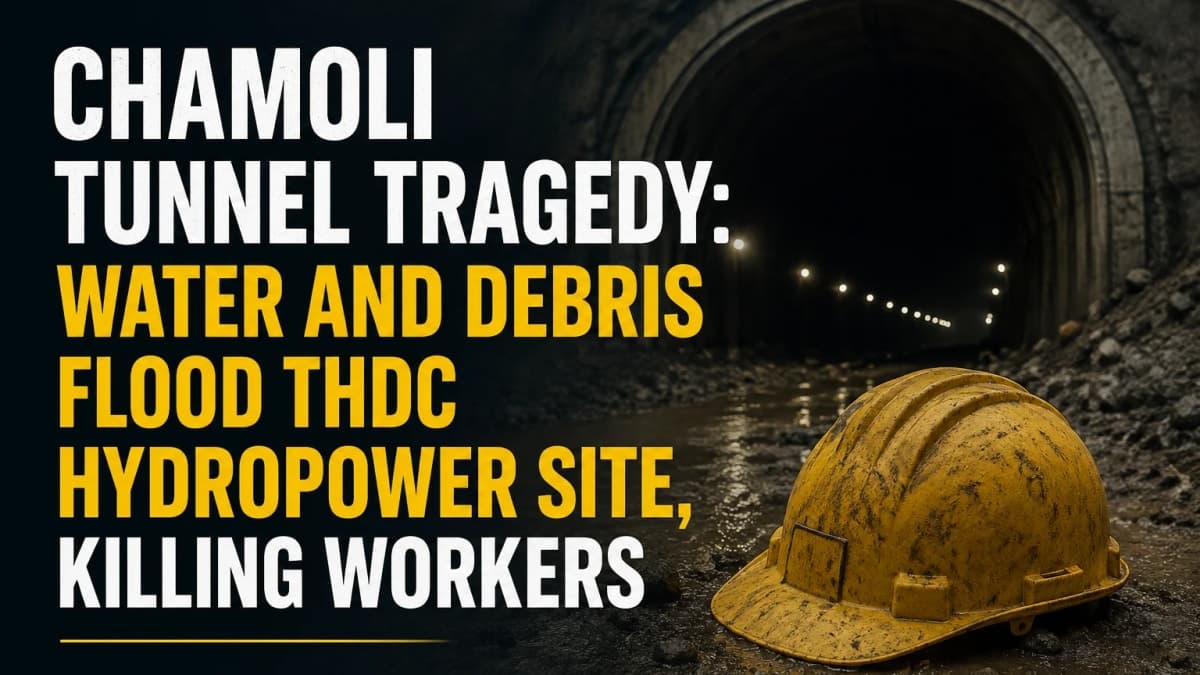
Chamoli Tunnel Accident: Workers Killed After Water and Debris Surge Into Hydropower Tunnel
A major rescue operation is underway in Uttarakhand’s Chamoli district following a deadly accident inside an under-construction tunnel associated with a THDC hydropower project.
The incident occurred near Mayapur in the Pipalkoti area on Thursday evening, when a large volume of water and debris suddenly entered the tunnel while workers were inside. Reports indicate that 22 workers were at the project site when the emergency unfolded.
Initial information said six workers had died, 14 had been injured and two remained trapped. As rescue work progressed, however, subsequent reports raised the confirmed death toll to seven, illustrating how quickly the situation was changing as teams gained access to affected sections of the tunnel.
Multi-Agency Rescue Operation Underway
Emergency personnel have been working to remove debris, manage water inside the tunnel and reach workers who remain unaccounted for.
The rescue response has involved the National Disaster Response Force (NDRF), State Disaster Response Force (SDRF), local administration and police, with other agencies also joining operations. Flooded portions and accumulated debris have made movement through the tunnel particularly difficult.
The priority remains locating the missing workers while ensuring rescue personnel can enter affected areas without exposing themselves to further collapse or water-related danger.
What Happened at the THDC Project?
The accident occurred at an under-construction hydropower tunnel near Pipalkoti in Chamoli. Officials reported that a sudden surge of water and debris entered the structure during the evening, trapping workers who were on duty inside.
The precise sequence of events and the underlying cause will require investigation. While reports have referred to landslides, subsidence and water ingress, conclusions about responsibility or possible safety failures should await technical findings.
Why the Chamoli Accident Matters
The tragedy again puts the safety of major infrastructure construction in the Himalayan region under scrutiny.
Uttarakhand’s mountainous terrain presents significant engineering challenges. Tunnelling projects must contend with complicated geology, groundwater, landslides and extreme weather. Such conditions do not by themselves establish the cause of an individual accident, but they make geological assessment, monitoring, drainage systems, emergency planning and worker protection particularly important.
The incident is also likely to renew discussion over how construction risks are assessed at large hydropower and tunnel projects and whether emergency procedures are adequate for workers operating deep inside confined structures.
Uttarakhand Has Faced Previous Tunnel Emergencies
Tunnel safety has received significant national attention in recent years. In November 2023, 41 workers were trapped for 17 days after a section of the Silkyara tunnel in Uttarkashi collapsed. All of them were eventually rescued following a complex multi-agency operation.
Chamoli itself has also experienced destructive Himalayan disasters. The devastating 2021 flood affected hydropower facilities in the district and left scores of people dead or missing, including workers at project sites.
Those earlier events provide important context, although the causes and circumstances of the latest Pipalkoti accident must be investigated independently.
Safety Questions Likely to Follow
Once the immediate rescue operation is completed, attention is likely to turn toward how such a large quantity of water and debris was able to enter the tunnel and whether there were warning signs before the accident.
Investigators may need to examine geological conditions, drainage arrangements, monitoring systems, construction procedures and emergency evacuation protocols. It will also be important to determine whether established safety standards were being followed at the time.
At this stage, however, assigning blame would be premature. A technical investigation will be necessary to distinguish between an unpredictable geological event and risks that could potentially have been identified or mitigated.
Balanced Analysis
Large hydropower and infrastructure projects can provide electricity, connectivity and economic benefits, particularly in mountainous regions where development is difficult. At the same time, construction in the Himalayas requires unusually careful management because geological and environmental conditions can change rapidly.
The Chamoli accident therefore carries significance beyond the immediate tragedy. It underscores the need to balance infrastructure development with rigorous geological assessment, continuous monitoring and strong workplace-safety systems.
For now, the central concern remains the workers affected by the disaster and the rescue teams attempting to reach anyone still trapped.
This article is based on reporting published by WION.