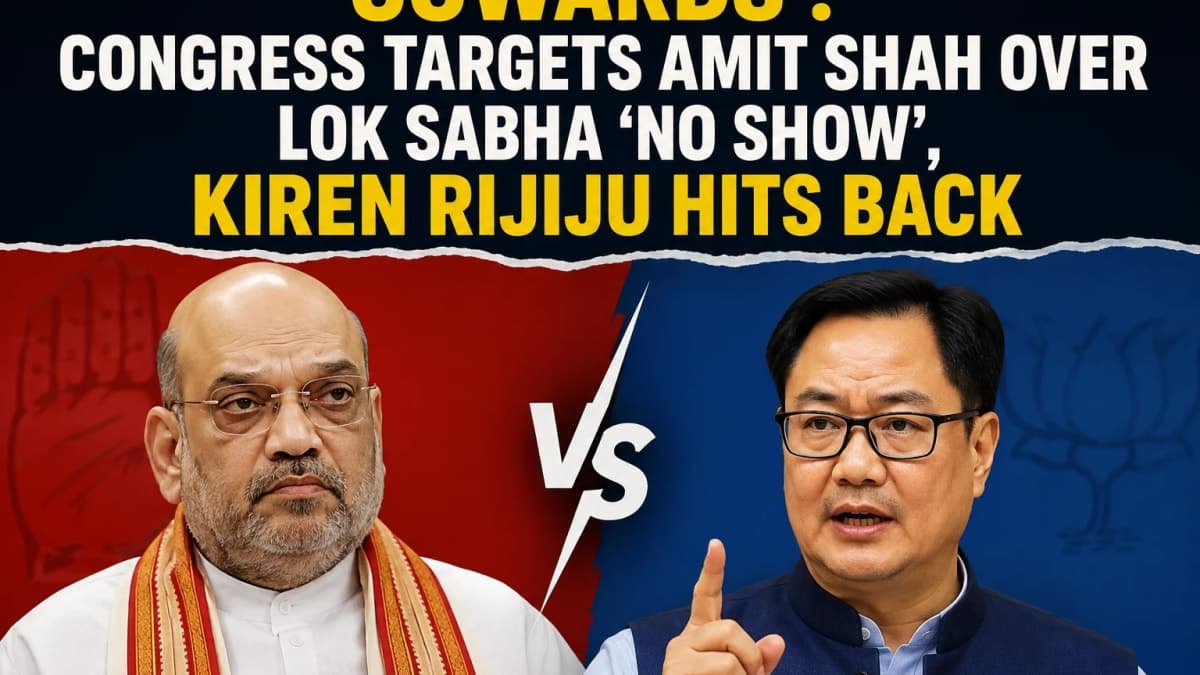
New Delhi: A fresh political confrontation erupted between Congress and the ruling side over Union Home Minister Amit Shah’s absence from the Lok Sabha, with the opposition launching a sharp attack and using the term “cowards” in its criticism. Union Parliamentary Affairs Minister Kiren Rijiju responded to Congress, pushing back against the opposition’s charge.
The exchange comes amid heightened political friction between the government and opposition in Parliament. The presence or absence of a senior minister in the House can become more than a matter of attendance, particularly when the opposition links it to questions of accountability and parliamentary responsibility.
Congress Questions Amit Shah’s Absence
Congress targeted Amit Shah over his absence from the Lok Sabha, signalling that the party viewed the matter through the broader lens of government accountability in Parliament.
The use of the word “cowards” also reflected the increasingly confrontational tone of political exchanges between the government and opposition.
By putting the spotlight on Shah, one of the most prominent figures in the Union government, Congress sought to intensify political pressure on the ruling side.
Kiren Rijiju Hits Back at Congress
Following Congress’ criticism, Kiren Rijiju responded to the opposition and challenged its attack.
The response indicated that the government was unwilling to allow Congress’ political narrative surrounding Shah’s absence to go unanswered.
Rijiju’s intervention also carries significance because, as Parliamentary Affairs Minister, he plays an important role in the functioning of Parliament and in coordination between the government and political parties.
Why Does the Controversy Matter?
The dispute extends beyond the question of whether Amit Shah was present in the Lok Sabha at a particular moment. At its core is the wider political debate surrounding government accountability and the opposition’s role in Parliament.
In a parliamentary democracy, the opposition is expected to question the government and seek accountability from ministers. At the same time, a minister’s absence at a particular point cannot automatically establish that the minister was deliberately avoiding parliamentary scrutiny.
That distinction is important when assessing the political claims being made by both sides.
Political Language Comes Into Focus
Congress’ use of the term “cowards” could also fuel debate over the tone of political discourse.
Sharp exchanges between the government and opposition are hardly unusual in Indian politics. However, highly charged language can sometimes shift attention away from the substantive parliamentary issue behind a controversy.
Supporters of aggressive opposition politics may view such language as a way of putting pressure on the government, while critics could argue that personal or provocative terminology reduces the scope for meaningful parliamentary debate.
Balanced Analysis
The episode highlights the contrasting political strategies of the two sides. Congress appears to be using Amit Shah’s absence to raise a broader question about government accountability, while Rijiju’s response represents the government’s effort to counter that narrative.
However, it would be inappropriate to draw conclusions about the reason or intention behind Shah’s absence solely on the basis of political allegations. Based on the facts available for this report, the controversy centres on Congress’ criticism of Shah’s Lok Sabha absence and Rijiju’s subsequent response.
The larger significance will depend on whether the confrontation remains a political war of words or develops into part of a wider parliamentary debate between the government and opposition.
This article is based on reporting published by HT News Desk.