PM’s Breakfast Meeting Draws Political Attention
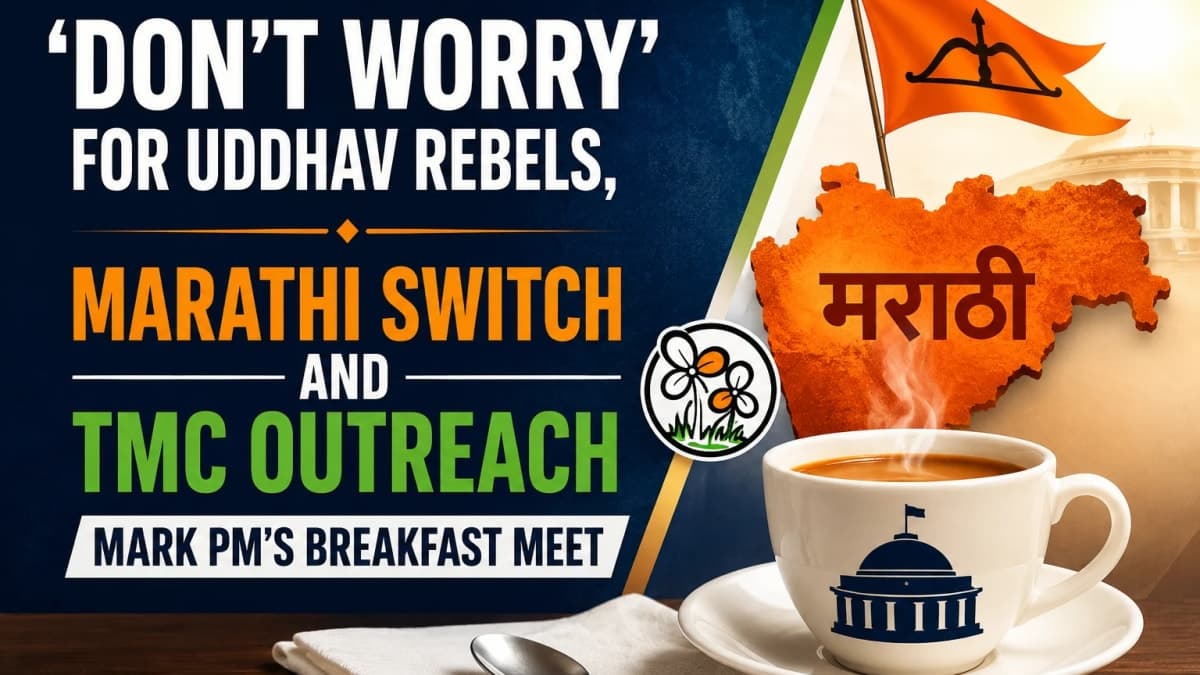
An informal breakfast meeting hosted by the Prime Minister has emerged as a talking point in political circles, with attention centring on three elements of the interaction — reassurance for rebels associated with Uddhav Thackeray’s political camp, the use of Marathi, and outreach towards the Trinamool Congress.
While breakfast meetings in political circles can often be social or parliamentary in nature, seemingly small exchanges at such gatherings can attract considerable attention when they involve parties and leaders navigating sensitive political equations.
The “don’t worry” message connected with the Uddhav rebels is particularly significant because Maharashtra politics has undergone major realignments in recent years. Without additional details about the precise context of the remark, however, it would be premature to interpret it as a formal political assurance.
Why the Marathi Switch Matters
The switch to Marathi during the interaction also carries symbolic significance.
Language frequently plays an important role in Indian political communication, particularly when national leaders engage with representatives from states where regional identity has a strong political presence. Speaking in Marathi can help create familiarity and establish a more direct connection with Maharashtra-linked participants.
At the same time, a conversational language switch should not automatically be treated as evidence of a new political strategy. It may simply reflect the informal character of the breakfast interaction.
Nevertheless, in Maharashtra's highly competitive political environment, such gestures are likely to be closely interpreted by parties on all sides.
‘Don’t Worry’ Message and Maharashtra Politics
The reference to Uddhav rebels adds another layer to the political significance of the meeting.
Maharashtra has witnessed substantial political churn following divisions within parties and alliances. Uddhav Thackeray's political camp has been at the centre of that transformation, making any interaction involving rebels or former associates politically noteworthy.
A reassuring message at a high-level meeting could be interpreted as an effort to maintain confidence among political partners or participants. But without further details about who received the message and the circumstances in which it was delivered, its wider political implications remain uncertain.
TMC Outreach Adds a Cross-Party Dimension
Another notable aspect of the breakfast interaction was outreach towards the Trinamool Congress.
TMC has frequently positioned itself as a major political opponent of the BJP, particularly in West Bengal and at the national level. Against that backdrop, even informal engagement can draw attention.
Political outreach, however, does not necessarily indicate a change in alliances or ideological positions. Parliamentary politics routinely requires communication between parties that remain fierce electoral rivals.
The significance may therefore lie less in immediate political realignment and more in keeping channels of communication open.
Informal Meetings Can Carry Formal Political Signals
Political breakfast meetings occupy an unusual space. They are informal enough to encourage conversations that might not occur during structured meetings, yet high-profile enough for individual remarks and gestures to acquire wider political meaning.
The combination of reassurance concerning Uddhav-linked rebels, communication in Marathi and outreach to TMC gives the meeting significance across more than one political front.
For Maharashtra, the interaction can be viewed against the backdrop of continuing competition among rival political formations. For national politics, engagement with TMC highlights how communication across party lines can coexist with sharp electoral rivalry.
Balanced Analysis: Gesture or Larger Strategy?
It would be easy to interpret all three developments as evidence of a coordinated political strategy, but the available facts do not establish that conclusion.
The “don’t worry” remark could represent reassurance without implying a new political arrangement. The Marathi conversation could simply be an effort to communicate comfortably with Maharashtra representatives. Similarly, engagement with TMC could reflect ordinary political courtesy rather than a shift in relations.
Yet politics is also shaped by symbolism. When senior leaders communicate in informal settings, language choices, reassurance and cross-party gestures can influence perceptions among allies and opponents.
The breakfast meeting therefore matters not necessarily because it confirms a political realignment, but because it demonstrates how informal interactions can become part of the broader messaging surrounding coalition management, regional politics and relations between competing parties.
Why This Matters
The meeting highlights three important features of contemporary Indian politics: managing relationships within fragmented political landscapes, recognising regional identities in national-level engagement, and maintaining communication between rival parties.
Whether these moments lead to any concrete political development will depend on subsequent events. For now, the breakfast interaction offers more evidence of the importance of personal communication and political signalling alongside formal negotiations.