हिंदी में पढ़ें —JantaScope हिंदी
Politics

Former Congress MP Sajjan Kumar Dies at 80 While Serving Life Sentence in 1984 Anti-Sikh Riots Cases

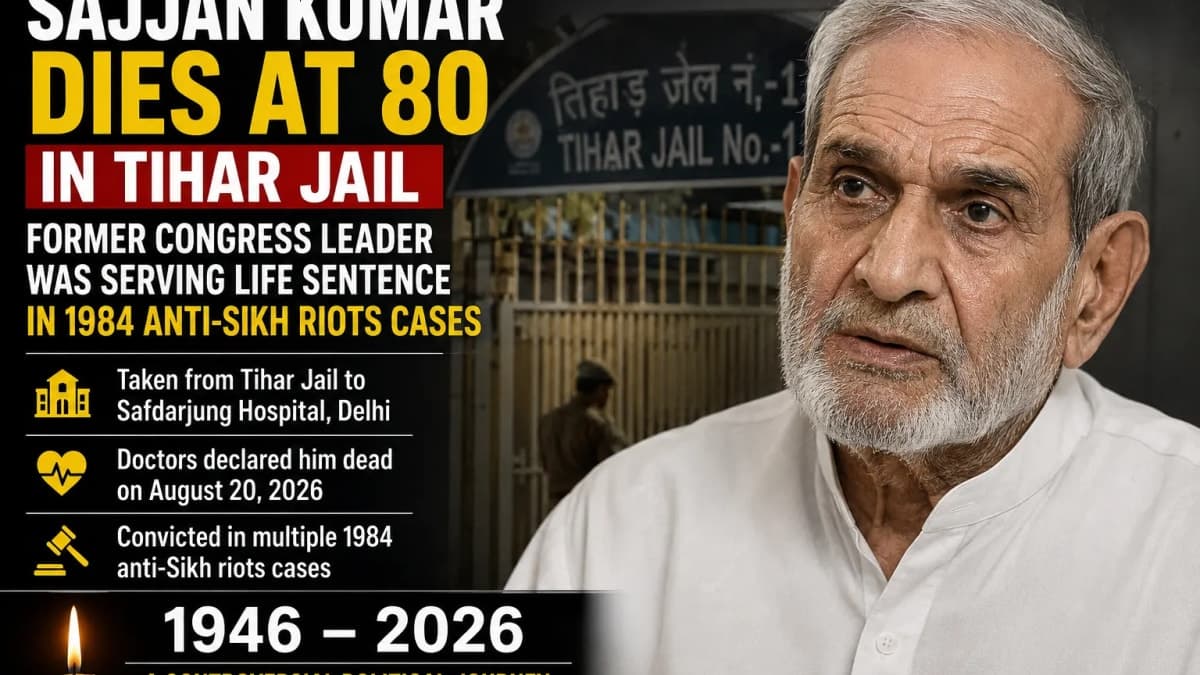
Former Congress MP Sajjan Kumar died on Thursday, August 20, 2026, at the age of 80 while serving a life sentence in cases connected with the 1984 anti-Sikh violence in Delhi. Kumar was taken from Tihar Jail to Safdarjung Hospital, where doctors declared him dead. At the time of initial reports, the hospital had not officially disclosed the cause of death.

Former Congress MP Sajjan Kumar Dies at 80 While Serving Life Sentence in 1984 Anti-Sikh Riots Cases

By Jeet Nirmal

Source: TOI

Sajjan Kumar Dies at 80

Former Congress parliamentarian Sajjan Kumar, one of the most prominent political figures convicted in cases arising from the 1984 anti-Sikh violence, died in Delhi on Thursday.

Kumar had been lodged in Tihar Jail while serving a life sentence. After being taken to Safdarjung Hospital on August 20, he was declared dead by doctors. He was 80 years old. Initial reports said the hospital had not clarified the precise cause of his death.

His death closes a controversial chapter involving a politician who once wielded considerable influence in Delhi but whose later years were dominated by criminal proceedings connected to one of the darkest episodes of communal violence in independent India.

From Delhi Politics to Criminal Conviction

Kumar was a three-time Lok Sabha MP and for decades remained an influential Congress politician in Delhi. His political career, however, became inseparable from allegations and subsequent convictions connected with the violence against Sikhs following the assassination of then Prime Minister Indira Gandhi in 1984.

A major legal turning point came in December 2018, when the Delhi High Court convicted Kumar in a case involving the killing of five members of a Sikh family and the burning of a gurdwara during the 1984 violence. He was sentenced to life imprisonment and subsequently resigned from the Congress.

Kumar had remained in custody since 2018. His legal troubles continued beyond that conviction, with another Delhi court sentencing him to life imprisonment in 2025 in a separate case connected with the killings of Jaswant Singh and his son Tarundeep Singh.

Why Sajjan Kumar's Death Matters

Kumar's death carries significance beyond the end of a former politician's life. His prosecution became closely associated with the decades-long struggle by victims and their families to secure accountability for the 1984 anti-Sikh violence.

The lengthy gap between the violence and major convictions also made the cases an important part of India's wider debate over delayed justice, political influence, investigation of communal crimes and the ability of victims to pursue accountability over several decades.

Kumar's transformation from an influential parliamentarian into a convicted prisoner demonstrated that cases involving politically powerful individuals can remain legally consequential even many years after the original crimes.

A Political Legacy Overshadowed by 1984

During his political career, Kumar built a substantial electoral presence in Delhi and served in Parliament multiple times. But his convictions ultimately came to define his public legacy far more strongly than his years as an elected representative.

For survivors and families affected by the 1984 violence, the legal proceedings involving Kumar represented part of a much longer search for recognition and justice. His death does not erase the judicial findings against him, nor does it close the broader historical discussion surrounding responsibility for the violence.

At the same time, his death may affect any legal proceedings involving him that had not reached final resolution, while cases concerning other accused individuals remain separate matters governed by their own evidence and judicial processes.

Balanced Analysis

Sajjan Kumar's death sits at the intersection of politics, history and criminal justice. His supporters once viewed him as a powerful grassroots political figure in Delhi, but courts later convicted him of grave offences linked to the 1984 violence.

The case also illustrates how difficult accountability can become when investigations and trials stretch across generations. For victims, delayed convictions may provide legal recognition but cannot compensate for decades spent waiting for cases to reach decisive outcomes.

It is therefore important to distinguish Kumar's death from the historical and judicial record surrounding the 1984 violence. His passing ends his personal journey through the criminal justice system, but public discussion about institutional accountability, victims' rights and delayed justice is likely to continue.


This article is based on reporting published by TOI.

Related

More stories

Xi Jinping Likely to Visit India After 7 Years for BRICS Summit in Major Diplomatic Development

Chinese President Xi Jinping is likely to travel to New Delhi for the BRICS Summit on September 12–13, 2026, in what would be his first visit to India in seven years. Reports indicate he could arrive with a delegation of about 400 officials, while his final travel plans have not yet been officially confirmed.

Politics

Xi Jinping Likely to Visit India After 7 Years for BRICS Summit in Major Diplomatic Development

Tension at Vidhana Soudha as Karnataka BJP Protest Over Valmiki Corporation Case Escalates

Political tensions intensified around Bengaluru's Vidhana Soudha as Karnataka BJP leaders and workers protested demanding the removal of minister B Nagendra over alleged financial irregularities involving the Maharshi Valmiki Scheduled Tribes Development Corporation. Police blocked protesters attempting to move toward the legislature, leading to scuffles and the detention of several BJP leaders.

Politics

Tension at Vidhana Soudha as Karnataka BJP Protest Over Valmiki Corporation Case Escalates

Women’s Reservation Back in Spotlight: BJP and Congress Clash as Rahul Gandhi Becomes Centre of Political Battle

The debate over women’s political representation has returned to the centre of national politics, with the BJP and Congress trading sharp accusations over the implementation of the 33% reservation for women in the Lok Sabha and state assemblies. Rahul Gandhi has emerged as a key figure in the confrontation as both sides challenge each other’s record on women’s empowerment.

Politics

Women’s Reservation Back in Spotlight: BJP and Congress Clash as Rahul Gandhi Becomes Centre of Political Battle

Parliament Session Ended 10 Days Ago — So Why Has It Still Not Been Formally Closed? Congress Raises Questions

A procedural delay after Parliament’s Monsoon Session has turned into a fresh political controversy. Both the Lok Sabha and Rajya Sabha were adjourned sine die on August 13, 2026, but the session had still not been formally prorogued more than a week later. Congress has questioned the gap and sought clarity from the government, while political speculation has grown over whether Parliament could be recalled to consider important legislation.

Politics

Parliament Session Ended 10 Days Ago — So Why Has It Still Not Been Formally Closed? Congress Raises Questions

PM Modi’s Marathon BJP Meeting Signals Early Push for 2027 State Elections — Here’s What Was Discussed

Prime Minister Narendra Modi held an extended meeting with the BJP’s newly appointed national office-bearers in New Delhi as the party begins sharpening its organisational and political strategy for the next round of Assembly elections. The discussions put emphasis on strengthening the party organisation, connecting with younger voters, improving coordination and preparing state units for upcoming electoral contests.

Politics

PM Modi’s Marathon BJP Meeting Signals Early Push for 2027 State Elections — Here’s What Was Discussed

Rahul Gandhi–BJP Political Battle Escalates After Pune Student Outreach

A student-focused outreach programme led by Congress leader Rahul Gandhi in Pune has triggered a fresh political confrontation between the Congress and the BJP. While Gandhi used the platform to raise questions around women’s rights, gender equality and concerns affecting students, BJP leaders accused the Congress of converting a youth interaction into a political event. The Congress, in turn, has argued that the sharp BJP response shows the ruling party is uncomfortable with Gandhi’s growing.

Politics

Rahul Gandhi–BJP Political Battle Escalates After Pune Student Outreach