Vande Mataram Issue Fuels Fresh Congress-BJP Clash
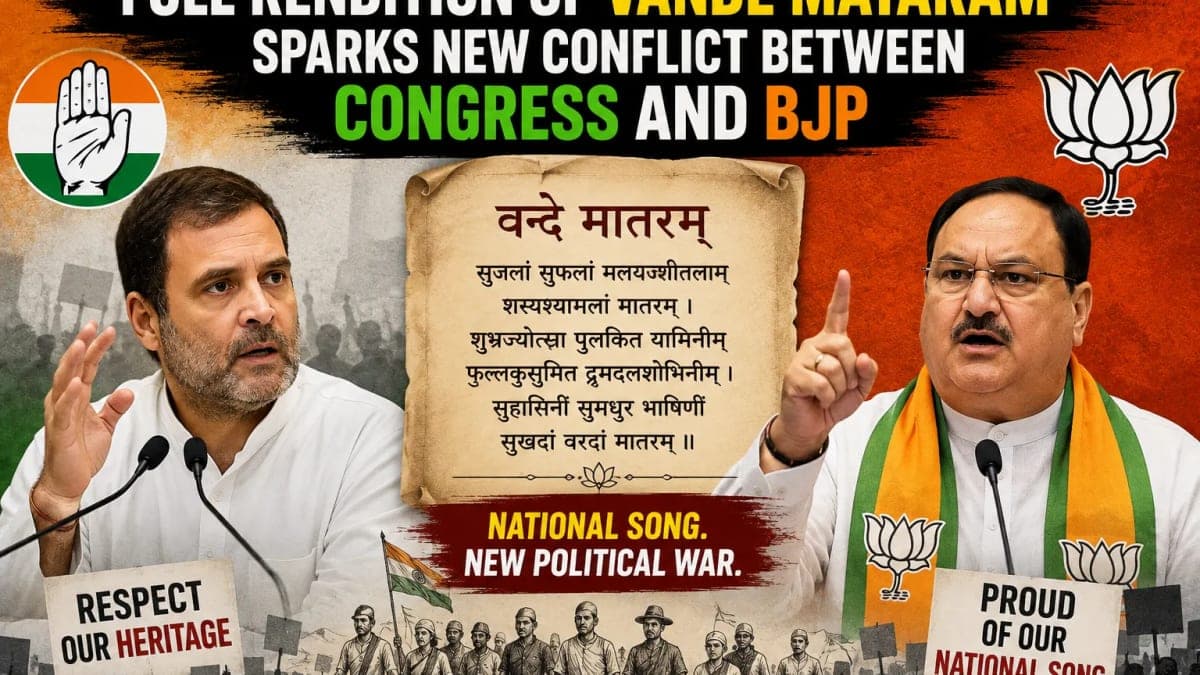
The complete performance of Vande Mataram has become the centre of a new political dispute between the Congress and BJP, adding another contentious issue to the ongoing rivalry between India’s two major national parties.
The disagreement goes beyond the performance itself. It reflects the broader political contest over how historical events, national symbols and expressions of patriotism are interpreted in contemporary public life.
Both parties have frequently invoked India’s freedom movement and its leading figures while presenting competing versions of the country’s political and historical legacy. The latest controversy surrounding Vande Mataram fits into that larger debate.
Why Vande Mataram Carries Deep Historical Significance
Written by Bankim Chandra Chattopadhyay, Vande Mataram emerged as an influential patriotic expression during India’s struggle against British colonial rule.
The song appeared in Chattopadhyay’s novel Anandamath and later became closely associated with the independence movement. Its opening verses gained widespread recognition among freedom fighters and nationalist groups.
After independence, Vande Mataram retained a special place in India’s national consciousness and is recognised as the country's national song.
Its long association with the freedom movement means that disputes surrounding its interpretation or performance often extend beyond cultural questions and enter the political arena.
Complete Rendition Becomes the Latest Political Flashpoint
The present dispute centres on the performance of the complete version of Vande Mataram.
Questions surrounding which portions of the composition should be performed publicly have historical roots. The issue has periodically resurfaced in Indian politics, particularly when political parties debate nationalism, cultural identity and the legacy of the freedom struggle.
The latest Congress-BJP confrontation demonstrates how historical questions can continue to influence modern political narratives.
BJP and Congress Compete Over Historical Narrative
The controversy also highlights the continuing competition between the BJP and Congress over the interpretation of India's independence movement.
The Congress frequently emphasises its organisational role in the freedom struggle and the contributions of leaders associated with the movement. The BJP, meanwhile, has repeatedly sought greater recognition for nationalist figures and traditions that it argues have not received sufficient attention in mainstream historical narratives.
As a result, symbols such as Vande Mataram can become part of a much wider political argument about history, nationalism and national identity.
Why the Controversy Matters
The significance of the dispute lies partly in the powerful symbolic position Vande Mataram occupies in Indian history.
National songs, flags and other patriotic symbols often carry meanings extending far beyond their original context. Political disagreements involving these symbols can therefore generate strong public reactions.
The controversy also illustrates how debates about events from the independence era remain politically relevant decades later.
With Congress and BJP competing for public support, historical narratives can become an important way for both parties to communicate their respective ideas about India's national identity.
Balanced Analysis: History, Symbolism and Politics
The complete rendition of Vande Mataram can be viewed from several perspectives.
Supporters of performing the entire composition may see it as recognition of an important literary and patriotic work associated with India's independence movement. From this perspective, presenting the complete song can be understood as an effort to highlight its historical legacy.
Others may emphasise the complex historical discussions surrounding different portions of the composition and argue that such context should be acknowledged when the song is used in official or political settings.
The political dispute therefore involves more than a disagreement about a performance. It touches on broader questions concerning how historical texts should be remembered and how national symbols should be used in contemporary politics.
At the same time, political claims surrounding the issue should be distinguished from established historical facts. Debate over Vande Mataram has developed over many decades, and reducing that history to a confrontation between two present-day parties risks overlooking its wider context.
The latest clash shows that the national song remains both a powerful symbol of India's freedom struggle and a recurring subject of political debate.