HDFC Bank Under Pressure as ICICI Bank Extends Performance Lead
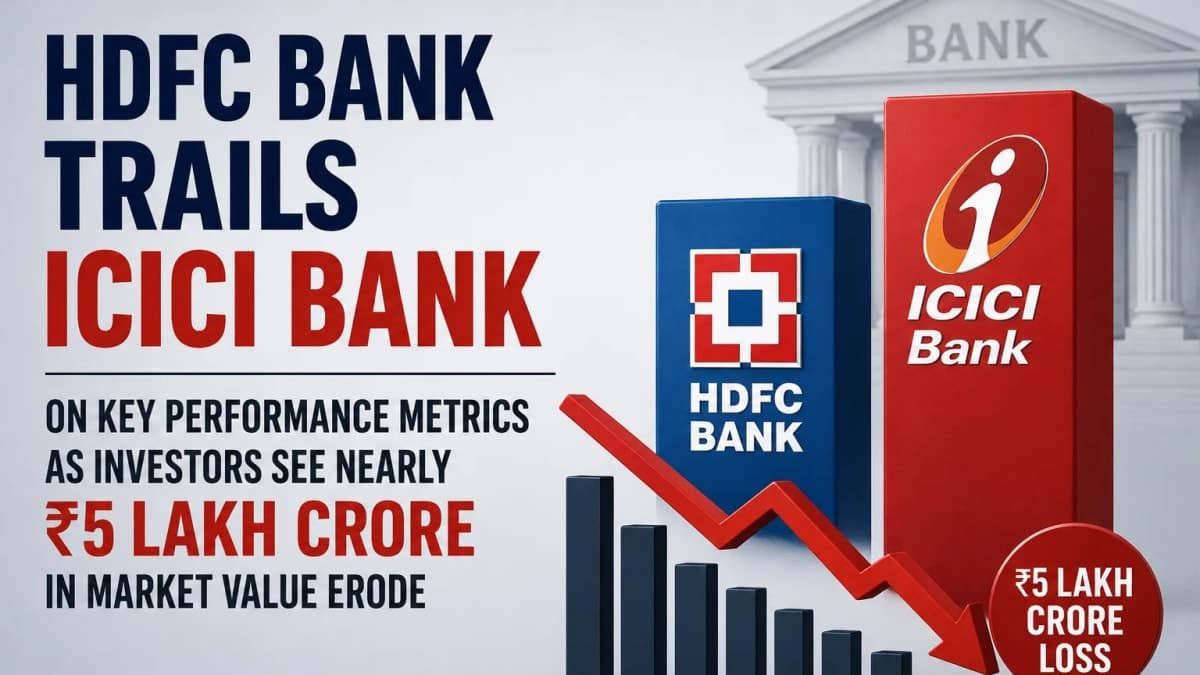
HDFC Bank has emerged as one of the weakest-performing large private banking stocks this year, with its share price declining sharply while rival ICICI Bank has continued to strengthen its position.
The stock's decline has erased nearly ₹5 lakh crore in market capitalisation, reflecting investor concerns over slower operational improvement following HDFC Bank's merger with Housing Development Finance Corporation (HDFC). Analysts say the gap between the country's two largest private lenders has become more noticeable across several financial indicators.
Key Financial Metrics Favour ICICI Bank
Brokerages point to several operating measures where ICICI Bank currently holds an advantage.
According to analysts, ICICI Bank continues to outperform HDFC Bank in net interest margins (NIMs), return on assets (RoA), loan growth and overall profitability. The bank has also maintained stronger earnings momentum and operational efficiency, reinforcing its position as a preferred pick among many market experts.
By comparison, HDFC Bank continues to deal with pressure on margins as funding costs remain elevated and low-cost CASA deposits recover more slowly than expected. Although loan growth has improved, analysts believe profitability metrics have yet to return to pre-merger levels.
Asset Quality Remains a Positive for HDFC Bank
Despite concerns over growth and profitability, HDFC Bank's credit quality remains relatively strong.
The bank has reported stable non-performing asset (NPA) levels and maintains sizeable provisioning buffers, factors that continue to provide confidence in its balance sheet. Several brokerages also note that disciplined cost management has helped cushion earnings even as revenue growth has moderated.
Many analysts therefore distinguish between HDFC Bank's operational challenges and its overall financial stability, arguing that the lender remains fundamentally strong despite current headwinds.
Background
HDFC Bank completed its merger with mortgage lender HDFC Ltd in 2023, creating one of the world's largest financial institutions by market value.
While the merger significantly expanded the bank's balance sheet and customer base, it also created integration challenges. The combined entity has been working to improve its funding mix, rebuild low-cost deposits and gradually restore profitability ratios that were affected by the merger.
Meanwhile, ICICI Bank has continued to report steady improvements in credit growth, margins and return ratios, allowing it to strengthen its competitive position within India's private banking sector.
Why This Matters
The comparison between HDFC Bank and ICICI Bank is closely watched because both institutions play a central role in India's banking system and are widely held by domestic and foreign investors.
Differences in profitability, deposit growth and lending efficiency often influence institutional investment decisions, stock valuations and broader market sentiment toward the banking sector.
HDFC Bank's performance is also viewed as an indicator of how successfully large financial mergers can translate into sustained shareholder value over the long term.
Balanced Analysis
The recent underperformance has increased investor concern, but it does not necessarily signal a deterioration in HDFC Bank's core franchise.
Supporters argue that the bank continues to possess one of the country's strongest retail banking networks, high-quality assets and significant long-term growth potential. They believe margin pressures could ease as funding costs normalise and merger-related adjustments gradually fade.
On the other hand, analysts favouring ICICI Bank point to its stronger execution, higher profitability, faster loan growth and stable management as reasons for its superior market performance. They suggest that HDFC Bank must demonstrate sustained improvement in margins, deposit mobilisation and return ratios before investor confidence fully returns.
For now, both banks remain financially strong, but ICICI Bank appears to have established a clearer operational lead, making future quarterly performance an important factor for investors assessing India's private banking sector.


