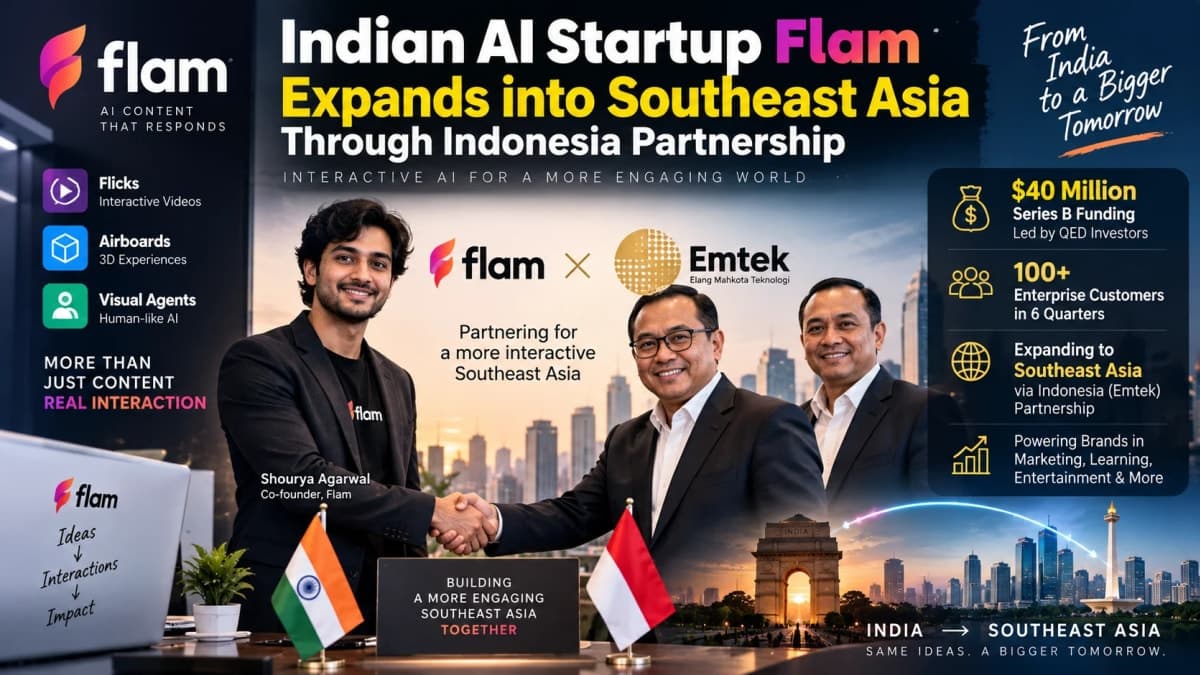
Flam Sets Its Sights on Southeast Asia
Indian-founded AI startup Flam is stepping up its international expansion with a new partnership in one of Southeast Asia’s largest digital markets.
The company has partnered with Elang Mahkota Teknologi (Emtek) in Indonesia to bring Flam’s AI-powered interactive content technology to brands across Southeast Asia.
The move gives Flam a strategic entry point into a region where digital advertising, mobile-first consumer behaviour and brand engagement are increasingly important to businesses.
The partnership was announced alongside another major development for the company: Flam has raised $40 million in Series B funding to accelerate its AI development and international expansion.
What Is Flam's Partnership With Emtek?
Flam says it has partnered with Indonesian technology and media group Emtek to bring its interactive-content technology to brands across Southeast Asia.
The companies have not publicly disclosed detailed commercial terms of the partnership in the announcement.
That distinction is important: the confirmed development is a regional technology partnership, while specific projections about revenue, customer numbers or market share resulting from the deal have not been announced.
For Flam, however, Indonesia provides an important base for reaching the broader Southeast Asian market.
The company is trying to move digital content beyond the familiar progression of text, images and conventional video by making experiences interactive.
Flam Raises $40 Million in Series B Funding
The Southeast Asia expansion comes as Flam has secured $40 million in Series B funding.
The round was led by QED Investors.
Participants named in Flam's announcement include Claypond Capital, Martin Chavez, Olivier Pomel, Venky Harinarayan and Shah Rukh Khan, while existing investors RTP Global and Dovetail also participated.
Flam says the new capital will be directed toward three major areas: research and development of its AI models, expansion of its product suite, and scaling enterprise sales internationally.
The financing gives the company additional resources as it attempts to establish interactive AI content as a new category for enterprise customers.
More Than 100 Enterprise Customers in Six Quarters
Flam says it has signed more than 100 enterprise customers over six quarters.
The company names businesses including Google, Grab and KFC among its customers.
According to Flam, businesses are using its products across areas such as marketing, product visualisation, learning and development, entertainment, fan engagement, customer support and sales.
These customer and growth figures are company-reported and should therefore be understood as Flam's stated business metrics rather than independently audited figures disclosed in the announcement.
Still, the range of applications provides some indication of the market Flam is targeting.
Rather than positioning interactive AI exclusively as an advertising product, Flam is trying to make the technology useful across multiple parts of an enterprise.
What Does Flam Actually Build?
Flam describes itself as an AI interactive content company.
Founder Shourya Agarwal says the company is built around the idea that internet content has progressed through several major phases—from text to images and then video—but has largely remained a one-way experience between creator and viewer.
Agarwal said:
“We think interactive is the next default for the internet.”
Flam's proposition is that AI and new delivery infrastructure can allow users to interact directly with digital experiences rather than simply watch them.
The company currently highlights three major interactive formats: Flicks, Airboards and Visual Agents.
Flicks: Making Video Interactive
Flicks are interactive videos designed to let elements such as a person, product or scene change while the video is playing.
Flam says the format uses a patented compression algorithm and can achieve a 50-millisecond time-to-first-buffer.
The company also has an editing model called Forge, which is designed to take image references and modify only a specified element.
The goal is to give businesses more control over AI-generated or AI-edited creative material without rebuilding an entire asset whenever a single component needs to change.
Airboards Bring 3D Content to the Camera
Another Flam product, Airboards, focuses on interactive 3D experiences.
The technology is designed to deliver high-fidelity 3D content through a camera interface while supporting interactions through touch, voice and haptic feedback.
Flam claims its 3D streaming infrastructure can load these experiences in around 300 milliseconds, without requiring users to install an application.
Its Fable image-to-video model is used to generate assets as native alpha-channel videos.
This app-free approach could be particularly relevant to advertising and consumer campaigns, where requiring someone to install another application can add friction before they reach the actual experience.
Visual Agents Aim to Replace the Chat Window With a Face
Perhaps the most ambitious part of Flam's product portfolio is its Visual Agents.
These are designed as human-like AI characters capable of holding conversations and taking agentic actions.
Instead of interacting with a conventional text chatbot, Flam's concept is closer to communicating through a video call with an AI-generated character.
The underlying system combines several models.
Fantom handles areas including facial expression, identity preservation and motion transfer, while Finesse is responsible for voice capabilities across languages.
Flam also says Falcon, its 26-billion-parameter Mixture-of-Experts large language model, powers responses with a claimed 30-millisecond time-to-first-token.
According to the company, the complete pipeline can return an answer in under two seconds.
These performance figures are Flam's own technical claims.
Why Indonesia Matters for Flam's Expansion
Indonesia gives Flam access to an important Southeast Asian digital economy and, through its partnership with Emtek, a locally established business ecosystem.
But the significance of the deal extends beyond Indonesia itself.
Flam explicitly says the partnership is intended to bring its technology to brands across Southeast Asia, making the agreement a regional expansion move rather than simply an entry into one country.
That could matter as Flam competes to persuade marketers and enterprises that AI content should evolve beyond image and video generation.
Generative AI has already dramatically lowered the cost and time required to produce digital assets. Flam's bet is that the next competitive layer will involve making those assets responsive and interactive.
QED Investors Sees Opportunity Beyond Traditional AI Content
QED Investors, which led Flam's Series B round, has framed the company's opportunity around the amount of the content ecosystem that remains untouched by current frontier AI companies.
QED co-founder and managing partner Nigel Morris said:
“That gap is bigger than most people think.”
QED partner Sandeep Patil, meanwhile, pointed to both Flam's growth and the pace of its AI research as reasons for the investment.
The investor enthusiasm does not guarantee that interactive AI will become a dominant internet format. Flam still has to demonstrate that brands and consumers will adopt such experiences at scale.
But the funding gives the company substantially more capital to test that thesis internationally.
From Indian Startup to Global AI Content Company
Flam was founded by Shourya Agarwal, Rajat Gupta and Malhar Patil.
The company's evolution illustrates how some Indian-founded technology startups are increasingly targeting international enterprise markets rather than building exclusively for domestic customers.
Flam says it now holds more than 15 patents, while its latest financing is aimed partly at strengthening proprietary AI research.
The Emtek partnership adds another piece to that strategy by creating a pathway into Southeast Asia.
What Comes Next?
The next test will be whether Flam can translate the Indonesia partnership into sustained adoption among Southeast Asian brands.
The company has funding, enterprise customers and a growing portfolio of AI technologies. But interactive content remains an emerging category, and widespread adoption will ultimately depend on whether businesses see measurable advantages over conventional video, websites, advertising and chatbot experiences.
For Flam, the strategy is clear: it does not want AI simply to make existing content faster or cheaper.
It is betting that AI can change what digital content actually is—from something people passively consume into something they can interact with in real time.
The partnership with Emtek suggests Southeast Asia will now be one of the key markets where that bet is tested.