Anthropic Unveils $100 Million AI Training Initiative
Anthropic is making a major investment in the human side of enterprise artificial intelligence.
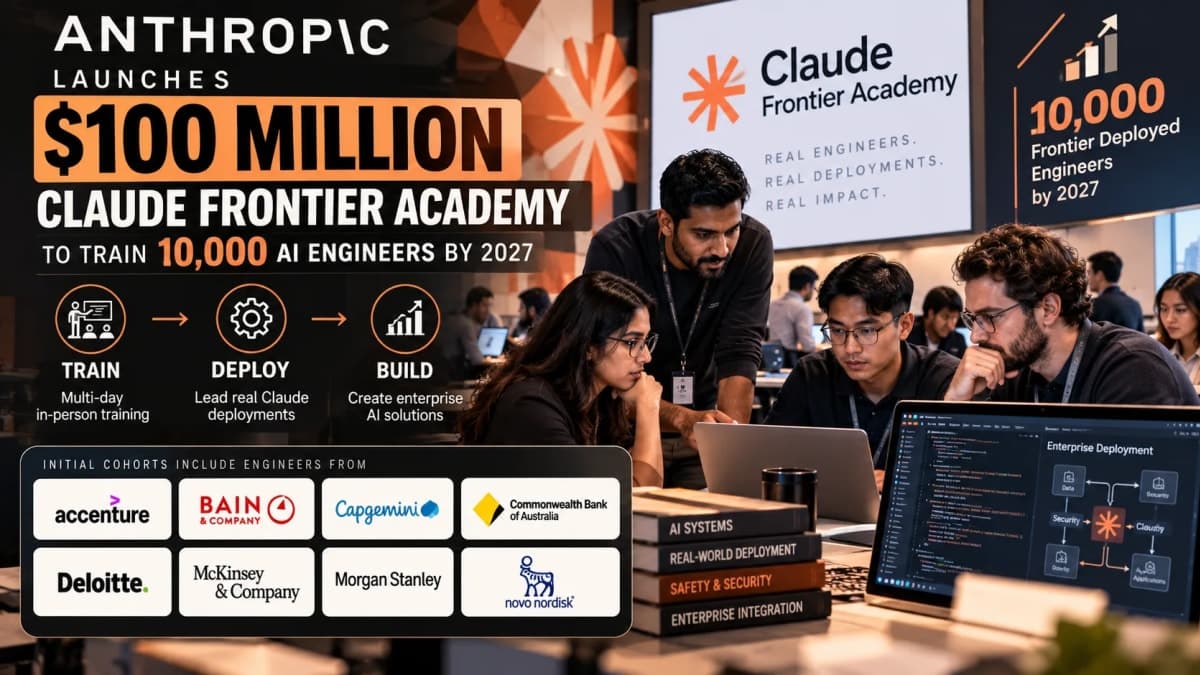
The Claude maker announced the Claude Frontier Academy on October 2, committing an initial $100 million to a training initiative designed to develop engineers capable of deploying advanced AI systems inside large organisations.
Anthropic says it aims to train 10,000 Frontier Deployed Engineers, or FDEs, by the end of 2027.
Rather than focusing on introductory AI education, the program is aimed at experienced software engineers who can take Claude-powered projects from an initial business idea through development, security review and production deployment.
What Is the Claude Frontier Academy?
The Claude Frontier Academy is Anthropic's new training platform for developing advanced, hands-on expertise with Claude.
Its first major program is called the Frontier Deployed Engineer Residency.
The initiative is built around a practical approach rather than conventional classroom-only certification.
Participating engineers will work through simulated enterprise deployments, undergo practical assessments and then apply what they have learned to real Claude projects inside their own organisations.
Anthropic says the goal is to create engineers who understand not only AI models but also the business systems, security requirements, organisational workflows and deployment challenges surrounding them.
10,000 Engineers Targeted by End of 2027
Anthropic has set a substantial target for the initiative.
The company wants to train 10,000 Frontier Deployed Engineers by the end of 2027.
Participants will not necessarily become Anthropic employees.
Instead, organisations nominate engineers from their own teams to participate in the program.
This approach could allow Anthropic-trained expertise to spread across consulting companies, financial institutions, technology organisations and other major enterprises using Claude.
Accenture, Deloitte, McKinsey and Morgan Stanley Among Early Participants
The first cohorts include engineers from several major global organisations.
Anthropic has named:
Accenture
Bain
Capgemini
Commonwealth Bank of Australia
Deloitte
McKinsey
Morgan Stanley
Novo Nordisk
among the organisations participating in the initial cohorts.
The mix is notable because it extends beyond technology companies.
Consulting, banking and pharmaceutical organisations are represented, illustrating how enterprise AI deployment is increasingly becoming a cross-industry issue.
How the Training Program Works
The Frontier Deployed Engineer Residency has multiple stages.
Participants initially attend an intensive in-person training program with Anthropic engineers and licensed instructors.
The official Academy program describes this initial intensive as a four-day process.
During the first three days, participants work on building a Claude-based system for a simulated enterprise environment.
The exercise covers the process from understanding a customer's request through security review and eventual handover.
On the fourth day, engineers face a graded practical assessment involving a new scenario.
Those who pass receive the Claude Resident Engineer credential.
Engineers Then Enter a 12-Week Residency
Passing the initial assessment is only the beginning.
Participants then move into a 12-week residency.
Instead of working solely on artificial training exercises, engineers are expected to lead a real Claude deployment inside their own organisation.
Anthropic engineers provide support and mentorship during this stage, while participants also learn alongside other members of their cohort.
At the end of the residency, engineers undergo another practical assessment.
Those who successfully complete it receive the Claude Frontier Deployed Engineer credential.
Anthropic expects the first engineers to earn this final credential in early 2027.
Anthropic Borrows the Residency Model From Medicine
One of the more distinctive aspects of the program is its training philosophy.
Anthropic says the residency was inspired by the way medical professionals develop expertise.
Doctors do not learn exclusively through textbooks. They train alongside experienced practitioners, work through real cases and demonstrate competence before operating independently.
Anthropic is applying a similar principle to enterprise AI engineering.
Engineers learn from practitioners, work through realistic deployments and are evaluated before receiving credentials.
The comparison does not mean AI engineering carries the same responsibilities as medicine; rather, it describes the Academy's emphasis on supervised practical experience.
Who Can Join the Program?
The Frontier Deployed Engineer Residency is not positioned as a beginner course.
Anthropic says participating organisations should nominate strong hands-on software engineers.
Candidates are expected to have solid engineering fundamentals, experience building with large language models and experience helping others adopt AI.
Previous experience specifically building AI agents is not mandatory.
However, each participant is expected to arrive with a named Claude project that they will lead after returning to their organisation.
The Academy is currently nomination-based rather than an open enrolment program for any individual developer.
Why Anthropic Is Investing in AI Talent
The investment reflects a broader challenge emerging as businesses adopt generative and agentic AI.
Access to increasingly capable AI models does not automatically mean companies can successfully integrate them into production systems.
Large organisations must determine where AI provides useful value, connect models with existing software and data, satisfy security and governance requirements and persuade employees to incorporate new systems into their workflows.
Anthropic argues that engineers capable of navigating this entire process remain difficult for companies to develop at sufficient scale.
The Academy is intended to address that gap.
From AI Experiments to Production Systems
Many organisations have spent the past several years experimenting with generative AI.
The next challenge is moving beyond isolated demonstrations and pilots.
Deploying AI in a real enterprise environment can involve data permissions, legacy systems, security reviews, compliance requirements, monitoring and organisational change.
Frontier Deployed Engineers are intended to operate at the intersection of these technical and business challenges.
Instead of merely creating a chatbot or prototype, their job is to turn an AI use case into a system that can operate inside an organisation.
What Is a Frontier Deployed Engineer?
The role is closely related to the better-known concept of a forward-deployed engineer.
Such engineers typically work closely with customers or internal business units to adapt technology to specific operational problems.
They may help determine what should be built, connect software to existing systems and data, resolve deployment problems and support adoption.
Anthropic's version adds an emphasis on advanced Claude and agentic-AI deployments.
The growing importance of these roles suggests that competition in AI is increasingly extending beyond model performance into implementation expertise.
Claude Partner Network Already Has a Large Training Ecosystem
The Frontier Academy is not Anthropic's first effort to train people to work with Claude.
According to the company, professionals across approximately 46,000 firms have earned more than 175,000 Claude certifications.
Nearly 4,000 people have also completed Basecamp, an immersive program based on training used by Anthropic's Applied AI teams.
The Frontier Academy is positioned above those broader training programs.
Its focus is a smaller group of engineers expected to lead difficult AI deployments and then spread those capabilities throughout their organisations.
Why the $100 Million Investment Matters
The size of the commitment is significant because it shows Anthropic is investing not only in building increasingly capable models but also in the ecosystem required to deploy them.
AI companies compete on model intelligence, coding performance, enterprise security, pricing and infrastructure.
Training can become another layer of that competition.
If consulting firms, banks and major corporations develop teams that are deeply familiar with Claude, those engineers may make it easier for their organisations to expand their use of Anthropic's technology.
That could benefit customers by increasing internal expertise, while also potentially strengthening Anthropic's position inside enterprise technology environments.
There Is Also a Strategic Business Dimension
Although Anthropic presents the Academy primarily as an answer to the enterprise AI skills gap, the initiative also has an obvious commercial dimension.
Training thousands of engineers to deploy Claude could create a much larger pool of professionals capable of implementing Anthropic's technology.
Consulting firms participating in the program could subsequently use that expertise while advising their own clients.
That creates the possibility of a multiplier effect: Anthropic trains engineers at major professional-services organisations, and those organisations then bring Claude expertise into other companies.
The long-term scale of that effect remains uncertain and will depend on whether organisations continue deploying Claude after the training.
Practical Training Could Be More Valuable Than Simple Certification
One notable feature of the Academy is its focus on assessment and real deployment rather than certification based solely on coursework.
Participants must first demonstrate their skills in a simulated enterprise scenario and later lead a genuine Claude project within their organisation.
That design could make the credential more meaningful than a basic online course.
However, its real value will ultimately depend on the quality of the training, the complexity of the projects participants complete and whether graduates can deliver measurable results for their organisations.
Balanced Analysis
Anthropic's $100 million Claude Frontier Academy reflects an important shift in the AI industry.
The central challenge for businesses is increasingly not simply obtaining access to a powerful AI model. Companies also need people who understand how to connect that technology to their systems, data, security requirements and business processes.
Training 10,000 engineers could help address part of that problem.
At the same time, the initiative should not automatically be interpreted as proof that enterprise AI deployments will deliver the productivity or financial benefits companies expect.
The target of 10,000 engineers is Anthropic's stated goal, not an already completed outcome. Claims about the severity of the enterprise AI talent gap also come partly from Anthropic's own assessment of the market.
There is additionally a strategic incentive for the company: creating thousands of engineers proficient in Claude could deepen its presence inside large enterprises and strengthen its partner ecosystem.
The significance of the Academy will therefore become clearer as its first graduates complete the residency, deploy real systems and demonstrate whether the model can produce measurable business outcomes.
What is already clear is that competition among AI companies is expanding beyond building better models.
The next phase is also about building the people capable of putting those models to work.