Maharashtra's Marathi Rule Reaches Bombay High Court
A dispute over Maharashtra's Marathi-language requirement for commercial passenger vehicle drivers has moved from the streets to the courtroom.
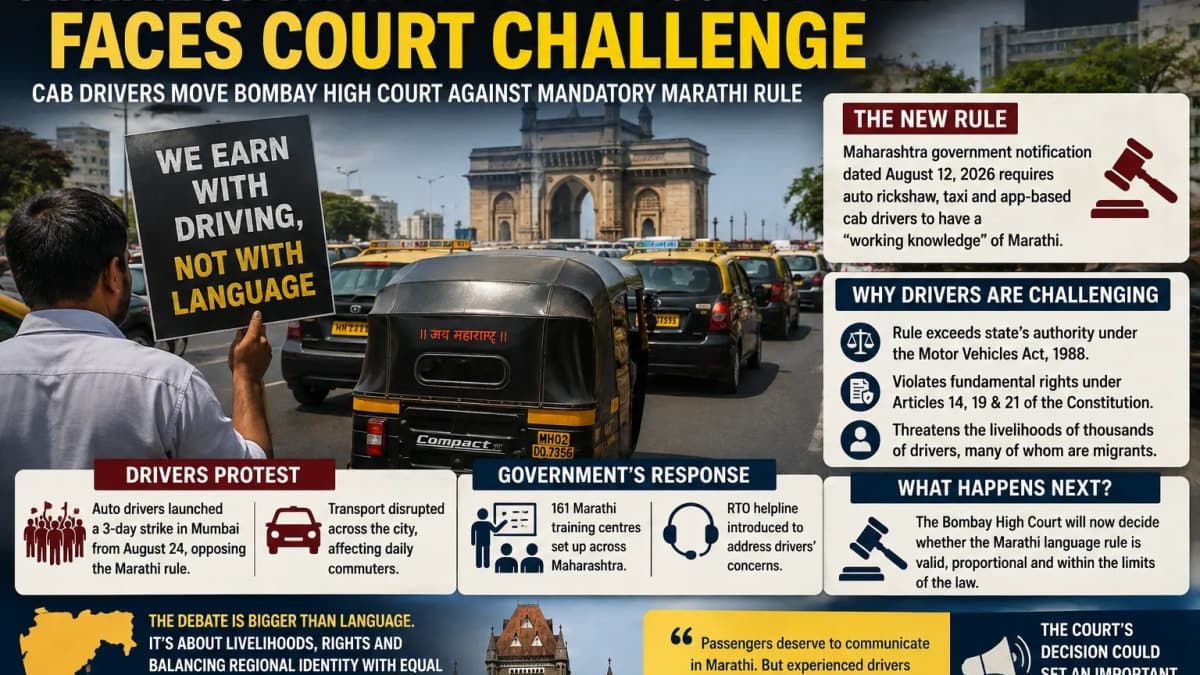
Four app-based cab drivers have approached the Bombay High Court challenging the Maharashtra government's notification requiring drivers of autorickshaws, taxis and app-based cabs to possess a "working knowledge" of Marathi.
The notification was issued on August 12, 2026, followed by enforcement measures by transport authorities.
The petitioners are seeking an immediate stay on the government's decision while questioning whether the state has the legal authority to impose such a language condition on commercial drivers.
What Does the Marathi Language Rule Require?
The policy requires passenger-transport drivers to have enough knowledge of Marathi to communicate with commuters.
The requirement covers traditional autorickshaw and taxi drivers as well as drivers operating through app-based cab platforms.
Transport authorities have begun assessing drivers' ability to communicate in Marathi as part of the government's enforcement campaign.
The state government's broader argument is that passengers should be able to communicate effectively with drivers in Maharashtra's official language.
That objective has received support from those who see Marathi proficiency as both a practical passenger-service requirement and a legitimate effort to strengthen the everyday use of the state's language.
However, the consequences of failing to satisfy the requirement have become a major source of controversy.
Reports indicate that non-compliance can ultimately result in action affecting drivers' badges or permits.
Why Have Cab Drivers Challenged the Rule?
The petition has been filed by four drivers who operate through mobile cab aggregator platforms.
Their legal challenge raises two broad questions: whether Maharashtra has the statutory authority to impose the requirement and whether its enforcement infringes constitutional protections.
The petitioners argue that the rule violates rights protected under Articles 14, 19 and 21 of the Constitution, concerning equality, occupational freedoms and protection of life and personal liberty.
They also argue that the Motor Vehicles Act, 1988 does not authorize the state government to create a language qualification of this kind as a condition affecting badges or permits.
These remain arguments presented by the petitioners; the court will determine their legal validity.
Livelihood Concerns Take Centre Stage
Beyond the technical legal arguments, the dispute has become an employment issue.
Mumbai and other parts of Maharashtra have large numbers of commercial drivers who originally migrated from other Indian states. Some have worked in the transport industry for years despite having limited proficiency in Marathi.
The petitioners argue that strict enforcement could disproportionately affect economically vulnerable and migrant drivers.
The challenge therefore asks a broader question: should a worker who can otherwise legally operate a commercial vehicle risk losing the ability to earn because of insufficient proficiency in the state's official language?
Supporters of the policy approach the issue differently.
They argue that drivers working directly with the public should possess basic Marathi communication skills, particularly when serving passengers who prefer or need to communicate in the state's official language.
The legal dispute will test how those competing interests should be balanced.
Drivers Protest as Enforcement Intensifies
The controversy has already moved beyond the courtroom.
Autorickshaw drivers launched protests and a three-day strike beginning August 24 in parts of Mumbai, opposing the Marathi proficiency requirement and its enforcement.
Transport disruptions were reported across parts of the Mumbai Metropolitan Region, including shortages of autorickshaws and taxis on routes used by commuters to reach railway stations.
The protests demonstrate that the dispute has immediate consequences for both drivers and passengers.
For drivers, the concern is employment security.
For commuters, disruptions can affect daily transportation.
For the government, the challenge is implementing its language policy without causing prolonged disruption or creating unnecessary hardship.
Government Introduces Marathi Training Centres
The Maharashtra government has also responded to concerns from drivers who say they want to comply but lack access to language training.
Transport Minister Pratap Sarnaik announced 161 Marathi-language training centres across Maharashtra to help drivers improve their proficiency.
A dedicated RTO helpline has also been introduced to address complaints concerning implementation of the policy.
The move suggests that the government is attempting to combine enforcement with training rather than relying exclusively on penalties.
That distinction could become important in determining how the policy functions in practice.
Providing accessible training, reasonable time to learn and transparent assessments could reduce some concerns among drivers.
Whether those safeguards are sufficient is another question.
Why Marathi Language Policy Is Politically and Culturally Important
Marathi is Maharashtra's official language and occupies a central place in the state's cultural identity.
Questions surrounding its use in government, education, businesses and public services have periodically become politically significant.
Supporters of stronger Marathi-language policies argue that rapid migration and increasingly multilingual metropolitan areas should not weaken residents' ability to receive services in the state's official language.
Mumbai makes the debate particularly complicated.
The city is both Maharashtra's capital and one of India's most linguistically diverse economic centres. Workers from across India participate in its transportation, construction, hospitality, finance and service industries.
Any language policy affecting employment therefore sits at the intersection of two legitimate considerations: protecting regional linguistic identity and maintaining equal economic opportunities within a highly mobile national workforce.
What Are the Arguments in Favour of the Rule?
Supporters can point to several practical reasons for encouraging commercial drivers to understand Marathi.
Passengers may need to communicate destinations, directions, safety concerns or other information quickly.
Elderly passengers and residents who are most comfortable speaking Marathi may particularly benefit from drivers having basic proficiency.
Language requirements are also not necessarily equivalent to demanding complete fluency.
If "working knowledge" means the ability to understand common passenger interactions, supporters may argue that it represents a reasonable professional skill for someone providing public-facing transportation services in Maharashtra.
The availability of government-backed language training could further strengthen that argument.
What Are the Concerns About Mandatory Marathi?
Critics focus primarily on proportionality and employment rights.
A driver may possess years of professional experience, a valid licence and a strong safety record while having limited Marathi skills.
If language assessments lead to suspension or cancellation of permits, critics argue that the punishment could have consequences far beyond communication difficulties.
Another issue is consistency.
Any language test used for regulatory purposes needs transparent standards so drivers understand exactly what level of proficiency is required.
Without clearly defined testing procedures, implementation could create concerns about arbitrary enforcement.
The government's decision to videograph Marathi verification for new auto and taxi badges indicates an attempt to introduce greater transparency into the assessment process.
The Bigger Constitutional Question
The Bombay High Court challenge could ultimately clarify an issue extending beyond Maharashtra's transport sector.
India's Constitution protects linguistic diversity while also allowing citizens to move across state boundaries and pursue occupations subject to lawful restrictions.
Regional languages remain fundamental to the cultural identities of individual states, but India's economy depends heavily on workers moving between those states.
The question before the court is therefore not simply whether learning Marathi is useful.
The more specific legal issue is whether the government can make working knowledge of Marathi an enforceable condition for these commercial drivers in the manner provided by its notification.
That distinction will be central to the dispute.
Why the Court Challenge Matters
The outcome could have implications for a large number of commercial drivers across Maharashtra.
If the court upholds the government's approach, it could reinforce the state's ability to impose language-related requirements in certain public-facing transport services.
If the court limits or overturns the measure, the ruling could clarify the boundaries of state authority when language requirements affect employment and commercial permits.
There is also room for an intermediate outcome.
The dispute could potentially lead to changes in implementation, such as clearer proficiency standards, longer training periods, exemptions or less severe consequences for drivers who initially fail assessments.
Marathi Identity and Employment Rights Face a Difficult Balance
The controversy illustrates a broader challenge faced by multilingual societies.
Residents should reasonably expect access to services in their regional language. At the same time, workers moving between Indian states depend on the ability to pursue livelihoods without unnecessarily restrictive barriers.
Those principles do not necessarily have to conflict.
Accessible Marathi training, clearly defined standards and proportionate enforcement could potentially promote passenger communication without abruptly excluding experienced drivers from employment.
The Bombay High Court challenge will now determine whether Maharashtra's current approach strikes that balance within the limits of the law.
This article is based on reporting published by NDTV.