Maharashtra Scraps Age Restriction for Tribal Hostel Admissions
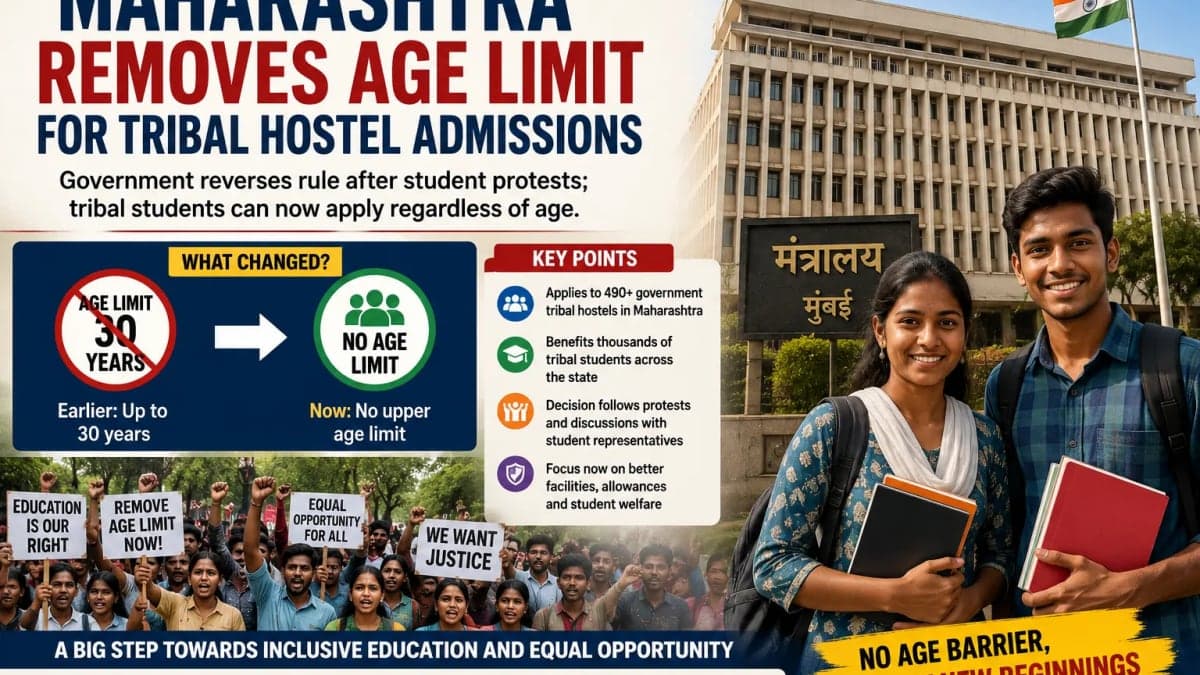
The Maharashtra government has removed the upper age limit for students seeking admission to hostels operated by the state's Tribal Development Department, reversing a controversial restriction that had triggered protests by tribal students.
Tribal Development Minister Ashok Uike announced the decision on Tuesday, August 25, following discussions involving tribal representatives, lawmakers and officials. The government decided to withdraw the August 14 Government Resolution and the revised rules associated with it.
The immediate effect is significant: tribal students seeking accommodation in these government hostels will no longer be excluded simply because they have crossed a prescribed age threshold.
From 26 to 30 — and Finally No Upper Age Limit
The controversy developed through a series of policy changes.
An August 5 government resolution had introduced a 26-year maximum age for hostel admissions. Following opposition from students, the government revised the rules on August 14 and increased the limit to 30 years. Students, however, continued to object to the principle of imposing an age ceiling at all.
Their argument was that educational journeys do not always follow a conventional timeline, particularly for students coming from remote or disadvantaged communities.
The latest decision goes further than increasing the limit again: the upper-age restriction itself has been removed.
Why Government Hostels Matter to Tribal Students
The policy affects an important part of Maharashtra's educational support system.
The state's Tribal Development Department operates around 490 government hostels, accommodating roughly 58,000 to 60,000 students annually while they pursue education.
For students travelling from remote tribal areas to cities and educational centres, affordable accommodation can determine whether continuing education is financially practical.
Hostel eligibility therefore extends beyond the question of housing. It can influence access to colleges, postgraduate programmes, professional education and preparation for competitive examinations.
Why Students Opposed the Age Cap
One of the central arguments made by protesting students was that tribal learners may experience interruptions or delays in their education because of economic circumstances, limited educational infrastructure or other barriers.
Students also pointed to competitive examinations such as the MPSC and UPSC, arguing that people may continue studying or preparing for examinations beyond the hostel age threshold previously imposed.
From that perspective, an inflexible age rule could affect students who remained actively engaged in legitimate educational pursuits.
The government's decision acknowledges the practical concern that age alone may not always be the best measure of whether a student needs residential educational support.
Student Protests Put the Rules Under Pressure
The reversal followed sustained demonstrations by tribal students.
Protests were reported in several parts of Maharashtra after the earlier hostel rules were introduced. In Nagpur, more than 1,000 Scheduled Tribe students participated in a sit-in against provisions contained in the August 5 resolution.
The agitation continued even after the age ceiling was raised from 26 to 30.
By Tuesday, the protest connected with the hostel demands had entered roughly its thirteenth day, demonstrating that students were seeking a complete removal of the age restriction rather than another adjustment to the maximum age.
Rahul Gandhi Raised the Issue With Devendra Fadnavis
The controversy also became a political issue.
Leader of the Opposition in the Lok Sabha Rahul Gandhi wrote to Maharashtra Chief Minister Devendra Fadnavis after tribal students raised their concerns with him. His intervention included the hostel age restriction as well as wider complaints about conditions and rules affecting students.
The Maharashtra government's announcement came a day after the letter, although the dispute over the rules and student demonstrations had already been developing before the political intervention.
That distinction is important. The decision emerged against a combination of sustained student pressure, administrative discussions and growing political attention.
Why Removing the Age Limit Matters
The change could make the hostel system more flexible for students whose educational paths take longer than conventional undergraduate timelines.
Someone who begins higher education later, changes courses, pursues advanced studies or spends several years preparing for competitive examinations could previously have faced difficulties once crossing the prescribed age threshold.
Removing the age ceiling shifts the emphasis away from a student's age and toward other eligibility requirements.
It could therefore widen access to accommodation for older tribal students who continue to pursue education.
The Decision Also Creates Administrative Questions
While removing the age limit increases accessibility, it may create practical challenges.
Government hostel capacity is finite. If the number of eligible applicants increases while the number of available beds remains relatively unchanged, authorities could face greater pressure when deciding how accommodation should be allocated.
The government may consequently need transparent criteria covering academic status, economic circumstances, distance from a student's home, course duration and other relevant factors.
Removing one restrictive criterion does not automatically solve the broader problem of matching limited hostel capacity with student demand.
Other Student Demands Have Not Disappeared
The age-limit reversal does not resolve every issue raised during the protests.
Students have also demanded improvements to financial allowances and insurance protection. Among the demands reported during the agitation were calls for allowances to be periodically increased and linked to inflation, as well as substantially higher insurance coverage for tribal students.
As a result, protesters indicated that their agitation could continue despite the government's concession on the age restriction.
This means the removal of the age limit should be viewed as an important development within a larger debate about the quality, safety and administration of tribal student accommodation.
Government Promises Improved Hostel Procedures
Following the decision, Uike directed officials to work on improved procedures covering admissions, hostel facilities, administration, supervision and inspections.
Officials were also instructed to address administrative difficulties and provide an environment more supportive of students' education.
How those instructions are implemented will ultimately determine whether the policy controversy produces broader improvements beyond the removal of the age ceiling.
A Significant Policy Reversal for Tribal Education
Maharashtra's decision demonstrates how rules governing educational support can have consequences beyond administrative convenience.
For students dependent on government accommodation, eligibility policies can directly influence whether higher education remains accessible.
Removing the age limit gives older tribal students greater flexibility to continue their education without automatically losing access to hostel accommodation because of their age.
However, the larger test now lies in implementation: ensuring sufficient capacity, transparent admissions and improved living conditions while addressing the remaining concerns raised by students.
The age restriction has been removed, but the debate over how Maharashtra supports tribal students is far from over.
This article is based on reporting published by The Economic Times.