NCP(SP) Delegation Meets PM Modi
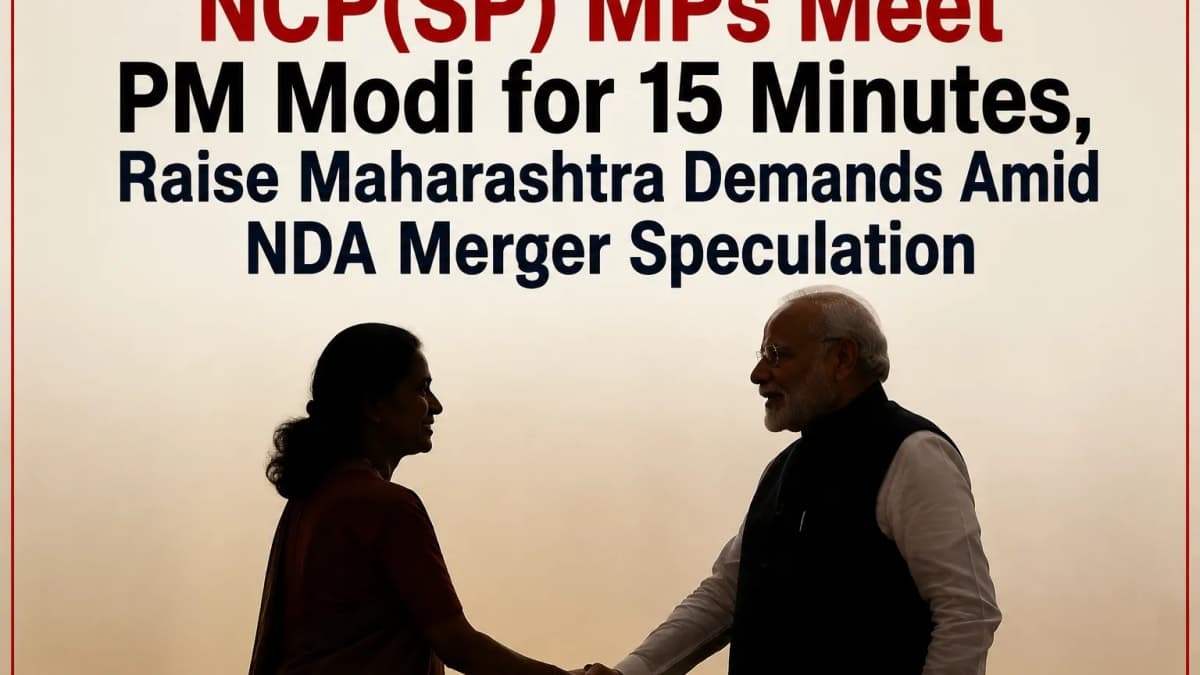
Eight NCP(SP) Lok Sabha MPs led by party working president Supriya Sule met Prime Minister Narendra Modi on August 10, bringing a range of Maharashtra-related issues directly before him.
The meeting lasted around 15 minutes and covered farmers’ concerns, infrastructure projects, healthcare requirements and demands for national recognition of prominent social reformers.
Its timing nevertheless attracted considerable political attention because of continuing speculation surrounding the future of the Sharad Pawar-led party and talk of a possible rapprochement with the BJP-led National Democratic Alliance.
NCP(SP) representatives rejected that interpretation, saying the meeting was intended to pursue public and constituency-related matters.
Why Did NCP(SP) MPs Meet PM Modi?
Supriya Sule said that difficulties in Parliament had made it important for MPs to find another way to bring unresolved public issues to the Prime Minister's attention.
The delegation therefore used the meeting to seek central intervention on several matters affecting Maharashtra.
The interaction also followed an earlier meeting between NCP(SP) chief Sharad Pawar and PM Modi, a sequence that has contributed to heightened political interest in relations between the two sides.
Drought Relief and Farmers’ Concerns Raised
Agricultural distress featured prominently in the MPs' demands.
Beed MP Bajrang Sonawane sought a special relief package for drought-affected areas of Marathwada. He also raised the question of releasing water from Ujani Dam into Manjara Dam to provide assistance to drought-prone areas.
Changes to crop insurance arrangements were also sought, while onion prices were among the agricultural issues discussed.
These demands are significant because farming conditions and commodity prices remain politically important across large parts of Maharashtra, where rural economic concerns can have a substantial impact on public sentiment.
Bharat Ratna Demand for Maharashtra's Social Reformers
The NCP(SP) delegation also sought posthumous Bharat Ratna honours for four influential figures associated with Maharashtra's social and cultural history:
Mahatma Jyotirao Phule
Savitribai Phule
Annabhau Sathe
Rashtrasant Tukdoji Maharaj
The demand adds a symbolic and social dimension to the MPs' representation before the Prime Minister. All four figures hold significant places in Maharashtra's history through their contributions to education, social reform, literature, equality or community development.
Navi Mumbai Airport Naming Issue Raised
MPs Suresh Mhatre and Amol Kolhe urged the Centre to take a decision on Maharashtra's proposal to name the Navi Mumbai International Airport after late leader D. B. Patil.
The naming issue has remained an important regional demand and has generated considerable interest among groups that regard Patil as an influential representative of local communities.
Railway, Metro and Infrastructure Projects Discussed
The delegation also sought faster progress on several infrastructure projects.
Among the matters raised were the Nashik-Pune high-speed railway project, Pune-Nashik Metro, PM Gati Shakti-related work in Chhatrapati Sambhajinagar and the Kalyan-Murbad railway line.
Issues concerning Jawaharlal Nehru Port were also brought up.
By placing these projects before the Prime Minister, the MPs attempted to frame the meeting around practical development priorities affecting their constituencies and Maharashtra's broader transport and economic infrastructure.
Healthcare and Cancer Treatment Facilities
Ahmednagar MP Nilesh Lanke raised the need for expanded cancer treatment facilities.
Another demand concerned increasing the financial assistance available to MPs through the PM CARES framework for patients suffering from serious illnesses.
Pollution affecting the Chandrabhaga River was also among the issues discussed during the interaction.
Political Speculation Surrounds Meeting
Despite the development-focused agenda, the political context surrounding the meeting was difficult to ignore.
The NCP underwent a major split in 2023, when Ajit Pawar and several legislators broke away from the Sharad Pawar-led organisation and joined Maharashtra's then-ruling BJP-Shiv Sena alliance.
Since then, the two NCP camps have followed different political paths, with the Sharad Pawar-led NCP(SP) remaining aligned with the opposition.
Recent speculation about a possible reconciliation between the factions — and reports suggesting a potential political realignment involving the NDA — have made meetings between senior NCP(SP) figures and the BJP leadership particularly noteworthy.
NCP(SP) MPs Deny Political Negotiations
NCP(SP) MPs involved in the meeting insisted that no political negotiations took place.
Bajrang Sonawane rejected suggestions that the interaction indicated an imminent move towards the BJP-led alliance and maintained that his party remained in the opposition.
Amol Kolhe similarly characterised the meeting as a positive discussion centred on Maharashtra's development and constituency-related matters.
According to an account from a member of the delegation, Modi also praised Sharad Pawar's long political career and work ethic during the interaction.
Why the 15-Minute Meeting Matters
The meeting is significant for two separate reasons.
First, it demonstrates that opposition MPs can directly engage with the Prime Minister on constituency and state-specific issues even during periods of intense political disagreement. Requests concerning drought relief, agriculture, transport infrastructure and healthcare have direct implications for residents across Maharashtra.
Second, the political timing gives the interaction importance beyond the demands themselves.
Any substantial change in the NCP(SP)'s political positioning could affect alliance calculations in Maharashtra as well as national opposition politics. That makes even routine meetings with senior NDA leaders subject to considerable scrutiny.
At the same time, a meeting between opposition MPs and the Prime Minister does not by itself establish that an alliance or merger is being negotiated.
Balanced Analysis: Development Outreach or Political Signal?
There are two ways the meeting is likely to be interpreted.
From the NCP(SP)'s perspective, MPs have a responsibility to approach the Union government when central approval, funding or intervention is required for projects affecting their constituencies. Seen from that perspective, engaging with the Prime Minister is part of parliamentary and administrative work rather than evidence of an alliance shift.
The broader political environment, however, makes speculation inevitable. Sharad Pawar's earlier interaction with Modi, combined with continuing discussion about the future relationship between the two NCP factions, means every high-level meeting will be examined for signs of a possible realignment.
For now, the publicly stated agenda provides clearer evidence of a development-focused meeting than of a political agreement. Unless either side confirms formal negotiations, claims of an NDA move remain speculation rather than an established outcome.
What happens next — particularly the Centre's response to the MPs' demands and the NCP(SP)'s future political decisions — will determine whether the 15-minute interaction is remembered simply as constituency advocacy or as part of a larger political shift.
This article is based on reporting published by The New Indian Express.