NDA Weighs Major 2029 Election Realignment
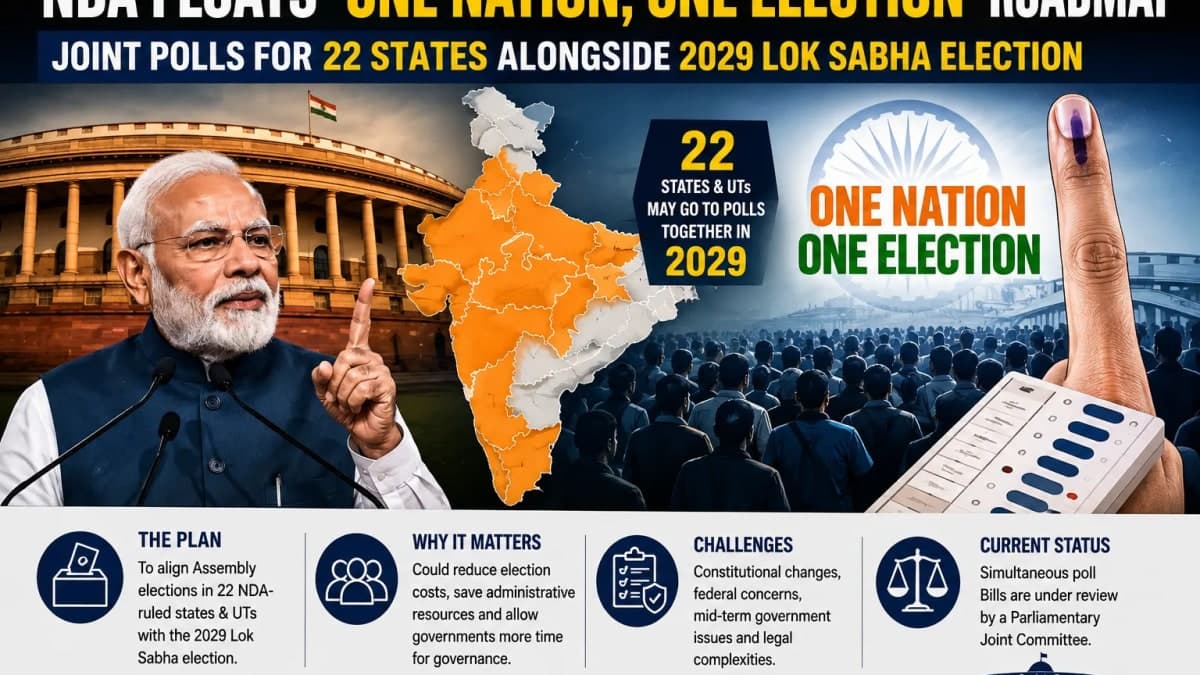
India's debate over "One Nation, One Election" has entered a significant new phase, with the NDA reportedly examining whether elections in 22 states and Union Territories under its political control could be synchronised with the next Lok Sabha election in 2029.
The possibility represents an attempt to move faster than the timeline arising from the framework currently before Parliament, under which full nationwide synchronisation could otherwise effectively emerge around 2034.
Importantly, the 2029 plan is being explored rather than being a finalised national election schedule. Any implementation would depend on political decisions, constitutional and legal requirements, and the continuing work of the parliamentary committee examining the simultaneous-election legislation.
Why 22 States and UTs Are Central to the Proposal
The reported strategy focuses on states and Union Territories where the NDA currently has the political numbers needed to consider voluntarily realigning election cycles.
One route being examined could involve dissolving certain Assemblies ahead of the completion of their normal five-year terms so fresh elections could be held alongside the 2029 Lok Sabha contest.
Four states — Andhra Pradesh, Arunachal Pradesh, Odisha and Sikkim — already conduct their Assembly elections alongside Lok Sabha elections. The larger challenge is synchronising states whose electoral calendars currently fall at different points in the five-year national cycle.
What Is ‘One Nation, One Election’?
"One Nation, One Election" broadly refers to synchronising elections to the Lok Sabha and state Legislative Assemblies.
It does not necessarily mean every Indian voter would cast ballots across the country on one single day. Parliamentary committee chairman P. P. Chaudhary has explained that simultaneous elections could still be conducted in phases according to the Election Commission's operational requirements.
The Constitution (129th Amendment) Bill, 2024, and the Union Territories Laws (Amendment) Bill, 2024 are currently being examined by a Joint Committee of Parliament.
The Lok Sabha recently extended the committee's tenure until the first day of the final week of Parliament's Winter Session in 2026.
Why the Government and Supporters Want Simultaneous Elections
Supporters argue that India's almost continuous cycle of state and national elections consumes administrative resources and repeatedly places government machinery into election mode.
Committee chairman P. P. Chaudhary has noted that around five to six Assembly elections can take place in India in a typical year, arguing that the recurring process has consequences extending beyond the state holding the election.
Advocates believe synchronisation could reduce repeated election expenditure, ease pressure on security and administrative personnel and give governments longer uninterrupted periods to focus on policymaking.
A coordinated election calendar could also simplify long-term planning for political parties, election authorities and government agencies.
Why Critics Are Concerned
The proposal remains politically contentious.
Opposition parties have raised concerns about federalism, the independence of state electoral mandates and what happens when a government loses its majority before completing its term.
These are not merely political talking points. The parliamentary committee itself has been examining questions involving mid-term elections, premature dissolution of legislatures, Election Commission powers, federalism and the Constitution's Basic Structure doctrine.
A particularly sensitive issue would arise if an elected Assembly's tenure were shortened specifically to bring its election into line with the Lok Sabha.
Supporters may regard such adjustments as a necessary transitional mechanism. Critics could argue that voters elected those governments for a constitutionally defined term and that shortening it requires strong democratic and constitutional justification.
Could ‘One Nation, One Election’ Really Begin in 2029?
The 2029 possibility has become increasingly prominent.
In July, committee chairman P. P. Chaudhary said the panel was working on a mechanism that could make simultaneous elections operational by the 2029 general election. He also indicated that some states could potentially synchronise earlier if political parties and chief ministers voluntarily agreed to adjust their electoral cycles.
That distinction is important.
A 2029 election involving the Lok Sabha and a large group of voluntarily synchronised states would not necessarily mean that every Assembly election in India had immediately moved onto the same calendar.
Instead, it could serve as a major transitional step toward broader synchronisation.
Why the 2029 Roadmap Matters
If the reported plan advances, the 2029 general election could become much more than a contest for control of the Lok Sabha.
Voters across a substantial number of states could potentially be choosing both their national and state governments during the same election period.
That would reshape campaign strategies, political spending, voter mobilisation and the relationship between national and regional issues.
National leaders could acquire greater influence over Assembly campaigns held simultaneously with a general election. At the same time, powerful regional parties could attempt to ensure state-specific issues are not overwhelmed by the national political narrative.
Balanced Analysis: Efficiency Versus Federal Autonomy
The strongest argument for simultaneous elections is administrative efficiency. India's election machinery is enormous, and reducing the frequency of separate polls could potentially save resources and minimise repeated deployment of officials and security forces.
The strongest counterargument concerns India's federal political structure.
State elections allow voters to judge governments primarily on regional issues, while Lok Sabha elections revolve more heavily around national leadership and policy. Combining the two could change voter behaviour and potentially alter the political space available to regional parties.
There is also a practical challenge: synchronisation is relatively straightforward when governments complete their terms, but considerably more complicated if a government collapses early.
For that reason, the success of any "One Nation, One Election" framework will depend not simply on putting multiple elections on the same calendar but on creating constitutional mechanisms capable of handling premature dissolutions, hung Houses and changes of government without weakening democratic accountability.
The reported 2029 roadmap therefore represents an important development, but not a completed decision. The coming parliamentary deliberations and consultations with states will be critical in determining whether India's election calendar undergoes its biggest structural change in decades.
This article is based on reporting published by The Indian Express.