‘One Nation, One Election’ Debate Intensifies as Parliament Panel Examines Major Electoral Reform
New Delhi, August 27, 2026: The political and constitutional debate over ‘One Nation, One Election’ has entered a more intense phase, with supporters and critics presenting competing arguments before the parliamentary committee examining legislation designed to synchronise elections to the Lok Sabha and state legislative assemblies.
At the centre of the debate are the Constitution (129th Amendment) Bill, 2024 and the Union Territories Laws (Amendment) Bill, 2024. The proposals were introduced in Parliament in December 2024 and subsequently referred to a Joint Parliamentary Committee (JPC) for detailed examination.
The committee’s work is continuing beyond the Monsoon Session. In July 2026, the Lok Sabha extended the JPC’s tenure until the first day of the final week of the Winter Session of Parliament, giving the panel additional time to examine the legal, constitutional and administrative implications of simultaneous elections.
Why Has the Debate Intensified?
The latest round of discussion has been driven by sharply contrasting assessments presented to the parliamentary panel.
JPC chairman and BJP MP P. P. Chaudhary has said that a majority of experts consulted by the committee have supported the proposal. According to Chaudhary, consultations with legal and constitutional experts have indicated that simultaneous elections can be implemented without violating the Constitution’s basic structure or undermining subjects reserved for states.
On the other side, senior Congress leader and former Union minister P. Chidambaram has strongly challenged the proposed framework. Appearing before the committee, he argued that the Bills in their present form are constitutionally flawed and raised objections to provisions that could shorten the terms of state assemblies in order to align them with the Lok Sabha election cycle.
The disagreement highlights the central question confronting lawmakers: Can India synchronise elections without weakening the constitutional independence and democratic mandate of state legislatures?
What Does ‘One Nation, One Election’ Mean?
The basic idea is to create a system in which elections to the Lok Sabha and state legislative assemblies are held on a common electoral cycle, rather than conducting major elections at different points throughout the five-year period.
India is not entirely unfamiliar with such a system.
Lok Sabha and state assembly elections were largely conducted together during the early decades after Independence. The first general elections in 1951-52 were followed by simultaneous election cycles in 1957, 1962 and 1967.
That alignment gradually collapsed after some state assemblies were dissolved prematurely in 1968 and 1969, followed by the early dissolution of the Fourth Lok Sabha in 1970. India subsequently developed the staggered electoral calendar that exists today.
The Government-Side Argument: Fewer Election Cycles, Greater Continuity
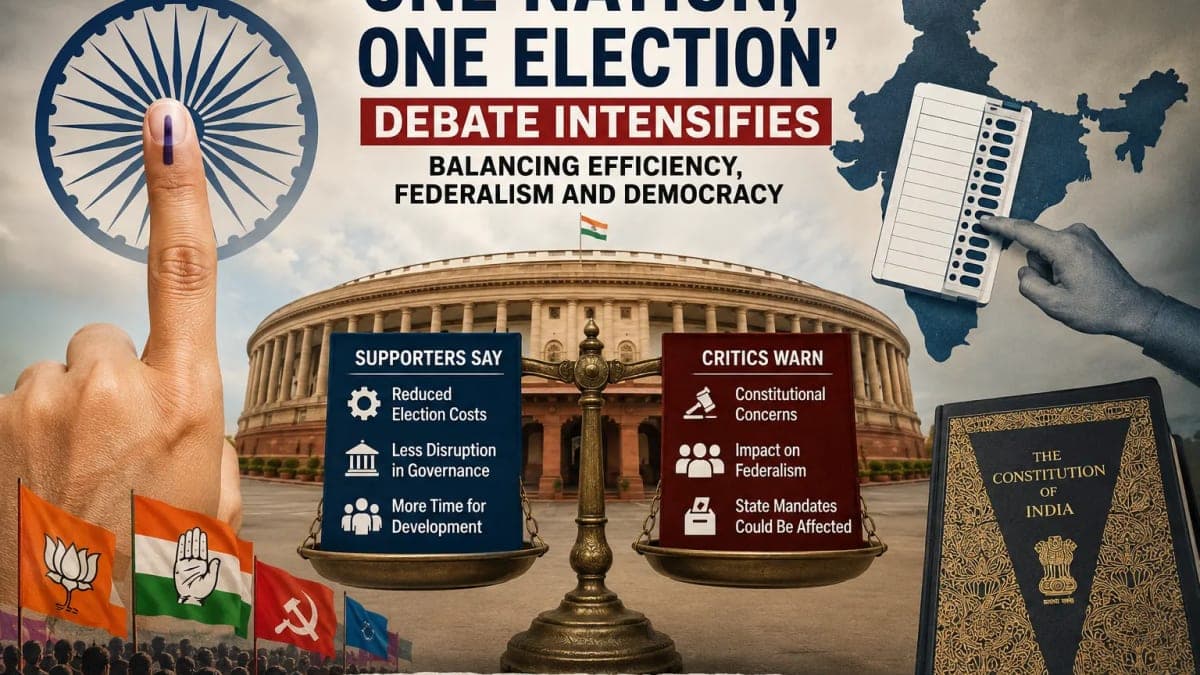
Supporters of simultaneous elections argue that India's frequent electoral cycles consume significant administrative resources and repeatedly pull government machinery into election-related duties.
They contend that combining major elections could reduce repeated deployment of government personnel and security forces while allowing administrations to concentrate for longer periods on governance and policy implementation.
Another argument concerns expenditure. Supporters believe fewer separate election cycles could reduce some of the recurring public costs associated with conducting polls.
The JPC chairman has also argued that simultaneous elections could benefit governance and reduce the burden election-related work places on public institutions.
Opposition Concerns: What Happens to a State’s Five-Year Mandate?
The strongest objections involve the constitutional consequences of synchronising legislatures whose terms currently begin and end at different times.
Under the proposed framework, the tenure of certain state assemblies could have to be adjusted so their next elections coincide with the Lok Sabha cycle. That possibility has become one of the most contentious elements of the debate.
Critics argue that voters elect a government and legislature for a constitutionally defined term and that shortening an assembly’s tenure merely to create a uniform election calendar raises serious democratic questions.
Opponents have also questioned whether simultaneous national and state campaigns could reduce the visibility of regional issues.
Rajya Sabha MP and senior advocate Kapil Sibal, for example, has argued that state-level aspirations and political debates could be overshadowed by the much larger national campaign surrounding a Lok Sabha election.
Federalism Becomes the Key Constitutional Battleground
The debate therefore goes beyond election scheduling.
India’s constitutional structure distributes political authority between the Union and the states. State governments possess their own democratic mandates, political priorities and electoral cycles.
Supporters maintain that coordinating election dates does not necessarily remove these constitutional powers. Critics, however, fear that forcing different legislatures into a single electoral timetable could indirectly strengthen the national political cycle at the expense of state-level political autonomy.
This makes federalism one of the most important tests the proposed reform will face.
Could Simultaneous Elections Begin by 2029?
The possibility of implementing at least part of the system around the 2029 Lok Sabha election has also entered the discussion.
Chaudhary has said that implementation could be possible if the required constitutional changes are approved and states take the necessary decisions regarding their assemblies. He has emphasised that states cannot simply be directed to dissolve their legislatures and that decisions would depend on the respective state governments.
That qualification demonstrates why moving from the concept of simultaneous elections to an operational nationwide system would be considerably more complicated than merely changing polling dates.
Parliamentary Numbers Could Prove Crucial
Because the proposal involves constitutional amendments, its political future depends not only on the committee’s recommendations but also on whether the required parliamentary support can be assembled.
The JPC is expected to continue examining the Bills and stakeholder submissions before presenting its conclusions to Parliament during the Winter Session timetable currently set for the committee.
Until that process is completed, the final shape of the legislation — and whether Parliament will ultimately approve it — remains uncertain.
Why This Debate Matters
‘One Nation, One Election’ could represent one of the most significant structural changes to India's electoral system in decades.
For supporters, the reform offers an opportunity to simplify the electoral calendar, limit repeated administrative disruption and create longer uninterrupted periods for governance.
For critics, efficiency cannot be the sole measure of electoral reform. They argue that the independence of elected legislatures, federal balance and the ability of voters to judge state and national governments separately must remain central considerations.
Both sides therefore address legitimate but competing priorities: administrative efficiency on one hand and constitutional safeguards and political autonomy on the other.
Balanced Analysis
The attraction of simultaneous elections is straightforward. India regularly enters major election cycles, and consolidating some of them could potentially reduce logistical repetition and administrative disruption.
The constitutional challenge is much harder.
Election calendars are shaped by democratic events that cannot always be predicted — governments can lose majorities, assemblies can be dissolved and political coalitions can collapse. Any durable simultaneous-election system would therefore need clear rules for situations in which either Parliament or a state assembly ends its term early.
Equally important will be protecting the political space available for regional issues. Holding national and state elections simultaneously may be administratively efficient, but policymakers will have to consider whether such a structure changes how voters, political parties and campaigns distinguish between state and national questions.
The continuing JPC consultations are therefore significant because the final debate is not simply about when India votes. It is about how electoral efficiency can be reconciled with representative government, federalism and constitutional stability.
As the committee moves toward its report, ‘One Nation, One Election’ is likely to remain one of India’s most closely watched political and constitutional debates.
This article is based on reporting published by Moneycontrol.